


Two studies published November 18 in Nature suggest that Homo erectus lived in mainland East Asia until at least 184,000 years ago and was capable of surviving in the rainforests of southern China. The research is based on nine human teeth found in two caves in Guangxi province. Eight were identified as H. erectus, while the ninth may belong to another human population, possibly Denisovans, raising the possibility that two hominins occupied the rainforest at the same time.
Nine teeth from two Chinese caves
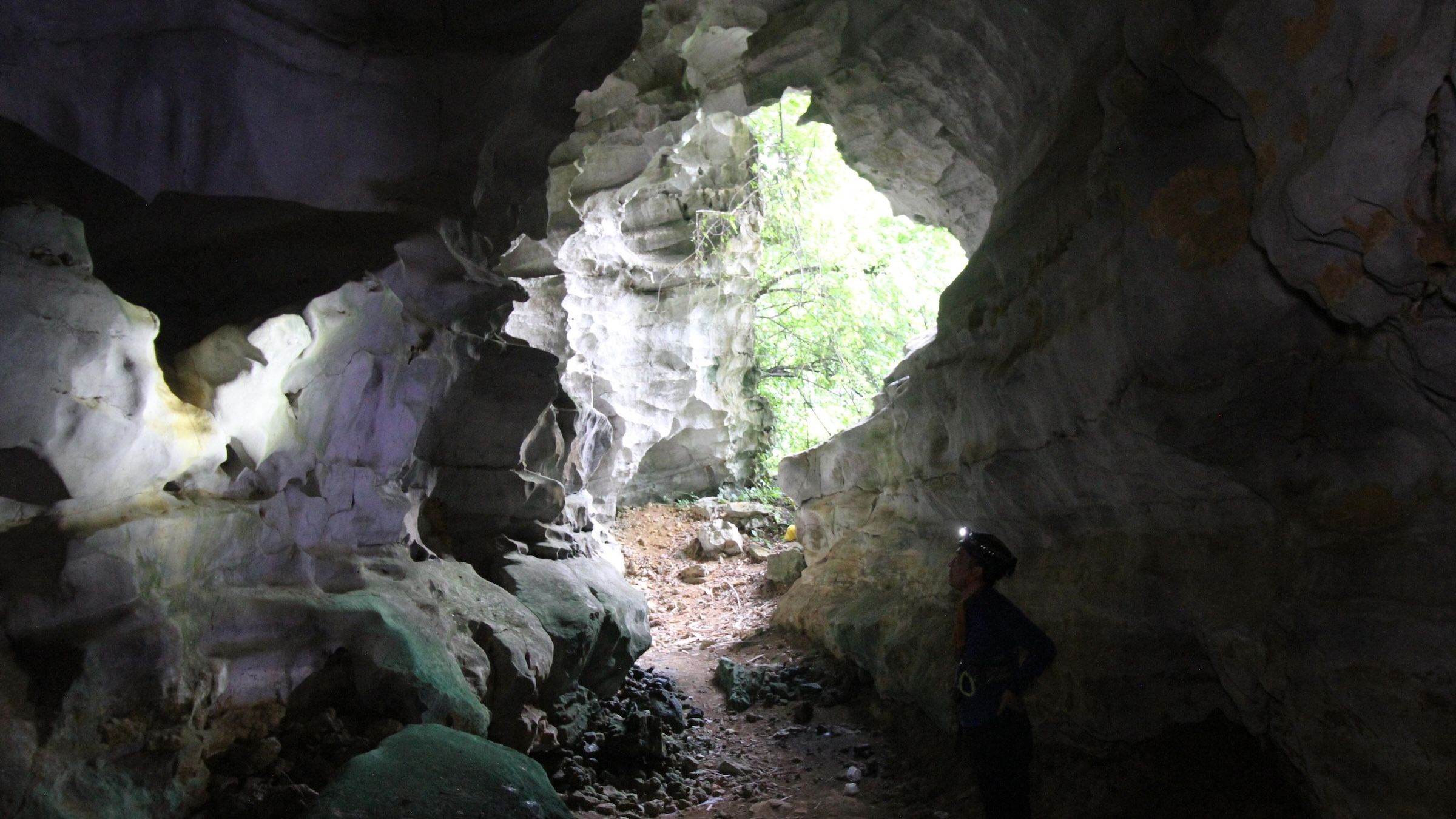
Researchers found the teeth among more than 18,000 fossils, including remains of great apes, elephants, rhinoceroses and other ancient ungulates. The fossils were recovered from Baxian and Naxiang caves, which are about 9 miles (15 kilometers) apart in a karst landscape formed from eroded limestone.
These caves would have provided important refuges for people living in the region. Much of the surrounding fossil material appears to have been accumulated by porcupines, according to a study of the cave deposits.
Radiometric dating based on uranium decay in the fossils and surrounding sediments placed the remains between approximately 324,000 and 184,000 years ago. Eight of the teeth have physical characteristics consistent with H. erectus. The ninth tooth, known as PA1796, is more difficult to classify: it does not resemble H. erectus, Neanderthals or modern humans.
“We think this is exciting because it means that there are two hominins living in these rainforest conditions at the same time,” study lead author Fried Welker, a molecular paleoanthropologist at the University of Copenhagen in Denmark, told Live Science.
Proteins identify the ancient teeth
Homo erectus is generally considered the first human species to migrate out of Africa after evolving roughly 2 million years ago. It spread across eastern Eurasia, reaching China and Indonesia between about 1.6 million and 1.8 million years ago.
The species was also one of the longest-surviving human lineages. The most recent known remains of H. erectus are from a river floodplain on the Indonesian island of Java and date to 108,000 years ago. Before the new discovery, there was no physical evidence that H. erectus survived in mainland Asia more recently than about 400,000 years ago.
Welker and his colleagues analyzed proteins from five of the teeth. Four were identified as H. erectus, confirming the initial identification based on tooth shape. Protein analysis can preserve biological information for much longer than DNA, which tends to degrade readily. The study of ancient proteins is known as proteomics.
“The morphology was successfully confirmed by proteomics,” Welker told Live Science. The researchers determined that three of the four confirmed H. erectus teeth came from males and one from a female by looking for amelogenin-Y, a protein encoded only by the Y chromosome.
The protein patterns in the four teeth were broadly consistent with those seen in previously studied H. erectus remains. However, some features differed from earlier samples. Welker said the teeth could represent a previously unknown population of H. erectus that remained in China and had a slightly different genetic makeup.

A possible second human population
The fifth tooth analyzed, PA1796, belonged to a male, but its protein sequence contained no recognizable signature that could identify its species. Welker’s team suggested that it may have belonged to another human species living in the region at the same time.
“Sequence-wise, this doesn’t seem to be Homo erectus, and morphologically it doesn’t look like erectus teeth,” Welker said.
The tooth could belong to a previously unknown hominin, although some experts think Denisovans are a more likely possibility. John Hawkes, an anthropologist at the University of Wisconsin-Madison who was not involved in the study, said the tooth was most likely Denisovan, perhaps from a branch for which protein data are not available. He also noted that it could represent an unusual individual from the same H. erectus population as the other teeth.
“I would have liked to have seen further comparisons with Denisovan teeth in the paper,” Hawkes said.
Chris Stringer, a paleoanthropologist at London’s Natural History Museum who was not involved in the research, said some of the new material is probably less than 200,000 years old. That would place it close in age to known or estimated Homo longi/Denisovan samples from southern China and Laos, suggesting that the populations may have overlapped for a long time. However, comparative data for Homo longi/Denisovans remain sparse.
Stringer said the finding also brings the history of H. erectus in East Asia closer in age to late Javanese populations. The groups could have been connected by land bridges when sea levels fell, he suggested.
Recent research has raised the possibility of interbreeding between H. erectus and Denisovans, Stringer said, although the identity of the PA1796 tooth cannot be established without more comparable specimens. Welker said a firm conclusion will require the discovery of additional similar teeth elsewhere.
Evidence of rainforest adaptation
In the second study published in Nature on November 18, geochronologist Kira Westaway of Macquarie University in Sydney and her colleagues examined trace elements in the human teeth and in animal remains from the caves. Their goal was to reconstruct the hominins’ diets and the habitats in which they lived.
The researchers concluded that the H. erectus individuals obtained plant and animal foods in ecosystems resembling tropical rainforests. That challenges the earlier view that only Homo sapiens could adapt successfully to such environments.
“Rather than being limited to open environments of forests and grasslands, H. erectus was much more ecologically adaptable than many of us imagined,” Stringer said.
“Adaptability and flexibility are not traits we associate with ancient humans; these are traits we associate with Homo sapiens,” Westaway told Live Science. “Suddenly we see H. erectus was able to survive in environments we didn’t think they could survive in.”

The team also measured strontium levels in the teeth. Because strontium levels vary between geological regions, the element can provide clues about where a person grew up based on the water and food consumed during childhood.
The strontium signatures were compared with those from another karst formation about 320 kilometers (200 miles) away in the Red River Valley of northern Vietnam. The results suggest that some of the H. erectus individuals moved across large areas of karst terrain within the rainforest.
“Apparently H. erectus were moving over large areas, traversing the karst terrain of the rainforest,” Westaway said.
Westaway said it was misleading to view H. erectus as a failed species. The species may have been the first human lineage to leave Africa and use fire, and survived for roughly six times longer than Homo sapiens has existed so far.
Questions about human overlap in China
Modern humans lived in China at least 45,000 years ago. Denisovan DNA is present in some island populations in Southeast Asia, indicating that modern humans encountered Denisovans at some point.
If H. erectus also survived in the region until relatively late in human prehistory, modern humans may have encountered that species as well. The new studies do not establish whether such encounters occurred, but the possibility adds to the evidence that several human populations occupied East and Southeast Asia at different times, and perhaps sometimes at the same time.
The research is reported in two papers: “Evidence for late Middle Pleistocene Homo erectus in mainland East Asia,” by Liao, W., Zanolli, C., Ásmundsdóttir, R.D., Wu, Z., Yi, Z., Villa-Islas, V., Fagernäs, Z., Troché, G., Zhou, K., Feng, X., Liu, F., Olsen, J.V., Shao, Q., Yu, W., Quinn, M., Bacon, A.-M., Liang, H., Pan, Y., Yang, L. and Welker, F., and “Rainforest adaptation of late Homo erectus in southern China,” by Westaway, K.E., Joannes-Boyau, R., Liao, W., Xiao, Q., Yu, W., Quinn, M., Bacon, A.-M., Liang, H., Burgon, N., Chao, J.-x., Roberts, P., Kono, R., Pan, Y., Yang, L., Wang, Y., Jin, C., Wu, Z., Murray, S., Zanoli, C. and Chan, Y. Both were published in Nature in 2026.
Source: www.livescience.com