



AI Actress Tilly Norwood Glitches Into Chinese During Interview—But Her Chatbot Also Scans Your Face
An interview featuring AI actress Tilly Norwood has gone viral after she appeared to glitch and suddenly started speaking Chinese on Piers Morgan Uncensored. The clip had been viewed more than 8 million times by the following night.
Norwood has attracted significant controversy and mainstream attention as the lead character in an upcoming AI-generated film. Her creator, Eline van der Velden, also runs Talking Tilly, a service that lets users video-call the AI character behind the viral moments.
I tried the service and examined its terms and privacy policy. The fine print reveals that callers must pass an age check, have their emotions analyzed during calls and agree to recording and transcription.
Talking Tilly requires a face scan before your first call
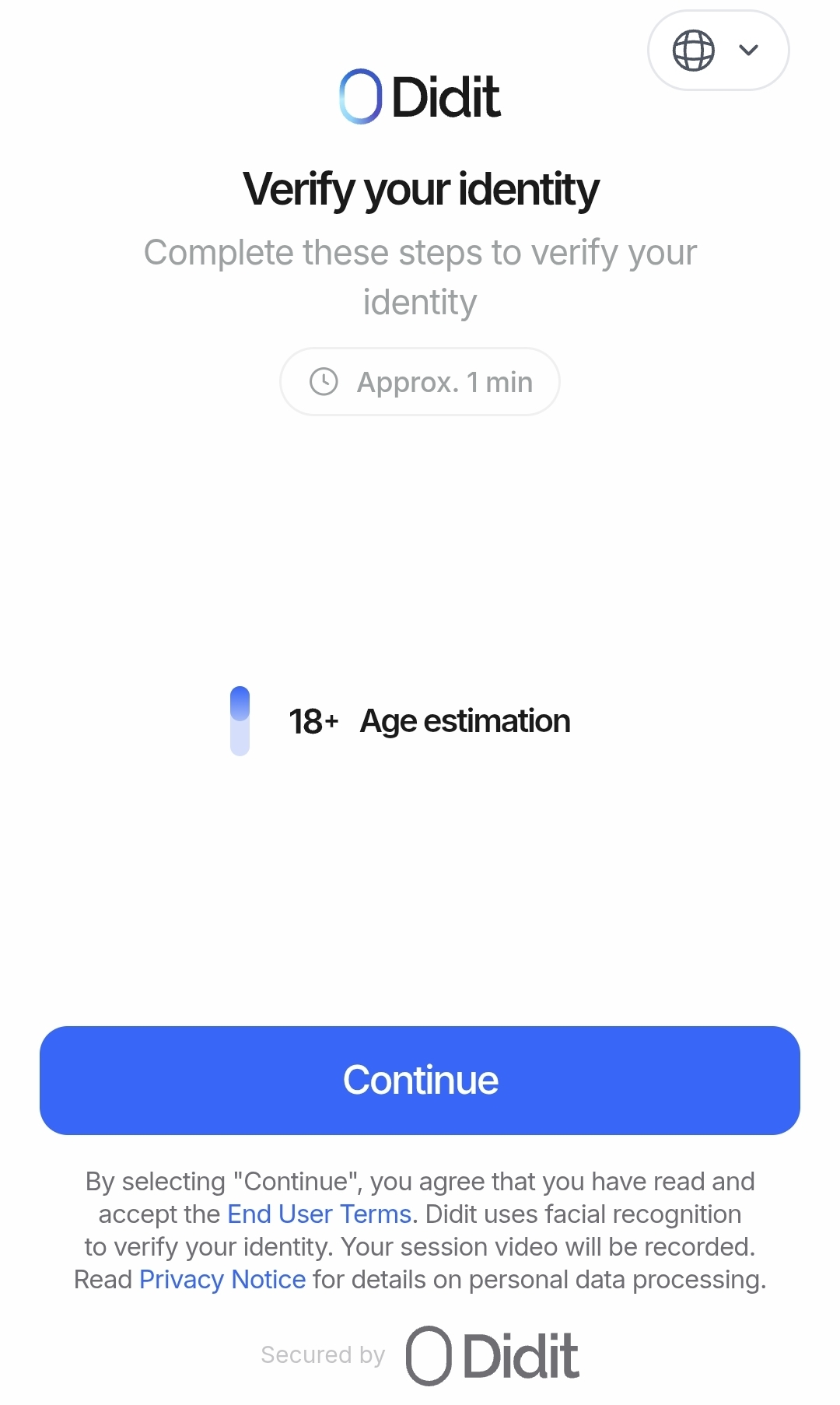
Users must pass an automated age check before their first call can connect. The check cannot be skipped and applies to callers worldwide.
A selfie video is analyzed by Didit, a Spain-based identity-verification provider, to estimate the caller’s age. If the system cannot determine the age with enough confidence, the user can upload a government-issued photo ID instead.
(Bleeping Computer)
Xicoia Ltd’s privacy policy says selfies are sent directly from the user’s device to Didit. The company says that no facial-recognition profile or biometric template is created, and that selfie videos and ID images are not retained after verification. Instead, Xicoia says it keeps approximate age ranges and reference numbers.
The age-verification requirement was added to the terms of service this month, alongside a workplace ban and new automated safety systems.
The AI analyzes your camera footage and voice
The facial scan is not the only analysis performed during a Talking Tilly call. The service monitors camera footage and listens to the caller’s tone of voice to infer their emotional state. The character can then adjust its responses to match the caller’s apparent mood.
The privacy policy states that this monitoring “cannot be turned off for individual calls.” Users who do not want their camera footage and voice analyzed are therefore advised not to use the service.
Both age verification and mood analysis rely on “legitimate interest” rather than consent as the legal basis for processing personal data. Xicoia’s version history indicates that this legal basis was selected in September.
Calls are recorded, transcribed and processed live by a US-based provider. Character responses are generated using Google’s Gemini model through the conversational video platform Tavus.
Automated moderation can stop calls by mistake
Talking Tilly also uses an automated classifier to scan call transcripts for profanity and abusive language. Under the service terms, a recording can be placed on hold when the system detects a violation.
In one of three calls, a conversation about the weather and news headlines was stopped for “hate and abusive language,” even though that language did not occur.
The policy says human reviewers can publish recordings that were incorrectly flagged. Regardless of the review outcome, however, recordings are permanently deleted after 24 hours.
Talking Tilly offers five free minutes before charging users
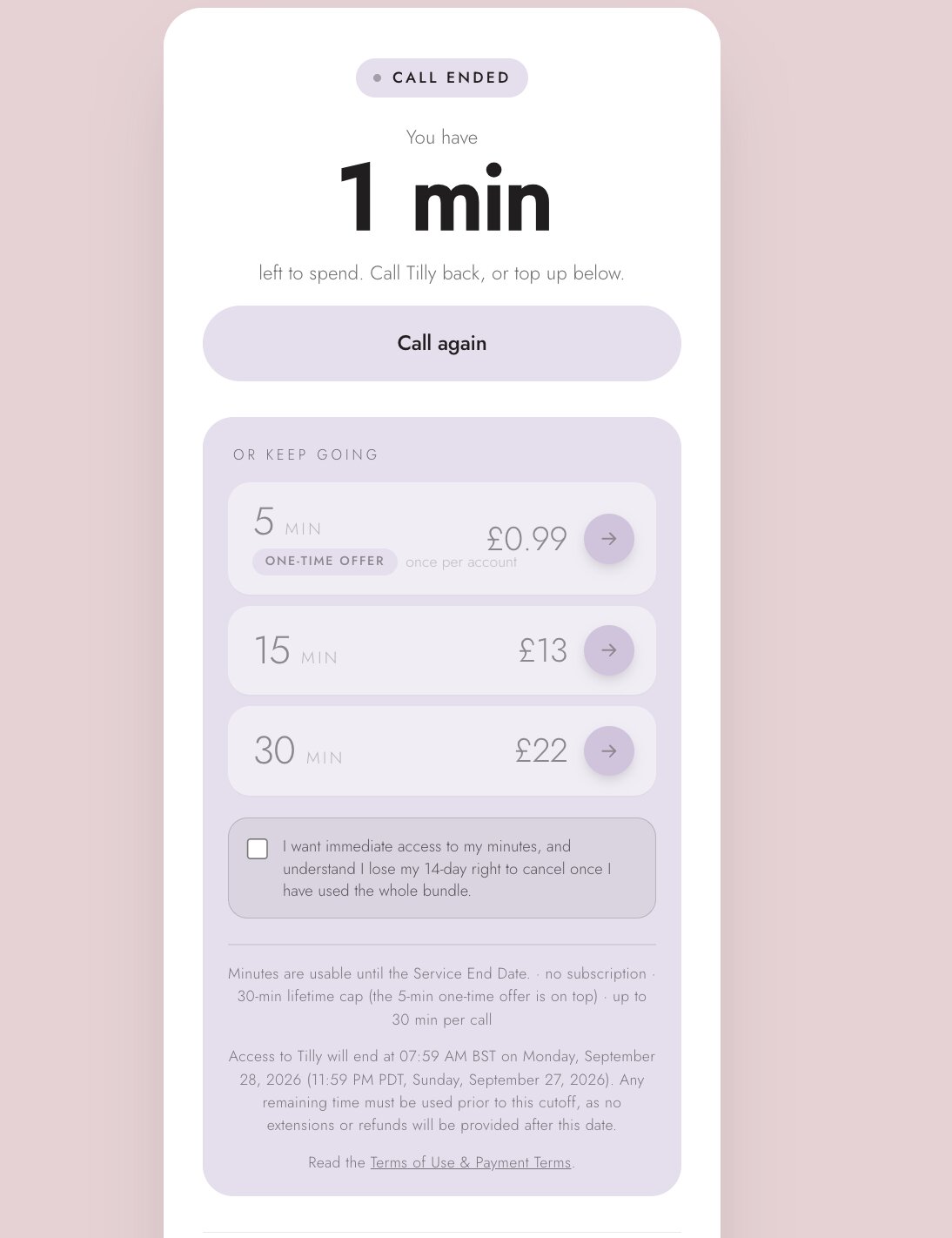
The first five minutes are free. After that, users are asked to purchase additional time:
- £0.99 for one five-minute session
- £13 for 15 minutes
- £22 for 30 minutes
The maximum purchase is 35 minutes per person.
(Bleeping Computer)
The terms are particularly important because Talking Tilly is a limited-time service. All free and paid minutes expire when the platform permanently shuts down on September 27 at 11:59 p.m. PT. Any unused minutes will be forfeited.
Transcripts can be retained for up to eight weeks and may be reviewed by Xicoia employees or third-party partners. The AI characters can also remember previous conversations to personalize future calls. Users can request that those memories be deleted.
Why Talking Tilly uses facial age verification
Facial age estimation for users who want to speak with a chatbot may seem unusual, but it reflects the direction of online regulation in the UK.
Under the Online Safety Act, adult websites serving visitors in the UK are required to use identification or facial age estimation. The requirement began in July 2025. The UK government’s planned social media ban for children under 16 is expected to introduce similar checks for people opening new social media accounts from spring 2027.
The government’s announcement also raised concerns among AI companies about the enforcement of age restrictions for chatbots intended for users over 18. Despite documentation about the service’s safety measures, Talking Tilly’s safety page claims that “Tilly is not one of us.”
As a result, regulatory compliance means callers can be subject to age verification regardless of whether they are in Manchester, Ohio or elsewhere.
Was the Tilly Norwood glitch an accident—or marketing?
Xicoia, the British company founded by Tilly creator Eline van der Velden, describes the AI character as an awareness project designed to demonstrate how far AI-generated video has advanced.
Exclusive: AI actress Tilly Norwood glitches during interview with Piers Morgan and real-life actor Tom Conti and starts speaking Chinese…
Watch the full interview at 7pm BST.
https://t.co/1nTb79BH8D
@piersmorgan |
@TillyNorwood
pic.twitter.com/DDkveWvVzz— Piers Morgan Uncensored
September 18, 2026
When asked about the Piers Morgan moment through Talking Tilly, the character explained that it “wasn’t exactly an approved answer.”
Talking Tilly will go offline permanently on September 27 at 11:59 p.m. PT—just days after the Piers Morgan appearance.
Whether the sudden language switch was a genuine AI glitch or a carefully timed marketing stunt remains unclear. Tilly, at least, claims it was only an accident.

Join Mikko Hypponen and security leaders from the NFL, Chanel and Atlassian for a two-hour digital summit about AI-powered attacks, defensive strategy and how to verify, decide, fix and revalidate at machine speed.
Source: www.bleepingcomputer.com