


Could Gravitational Lensing Explain the “Impossible” Black Hole Merger GW231123?
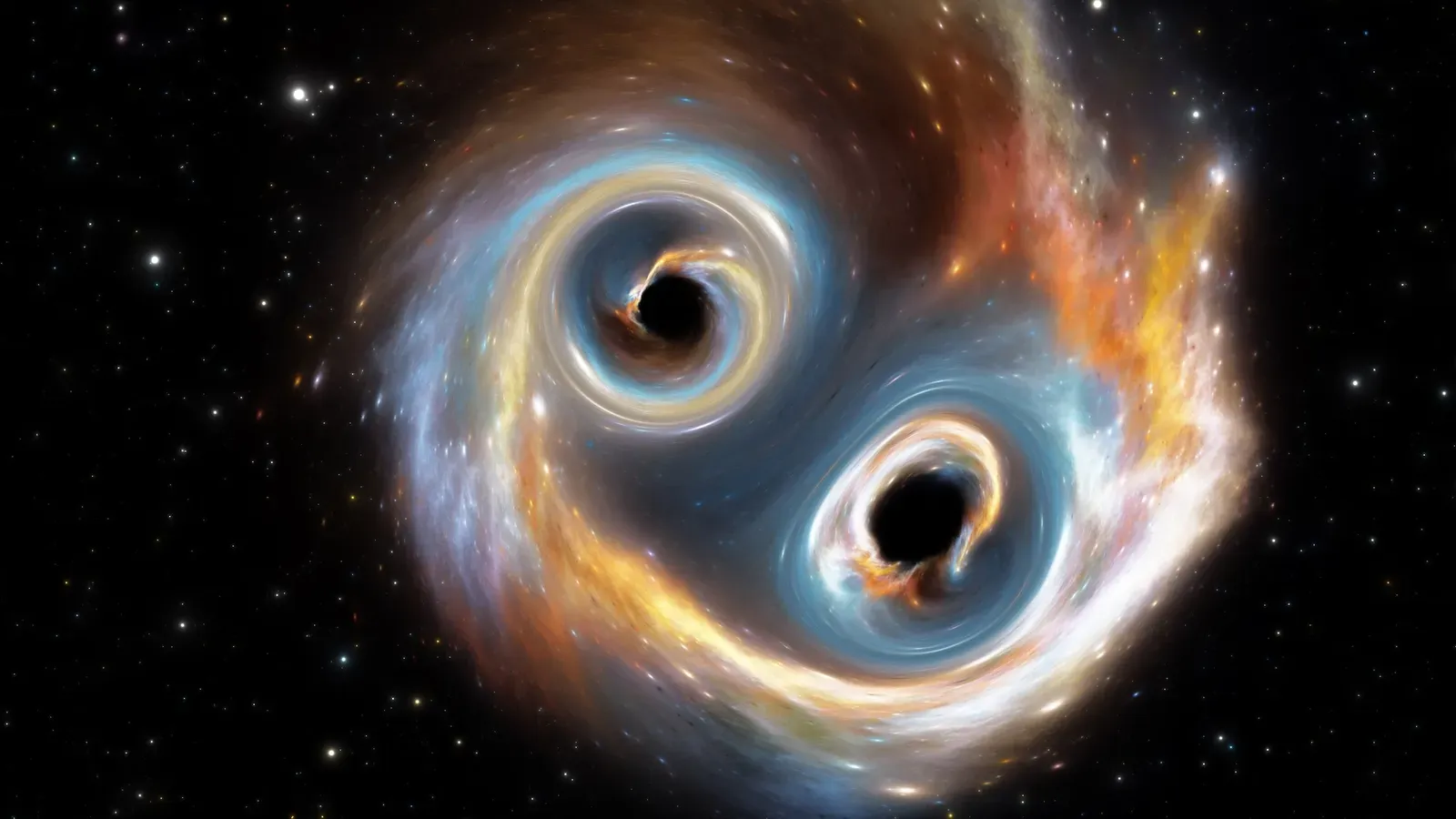
A mysterious black hole merger detected by LIGO may not be as massive as astronomers first thought. Researchers suggest that gravitational lensing—a phenomenon in which gravity bends and magnifies signals—could have distorted the gravitational waves from the event.
On November 23, 2023, both detectors of the Laser Interferometer Gravitational-Wave Observatory (LIGO), located in Washington and Louisiana, detected an unusual gravitational-wave signal known as GW231123.
Gravitational waves are ripples in space-time produced by some of the universe’s most powerful events, including stellar explosions and rapidly spinning neutron stars. In this case, the signal appeared to come from two black holes merging roughly 2 billion light-years from Earth.
A black hole merger in the mass gap
GW231123 attracted attention because it appeared to be the most massive black hole merger ever detected. The two parent black holes were estimated to have masses of approximately 100 and 130 times that of the Sun. Their merger appeared to produce a single black hole with a mass of about 230 solar masses.
Those measurements created a problem. The two black holes appeared to occupy the so-called black hole mass gap: they were too massive to be easily explained as the remnants of ordinary stellar collapse, yet smaller than the intermediate-mass black holes observed by astronomers.
The black holes also appeared to be spinning much faster than expected when they collided, adding to the mystery.
Researchers have proposed several explanations for how black holes of this size could form. One possibility is that they could be created when a very large star collapses and explodes as a supernova. However, that idea conflicts with much of the observational evidence gathered so far.
Could gravitational lensing have distorted the signal?
In a study published in Astrophysical Journal Letters, researchers proposed another explanation for GW231123: gravitational lensing.
Gravitational lensing occurs when radiation from a distant source passes through space-time warped by the gravity of a massive foreground object. The effect can magnify, distort or split the signal, much like a glass lens changes the appearance of light.
Image credit: NASA’s Goddard Space Flight Center Conceptual Imagery Lab
Scientists have observed gravitational lensing affecting visible light many times. However, researchers have not previously found evidence that the phenomenon can lens gravitational waves.
“Like light, gravitational waves can be deflected by massive objects, magnified, and split into multiple signals,” astrophysicist Miguel Zumalacárregui of Germany’s Max Planck Institute for Gravitational Physics said in a statement.
How gravitational lensing could change the mass estimate
Gravitational lensing was first proposed in 1915 as a consequence of Albert Einstein’s general theory of relativity. The theory states that massive objects, including galaxies and black holes, warp the space-time around them.
When a massive object lies between Earth and a more distant source, light can bend around it. This can create phenomena such as bright halos called Einstein rings, cross-shaped structures and multiple images of the same object. Astronomers use these effects to study the mass of foreground objects and investigate invisible matter such as dark matter.
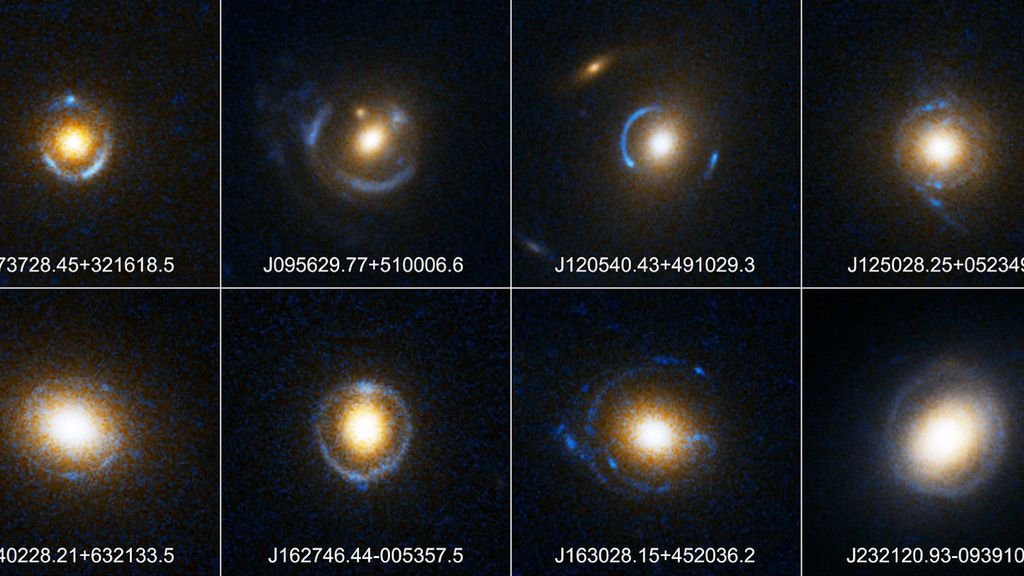
Image credit: NASA
For the new study, researchers modeled how gravitational waves might be modified by a lensing object. Their results suggest that the GW231123 signal may have been magnified, causing astronomers to overestimate the masses of the merging black holes.
“Assuming that GW231123 was deflected and distorted by a compact object or celestial-like extended structure of approximately 190 to 850 solar masses—a globular cluster—explains the large mass observed,” study lead author Srashti Goyal, a postdoctoral fellow at the Max Planck Institute for Gravitational Physics, said in a statement.
The researchers also concluded that the lensing explanation does not require the black holes to have unusually high spins.
After accounting for the possible distortion, the newly merged black hole could have a mass of about 140 solar masses instead of 230 solar masses. That would remove it from the mass gap that initially made the event so difficult to explain. It could also mean that the source of the signal is farther from Earth than astronomers first estimated.
The theory remains unconfirmed
Although gravitational-wave lensing is theoretically possible, it has never been directly observed. The researchers emphasized that their study is theoretical and that they found no direct evidence of lensing or an Einstein-ring-like effect associated with GW231123.
Researchers also have not identified an object between Earth and the merger that could have acted as the lens. In most known cases of gravitational lensing, the foreground object is enormous, such as a galaxy, and can be trillions of times more massive than the Sun.
However, the models in this study suggest that a possible lens for GW231123 would be much smaller. Individual compact lenses with masses between 100 and 1,000 solar masses should be extremely rare, leaving the nature of the proposed lens unresolved.
“Individual compact lenses of 100 to 1,000 solar masses should be extremely rare, so the nature of the lenses remains a major mystery in our analysis,” Zumalacárregui said. “Future research will need to establish whether such lenses can form or whether ensembles of lighter objects, including stars, can explain this phenomenon.”
A new mystery for gravitational-wave astronomy
Gravitational lensing could eventually help astronomers study black hole mergers and other ancient cosmic events that are too distant or faint to detect directly. Analyzing diffraction patterns in lensed gravitational-wave signals could also provide new clues about the nature of dark matter.
For now, however, GW231123 remains an unresolved puzzle. The lensing hypothesis may explain why the merger appeared to involve black holes with impossible masses and unexpectedly rapid spins—but proving that the gravitational waves were distorted will require further research.
Source: Goyal, S., Villarubia-Rojo, H., and Zumalacárregui, M. (2026). “The entire universe: GW231123 as a merger of enlarged and diffracted black holes.” Astrophysical Journal Letters, 1008(1), L12.
Source: www.livescience.com