


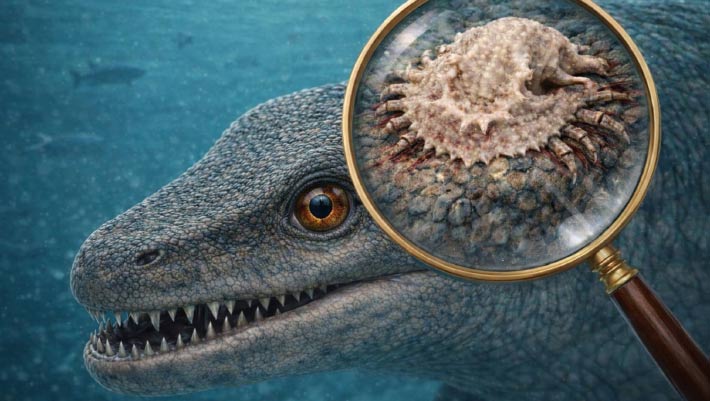
Paleontologists have described Alsasuacaris dirkeysermansi, a new species of extinct ciclidan arthropod, from a fossil measuring just 1.6 mm across. The specimen was recovered from a quarry near Maastricht in the Netherlands and dates to the Late Cretaceous, about 70 to 66 million years ago.
A rare group of crab-like arthropods
Ciclidans are an extinct group of small arthropods with rounded, crab-like shells. They lived from the Early Carboniferous to the Late Cretaceous, but their fossils are extremely rare.
Despite their appearance, ciclidians are only distantly related to true crabs and other decapod crustaceans.
“The order Cyclida consists of a diverse and enigmatic group of small arthropods with subcircular shells dating from the Early Carboniferous to the Late Cretaceous,” said Dr René H.B. Fraaije and colleagues.
“They are extremely rare in the fossil record, and each discovery is critical to documenting and understanding the diversity and stratigraphic development of this group.”
“In terms of appearance, ciclidians share morphological similarities with true crabs, but they are only distantly related to these crabs or other groups of decapod crustaceans and have independent evolutionary histories.”
A 1.6-millimeter fossil from the Netherlands
The new species is represented by a round, spiny shell only 1.6 mm in diameter. It was found in the Meerssen Formation, part of the Maastricht Formation in the southeastern Netherlands.
Belgian fossil collector Diederik Yzermans hand-extracted the specimen from the residue left after sieving. Yzermans has collected fossils in the area for 40 years and donated the only known specimen to the museum.
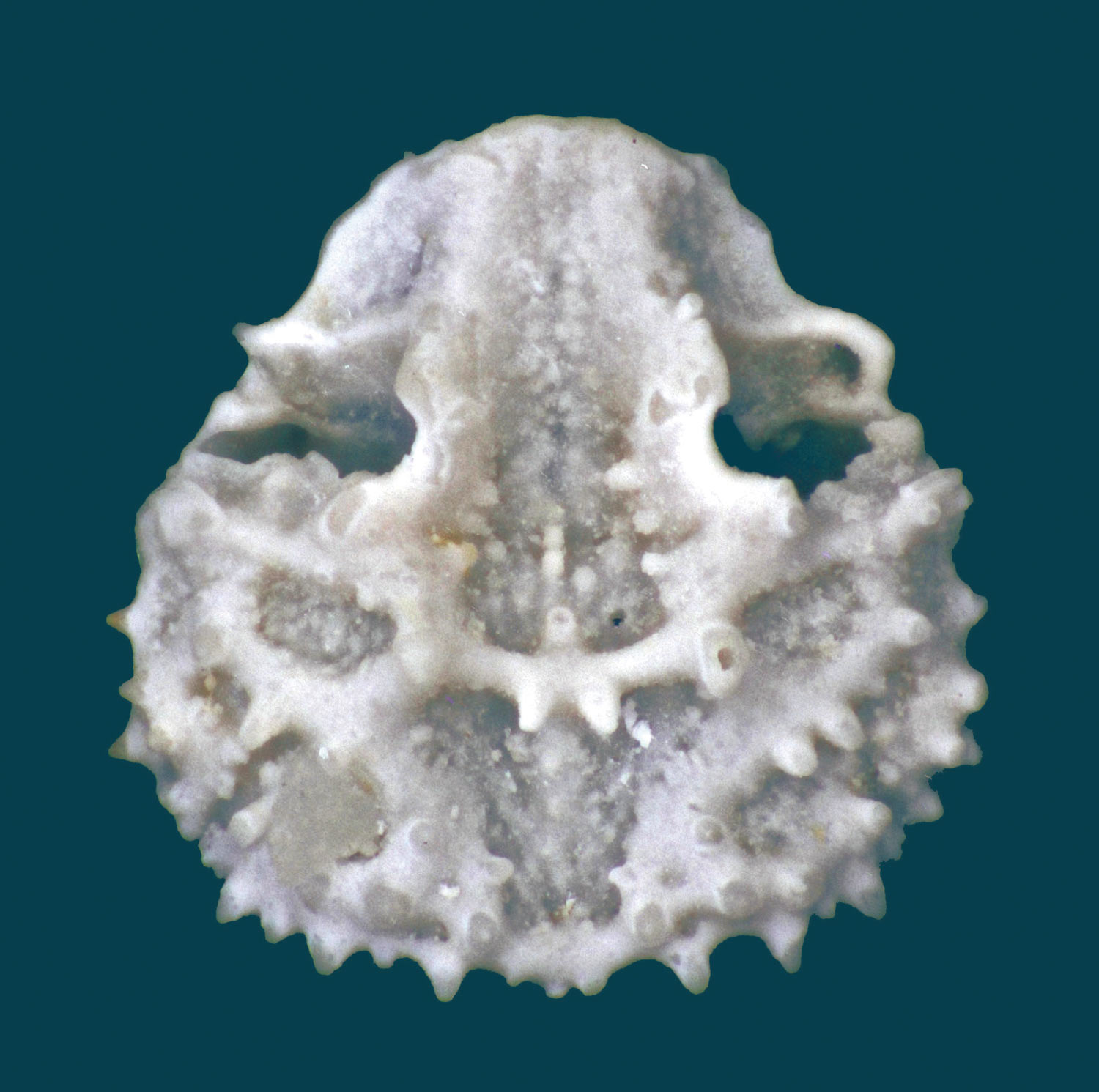
The fossil does not preserve the appendages, so the animal’s lifestyle cannot be confirmed. However, the paleontologists say that its small, flattened body is most consistent with a parasitic way of life.
Alsasuacaris dirkeysermansi may have attached itself to bony and cartilaginous fish, turtles, or mosasaurs that inhabited the ancient seas around Maastricht. Its large, raised structures may have functioned as suckers that allowed it to attach between the gills of fish, although the purpose of these structures remains uncertain.
Expanding the known range of the genus
Alsasuacaris dirkeysermansi is only the third known member of the family Alsasuacarididae. It is also the first member of the family to be preserved in three dimensions with its underside exposed.
The only other known species in the genus, Alsasuacaris nostradamus, was found in northern Spain and dates to the Albian, more than 100 million years ago. The Dutch specimen therefore significantly extends the known geographic and temporal range of the genus.
The new species joins Maastrichtiocaris rostratus, which was described in 2003 as the second ciclidian species from the Meerssen Member of the southeastern Netherlands.
“The presence of multiple ciclidians in the diverse faunal assemblages of the Meerssen Member in the southeastern Netherlands may suggest that such ciclidian taxa may be found in greater abundance in Mesozoic strata if millimeter-sized faunal elements are also examined in detail,” the researchers said.
“While ciclidians do have a crab-like appearance, it is very likely that alsasuacarids occupied a separate ecological niche from brachyurans.”
The discovery is reported in a paper published in Geodiversitas.
René H.B. Fraaije et al. 2026. The second mysterious Alsasuacaridae (Placusocarinae, Cyclida) discovered from the Maastrichtian-type region of the Netherlands (Late Cretaceous). Geodiversitas 48 (23): 547–554. doi: 10.5252/geodiversitas2026v48a23.
Source: www.sci.news