


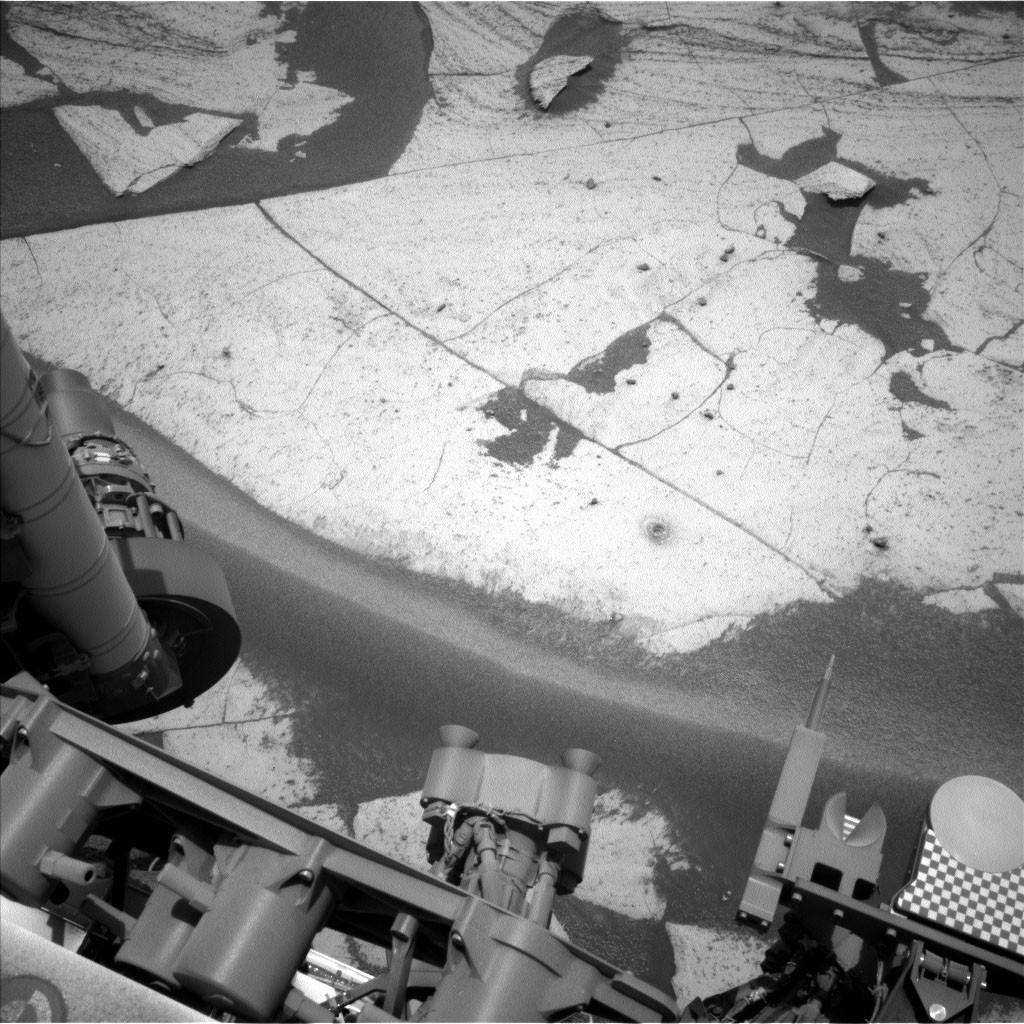
Curiosity Rover Analyzes the “Basque Lake” Mars Rock Sample
Written by Michelle Minitti, MAHLI Deputy Principal Investigator
Earth Plan Date: October 1, 2026 (Friday)
CheMin and SAM Investigate a Drilled Martian Sample
A large part of Curiosity’s plan includes Mastcam and ChemCam mosaics, chemical analyses from ChemCam and APXS, images from MAHLI and MARDI, and systematic measurements from REMS, RAD, and DAN. However, drilling is essential for meeting the Mars Science Institute’s specifications for analyzing Martian rocks with CheMin and SAM.
This week, the rover conducted a CheMin analysis of a sample from the “Basque Lake” borehole, prepared SAM for analysis, and examined the sample with SAM’s Tunable Laser Spectrometer (TLS). CheMin data helped SAM determine whether to analyze the sample. SAM will wait for the TLS results, which measure the volatiles present, before deciding whether to conduct an additional mass spectrometry test next week.
Curiosity Captures a 360-Degree View of the Workspace
Laboratory activities use a significant portion of the spacecraft’s daily power budget. As a result, much of the remaining payload takes a backseat during these campaigns, creating a valuable opportunity for CheMin and SAM to collect detailed data. The rover continued systematic environmental monitoring, using available power to study conditions at the excavation site.
Mastcam captured a 360-degree mosaic of the surroundings, creating a complete view of the sample’s geological environment. Its color and higher resolution compared with Navcam also supported additional science requests, including focused Mastcam imaging of structures near the workspace and ChemCam RMI imaging of the “Cordillera” butte.
Photometric Observations and Chemical Measurements
Working with Navcam, Mastcam planned seven photometric observations at fixed times of day. These observations measure how the spectral characteristics of a target change as the angle of the Sun above it changes. The results will help scientists better interpret images captured by rovers and orbiting cameras.
ChemCam collected additional chemical data from several materials across the workspace. Targets included the interior of the “Basque Lake” borehole, sand ripples covering the bedrock at “French Creek,” and gray blobs of unknown origin scattered throughout the workspace at “Woolly” and “Fireside.”
Monitoring Mars’ Atmosphere and Surface Environment
Curiosity’s environmental monitoring activities included regular REMS, RAD, and DAN measurements. Navcam and Mastcam also monitored atmospheric dust loads, cloud activity, and dust devil activity around the rover’s excavation site.
Source: science.nasa.gov