


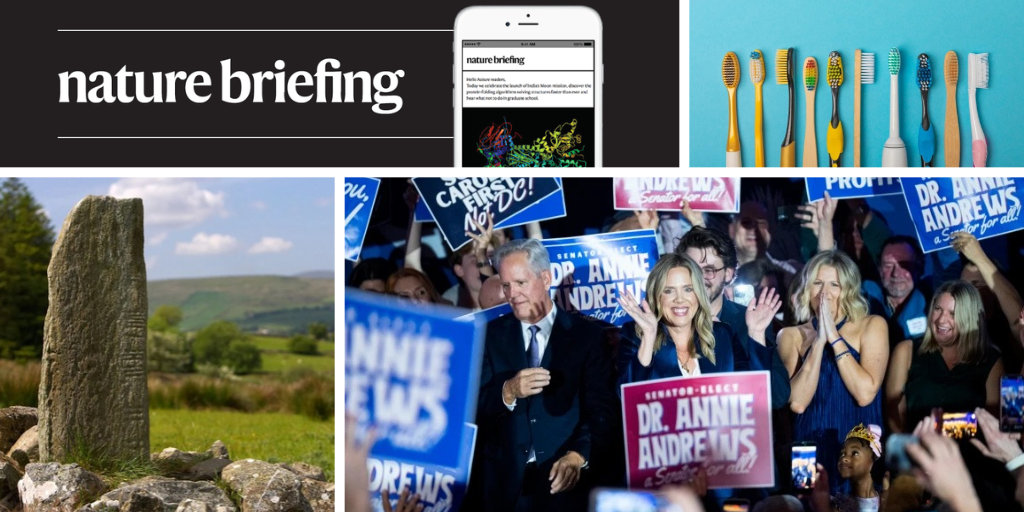
This briefing covers Democrats’ unexpected gains in the US midterm elections and what they could mean for science policy, along with research on electrically active toothbrush bristles, the origins of Celtic and Germanic languages, a gene therapy for drug-resistant epilepsy and an artificial-intelligence-controlled laboratory. It also examines how health information can reshape social networks, diversity in human spaceflight, possible environmental and gut-related contributors to Parkinson’s disease, and a call for names for the UK’s first space-debris-removal mission.
Democrats gained control of both chambers of Congress in the US midterm elections, raising hopes that lawmakers will push back against changes to science policy introduced by Republican President Donald Trump’s administration. A Democratic majority in both chambers would give the party the power to draft legislation countering Mr. Trump’s science policies. However, because Democrats do not hold a two-thirds majority in either chamber, the president could veto those bills.
The results also pushed scientists and medical experts further into the political arena. “The nerds are fighting back,” said Shaughnessy Norton, president of the political fundraising group 314 Action.
Nature | 7 min read
Research highlights
Electrically active toothbrush bristles
New manual toothbrushes can destroy bacteria by generating their own electrical charge rather than relying only on friction. The bristles are made from a polymer that researchers stretched and heated to give it piezoelectric properties. When the material deforms, it generates an electrical charge.
As the curved bristles move during brushing, they release a charge that produces highly reactive oxygen in nearby saliva. According to the research team, these reactive molecules damage bacterial cell membranes. When the bristles relax, the material reabsorbs the charge and can be used again.
Nature | 3 min read
Reference: Science Advances paper
Ancient genomes trace language migrations
Two new studies analyzing more than 4,700 ancient human genomes identify possible origins of Celtic and Germanic languages and reveal migrations that may have spread their speakers across Europe. The findings could help explain why Germanic languages such as English and Dutch are widespread, whereas Celtic languages such as Welsh and Gaelic are concentrated among millions of people in northern Europe.
Nature | 5 min read
Reference: Nature papers 1 and 2
Gene therapy reduces seizures in early trial
Three people with drug-resistant epilepsy experienced more than a 90% reduction in monthly seizures after receiving an injection of a virus carrying a gene into their brains in an early-stage clinical trial. The treatment targeted the small area of brain tissue responsible for each participant’s seizures.
The virus delivers a gene that makes neurons in the targeted area responsive to clozapine, a drug that activates the gene therapy and helps suppress the abnormal electrical activity associated with seizures. The participants experienced no serious side effects, but the researchers said that long-term use of clozapine could bring cardiovascular risks and other problems.
Nature | 5 min read
Reference: New England Medical Journal paper
AI-guided laboratory automates DNA research
Shanghai’s Genetics Research Institute has handed nearly all control of some experiments to robots guided by artificial-intelligence agents. The “self-driving” laboratory’s robotic arm can operate more than 20 types of equipment, complete thousands of operations in a single project and carry out experiments including DNA synthesis and sequencing.
The system, called “AutoDNA”, uses simple human prompts to plan and execute experiments. During operation, people need to intervene only to replenish reagents and maintain the hardware.
Nature | 5 min read
Reference: Nature paper
This week’s infographic

Health information distributed during randomized clinical trials can unintentionally reshape social relationships, according to a trial conducted in rural Honduras. Researchers found that an intervention providing information about child and maternal health affected people’s friendships, financial relationships and choice of sources for health advice.
In villages where only a small proportion of households received the information, overall connectivity decreased. Where most households received the intervention, connectivity increased.
Nature News and Views | 6 min read
Reference: Nature paper
Features and perspectives
Diversity and leadership in spaceflight
When NASA astronaut Jessica Watkins launched to the International Space Station in a SpaceX capsule last month, she became the first Black woman to lead a crewed space mission. Sian Proctor, the first Black woman to fly a spacecraft, on a SpaceX commercial mission in 2021, explains how commercial spaceflight is expanding access and considers what Watkins’ achievement could mean for the future of human spaceflight.
Space.com | 11 min read (Free registration required)
Investigating Parkinson’s disease beyond the brain
Parkinson’s disease research has historically focused on the brain and the process that causes dopamine-producing neurons to die. However, research has not identified a genetic component for most people with the disease, and its underlying triggers remain unknown.
Some researchers are investigating environmental factors that might contribute to the disease’s development. Others are finding evidence that changes in proteins in the gut may occur before symptoms appear in the brain.
Nature | 15 min video
This article is part of Nature’s perspective on Parkinson’s disease, a supplement manufactured with financial support from Aspen Neuroscience, Inc.
Quote of the day
Humanity will know within 10 years whether artificial-intelligence tools will enable “rapid enrichment” or “social tearing apart”, says computer scientist Jeffrey Hinton. He won the Nobel Prize in Physics in 2024 for developing tools to understand the neural networks that power AI. (The Guardian | 5 min read)
Name a space-debris-removal mission
The UK Space Agency (UKSA) is asking the public to suggest a name for its first space-debris-removal mission. The agency is seeking names of up to two letters inspired by “keeping spaces clean and safe for future generations”.
UKSA has provided examples of past mission names for inspiration, perhaps also to discourage joke suggestions. A previous British naming survey was topped by a widely discussed public choice.
Comments and suggestions about this newsletter can be sent to [email protected].
Thank you for reading,
Jacob Smith, Associate Editor, Nature Briefing
Contributed by Flora Graham
- Nature Briefing: Careers — insights, advice and award-winning journalism to help you optimize your work life.
- Nature Briefing: Microbiology — coverage of microorganisms, the most abundant life forms on Earth, and their roles in health, the environment and our food system.
- Nature Briefing: The Anthropocene — climate change, biodiversity, sustainability and geoengineering.
- Nature Briefing: AI and Robotics — 100% written by humans, of course.
- Nature Briefing: Cancer — a weekly newsletter written with cancer researchers in mind.
- Nature Briefing: Translational Research — biotechnology, drug discovery and pharmaceuticals.
Source: www.nature.com