


The discovery of zircon crystals and impact-altered minerals reveals that a massive asteroid collided with what is now Western Australia’s Pilbara region approximately 3 billion years ago.
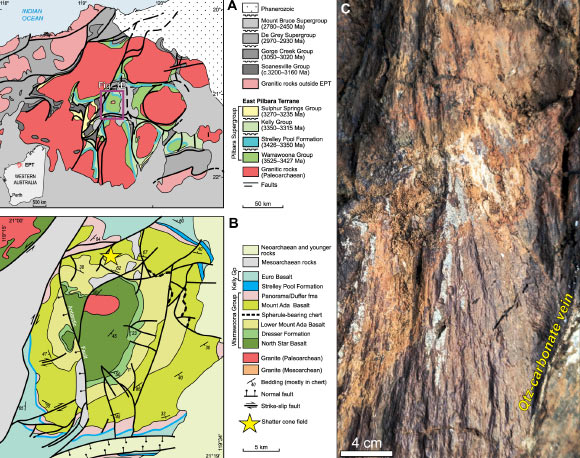
Arctic Dome Crater: (A) A simplified map of the Eastern Pilbara Terrain (EPT, Western Australia), highlighting Paleoarchean granite domes (pink) and greenstone belts (green and blue). (B) Geological map of the North Pole Dome (NPD) and shutter cone fields (yellow stars). (C) Quartz (Qtz) carbonate vein intersecting the line of the shutter cone. Image credit: Kirkland et al., doi: 10.1130/G54866.1.
Professor Chris Kirkland from Curtin University states: “While there is significant evidence of heavy bombardment on the Moon during the Hadean and early Archean eras, the details surrounding early impacts on Earth are still largely unknown.”
“Meteorite impact structures present unique challenges for researchers due to their alteration and the geological complexity of Archean upper crustal rocks predominantly made up of mafic protoliths.”
“These rocks often lack primary quartz or zircon, which are essential for preserving impact signatures and dating purposes.”
“Recent discoveries of dense shutter cone fields in the Arctic Dome, located in the East Pilbara belt, provide vital macroscopic evidence of impacts on weakly metamorphosed mafic rocks.”
“Shatter cones were initially believed to have formed around 3.47 billion years ago. However, our investigation reveals two fracture cones within the rock associated with the Neoarchean Low Basalt Mountains, indicating that the impact likely occurred between 2.7 billion and 400 million years ago.”
In this comprehensive study, researchers analyzed two rock samples featuring shattered cones (zircon-bearing metadolerite and apatite-bearing metabasalt), together with shocked quartz veins from the Arctic Dome.
Employing cutting-edge mineral dating techniques, they identified compelling evidence that the impact took place around 3 billion years ago.
“This groundbreaking discovery addresses longstanding questions regarding the timing of this event,” remarked Professor Kirkland.
“Although this site was previously recognized as an ancient impact structure, its precise age remained speculative.”
“The impact created a ‘mineral clock.’ By dating the newly formed or regenerated minerals in the damaged rocks, we can now ascertain when this significant event transpired.”
“Key evidence stems from zircon, a durable and elastic mineral that is capable of retaining geological time over billions of years.”
“Some zircons from the Arctic Dome exhibit distinctive branched skeletal forms. We interpret these as shock-altered crystals, which emerged when older zircon was destroyed, partially recrystallized, and in some areas, regrown due to intense shock-induced heating.”
“These zircon crystals provide a record dating back approximately 3 billion years, which we believe to be the most accurate estimate of their origin.”
“To further validate our findings, we also studied a second mineral, apatite, which develops when hot fluids permeate impact-altered rocks.”
“This independent dating technique yielded the same age, enhancing our confidence in identifying the clear signatures of a singular significant event: a meteorite impact.”
This new era positions the Arctic Dome structure as the oldest recognized impact crater on Earth and a unique example from the Archean Era when Earth’s earliest landmasses were forming.
“Dating ancient impact craters is inherently challenging, as rocks have undergone extensive alteration due to heat, pressure, and fluids over billions of years, which can obscure or reset the original impact signatures,” remarked Professor Kirkland.
“What we achieved in this study is the ability to distinguish the moment of impact from its extensive geological history.”
This landmark discovery propels Earth’s impact record further back in time than any previously dated crater, offering rare insights into the violent processes that shaped the early Earth.
The team’s research paper was published in the June 23rd issue of Geology.
_____
CL Kirkland et al. What is the age of the Arctic Dome impact in Western Australia? Geology published online June 23, 2026. doi: 10.1130/G54866.1
Source: www.sci.news