


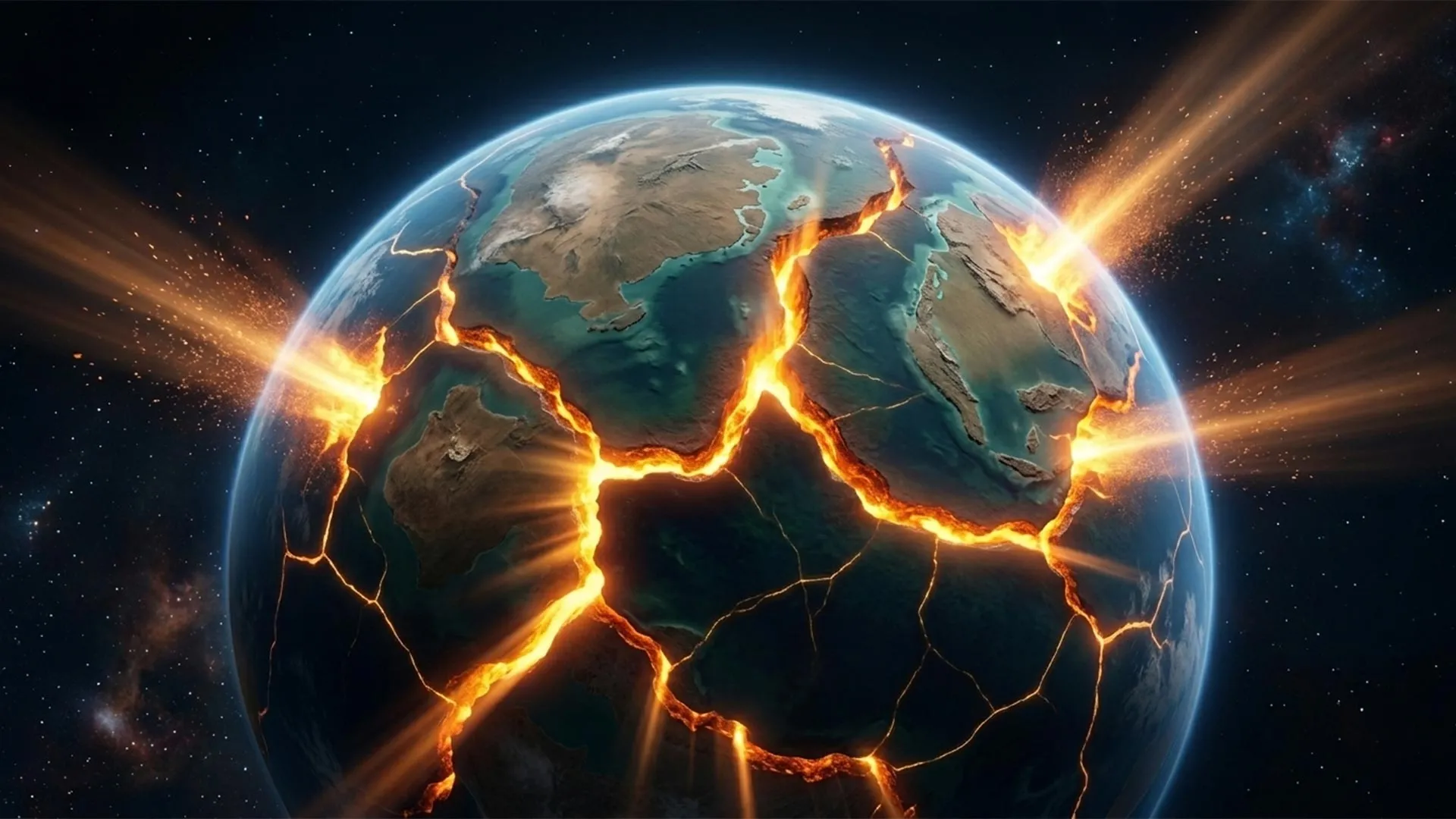
Researchers from Curtin University have found evidence that a fundamental change occurred in the way Earth’s crust formed and was recycled about 2.5 billion years ago. The disappearance of a distinctive chemical signature from rocks after that time suggests a transition from an early crustal system to the dynamic plate-tectonic system that operates today.
Tectonic plates have reshaped Earth’s continents and ocean basins for billions of years, while also helping regulate the planet’s climate and magnetic field. However, determining when modern plate tectonics emerged has been difficult because the process recycles deep crustal material, erasing much of the geological record.
A team from Curtin University identified distinctive chemical signatures in rocks collected from around the world. The disappearance of this signature around 2.5 billion years ago provides evidence of a major change in how Earth’s crust operated.
Chemical fingerprints in ancient rocks
Lead author Dr Janne Liebmann, a researcher in Curtin’s Mineral Systems Timescale Group within the Curtin Frontier Institute for Geoscience Solutions, said the discovery offers a rare view of how Earth’s oldest crust developed.
“New crust is often formed by melting old rocks, leaving a unique chemical fingerprint,” Liebmann said.
“We looked for this fingerprint in thousands of rocks around the world, going back almost four billion years of Earth’s history.
“We consistently found them in rocks older than 2.5 billion years and showed that they originated from ancient crustal pools that formed about 4 billion years ago.
“But after 2.5 billion years ago, that fingerprint disappeared from the geological record, and despite examining thousands of rocks, we never see it again.
“This tells us that something fundamental has changed in the process of formation and deformation of Earth’s crust, indicating a transition to the dynamic crustal system we see today.”
When modern tectonic processes emerged
Co-author Professor Chris Kirkland of the Mineral Systems Timescale Group in Curtin’s School of Earth and Planetary Sciences said the finding brings researchers closer to determining when Earth developed one of its defining geological features: a system of moving tectonic plates unlike those active on Venus and Mars today.
“Plate tectonics is fundamental to the way Earth has evolved over billions of years, continually reshaping the continents and oceans and influencing Earth’s atmosphere and climate,” Kirkland said.
“What makes this discovery so remarkable is that we can see the fingerprints of ancient Earth disappearing from the geological record at a very specific point in time.
“This marks a transition from the early Earth, where ancient crust could be repeatedly melted and reprocessed in situ, to a system in which crust can be moved and recycled on a much larger scale.
“This gives us the clearest geological evidence yet of when the tectonic engine that powers the modern Earth was ‘turned on’.”
The study, titled “Loss of ancient tectonic reservoirs signals changes in Earth’s geodynamic regime,” was published in Proceedings of the Royal Society A.
Source: www.sciencedaily.com