


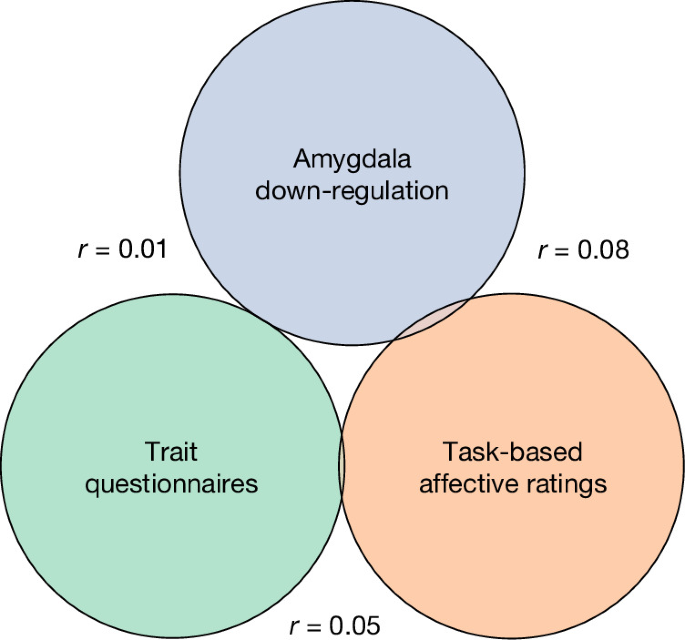
The supplied material is a reference collection covering the neuroscience and psychology of emotion regulation. It spans foundational theories, brain networks, individual differences, clinical disorders, neuroimaging methods, neuromodulation, statistical practices and emerging studies published through 2026. The references also highlight an important uncertainty in the field: findings about emotion and the brain can vary across people, tasks and measurement methods, making large samples, reliable instruments and reproducible analyses essential.
Emotion regulation and psychopathology
- Sheppes, G., Suri, G. & Gross, J. J. Emotion regulation and psychopathology. Annu. Rev. Clin. Psychol. 11, 379–405 (2015). Article · PubMed
- Morawetz, C. et al. Multiple large-scale neural networks underlying emotion regulation. Neurosci. Biobehav. Rev. 116, 382–395 (2020). Article · PubMed
- Morawetz, C. & Basten, U. Neural underpinnings of individual differences in emotion regulation: A systematic review. Neurosci. Biobehav. Rev. 162, 105727 (2024). Article · PubMed
- Sicorello, M. & Schmahl, C. Emotion dysregulation in borderline personality disorder: a fronto–limbic imbalance? Curr. Opin. Psychol. 37, 114–120 (2021). Article · PubMed
- Picó-Pérez, M., Radua, J., Steward, T., Menchón, J. M. & Soriano-Mas, C. Emotion regulation in mood and anxiety disorders: A meta-analysis of fMRI cognitive reappraisal studies. Prog. Neuropsychopharmacol. Biol. Psychiatry 79, 96–104 (2017). Article · PubMed
- Kievit, R. A., Frankenhuis, W. E., Waldorp, L. J. & Borsboom, D. Simpson’s paradox in psychological science: a practical guide. Front. Psychol. (2013). Article
- McDermott, T. J., Kirlic, N. & Aupperle, R. L. Roadmap for optimizing the clinical utility of emotional stress paradigms in human neuroimaging research. Neurobiol. Stress 8, 134–146 (2018). Article
- Morawetz, C., Hemetsberger, F. J., Laird, A. R. & Kohn, N. Emotion regulation: from neural circuits to a transdiagnostic perspective. Neurosci. Biobehav. Rev. 168, 105960 (2025). Article
Neural representations and brain networks
- Kragel, P. A. et al. Generalizable representations of pain, cognitive control, and negative emotion in medial frontal cortex. Nat. Neurosci. 21, 283–289 (2018). Article
- Wager, T. D., Davidson, M. L., Hughes, B. L., Lindquist, M. A. & Ochsner, K. N. Prefrontal–subcortical pathways mediating successful emotion regulation. Neuron 59, 1037–1050 (2008). Article
- Thomas Yeo, B. T. et al. The organization of the human cerebral cortex estimated by intrinsic functional connectivity. J. Neurophysiol. 106, 1125–1165 (2011). Article
- Zhang, J.-X., Bo, K., Wager, T. D. & Gross, J. J. The brain bases of emotion generation and emotion regulation. Trends Cogn. Sci. 29, 879–891 (2025). Article
- Menon, V. Large-scale brain networks and psychopathology: a unifying triple network model. Trends Cogn. Sci. 15, 483–506 (2011). Article
- Berboth, S. & Morawetz, C. Amygdala-prefrontal connectivity during emotion regulation: a meta-analysis of psychophysiological interactions. Neuropsychologia 153, 107767 (2021). Article
- Wang, R., Janet, R., Morawetz, C. & Tusche, A. Emotion regulation success involves systematic gradient-based reconfigurations of large-scale activation patterns in the human brain. PLoS Biol. 24, e3003666 (2026). Article
- Jiang, H. et al. Common and distinct neurofunctional signatures of dynamic naturalistic emotion regulation strategies. Nat. Commun. 17, 4272 (2026). Article
Emotion, appraisal and individual differences
- Drabant, E. M., McRae, K., Manuck, S. B., Hariri, A. R. & Gross, J. J. Individual differences in typical reappraisal use predict amygdala and prefrontal responses. Biol. Psychiatry 65, 367–373 (2009). Article
- McRae, K., Jacobs, S. E., Ray, R. D., John, O. P. & Gross, J. J. Individual differences in reappraisal ability: Links to reappraisal frequency, well-being, and cognitive control. J. Res. Personal. 46, 2–7 (2012). Article
- Silvers, J. A. & Guassi Moreira, J. F. Capacity and tendency: a neuroscientific framework for the study of emotion regulation. Neurosci. Lett. 693, 35–39 (2019). Article
- Goldin, P. et al. Cognitive reappraisal self-efficacy mediates the effects of individual cognitive-behavioral therapy for social anxiety disorder. J. Consult. Clin. Psychol. 80, 1034–1040 (2012). Article
- Brehl, A.-K., Schene, A., Kohn, N. & Fernández, G. Maladaptive emotion regulation strategies in a vulnerable population predict increased anxiety during the Covid-19 pandemic: A pseudo-prospective study. J. Affect. Disord. Rep. 4, 100113 (2021).
- Cunningham, W. A. & Brosch, T. Motivational salience: amygdala tuning from traits, needs, values, and goals. Curr. Dir. Psychol. Sci. 21, 54–59 (2012). Article
- Paré, D. & Headley, D. B. The amygdala mediates the facilitating influence of emotions on memory through multiple interacting mechanisms. Neurobiol. Stress 24, 100529 (2023). Article
- Gross, J. J. & John, O. P. Individual differences in two emotion regulation processes: implications for affect, relationships, and well-being. J. Pers. Soc. Psychol. 85, 348–362 (2003). Article
- Shafir, R., Thiruchselvam, R., Suri, G., Gross, J. J. & Sheppes, G. Neural processing of emotional-intensity predicts emotion regulation choice. Soc. Cogn. Affect. Neurosci. 11, 1863–1871 (2016). Article
- Inzlicht, M., Werner, K. M., Briskin, J. L. & Roberts, B. W. Integrating models of self-regulation. Annu. Rev. Psychol. 72, 319–345 (2021). Article
- Barrett, L. F. The theory of constructed emotion: an active inference account of interoception and categorization. Soc. Cogn. Affect. Neurosci. 12, 1–23 (2017). Article
- Mauss, I. B. & Robinson, M. D. Measures of emotion: a review. Cogn. Emot. 23, 209–237 (2009). Article
Clinical applications and neuromodulation
- Kang, Y. Transcranial focused ultrasound for emotion regulation: A systematic review and quantitative summary of human studies. J. Affect. Disord. (2026). Article
- Tschentscher, N. et al. The clinical impact of real-time fMRI neurofeedback on emotion regulation: a systematic review. Brain Sci. 14, 700 (2024). Article · PubMed Central
- Goldental, N. et al. Amygdala EFP neurofeedback effects on PTSD symptom clusters and emotional regulation processes. J. Clin. Med. 14, 2421 (2025). Article · PubMed Central
- Kang, T. et al. High-intensity transcranial alternating current stimulation for emotion regulation and attentional bias in adolescents with nonsuicidal self-injury: a randomized clinical trial. JAMA Netw. Open 9, e2617336 (2026). Article · PubMed Central
- Hu, Y.-T. et al. Motor cortex repetitive transcranial magnetic stimulation in major depressive disorder — a preliminary randomized controlled clinical trial. J. Affect. Disord. 344, 169–175 (2024). Article
- Downar, J. & Daskalakis, Z. J. New targets for rTMS in depression: a review of convergent evidence. Brain Stimulat. 6, 231–240 (2013). Article
Measurement, reproducibility and analysis
- Ward, P. G. D. et al. Individual differences in haemoglobin concentration influence bold fMRI functional connectivity and its correlation with cognition. NeuroImage 221, 117196 (2020). Article
- Hedge, C., Powell, G. & Sumner, P. The reliability paradox: why robust cognitive tasks do not produce reliable individual differences. Behav. Res. Methods 50, 1166–1186 (2018). Article
- Berboth, S., Windischberger, C., Kohn, N. & Morawetz, C. Test-retest reliability of emotion regulation networks using fMRI at ultra-high magnetic field. NeuroImage 232, 117917 (2021). Article
- Paret, C. et al. Survey on open science practices in functional neuroimaging. NeuroImage 257, 119306 (2022). Article
- Marek, S. et al. Reproducible brain-wide association studies require thousands of individuals. Nature 603, 654–660 (2022). Article
- Sicorello, M. et al. Affective neural signatures do not distinguish women with emotion dysregulation from healthy controls: a mega-analysis across three task-based fMRI studies. Neuroimage Rep. 1, 100019 (2021). Article
- Gianaros, P. J. et al. Affective brain patterns as multivariate neural correlates of cardiovascular disease risk. Soc. Cogn. Affect. Neurosci. 15, 1034–1045 (2020). Article
- Gianaros, P. J. et al. Multivariate brain activity while viewing and reappraising affective scenes does not predict the multiyear progression of preclinical atherosclerosis in otherwise healthy midlife adults. Affect. Sci. 3, 406–424 (2022). Article
- Kohoutová, L. et al. Individual variability in brain representations of pain. Nat. Neurosci. 25, 749–759 (2022). Article
- Taschereau-Dumouchel, V., Kawato, M. & Lau, H. Multivoxel pattern analysis reveals dissociations between subjective fear and its physiological correlates. Mol. Psychiatry (2019). Article
- Chang, L. J., Gianaros, P. J., Manuck, S. B., Krishnan, A. & Wager, T. D. A sensitive and specific neural signature for picture-induced negative affect. PLoS Biol. 13, 1–28 (2015). Article
- Zhou, F. et al. A distributed fMRI-based signature for the subjective experience of fear. Nat. Commun. 6643 (2021).
- Krishnamurthy, V. et al. Correcting task fMRI signals for variability in baseline CBF improves BOLD–behavior relationships: a feasibility study in an aging model. Front. Neurosci. 14, 336 (2020). Article
- Yarkoni, T., Poldrack, R. A., Nichols, T. E., Van Essen, D. C. & Wager, T. D. Large-scale automated synthesis of human functional neuroimaging data. Nat. Methods 8, 665–670 (2011). Article
Questionnaires, reviews and statistical tools
- Preece, D. A., Becerra, R., Robinson, K. & Gross, J. J. The emotion regulation questionnaire: psychometric properties in general community samples. J. Pers. Assess. 102, 348–356 (2020). Article
- Jermann, F., Van der Linden, M., d’Acremont, M. & Zermatten, A. Cognitive emotion regulation questionnaire (CERQ). Eur. J. Psychol. Assess. 22, 126–131 (2006). Article
- Grob, A. & Horowith, D. FEEL-E: Fragebogen Zur Erhebung Der Emotionsregulation Bei Erwachsenen (Hans Huber, 2014).
- Ouzzani, M., Hammady, H., Fedorowicz, Z. & Elmagarmid, A. Rayyan—a web and mobile app for systematic reviews. Syst. Rev. 5, 210 (2016). Article
- Wager, T. D. CanlabCore. GitHub (2024).
- Suri, G. Affordances and the mechanisms underlying reappraisal. In Handbook of Emotion Regulation, 3rd edn, 104–111 (Guilford Press, 2024).
- Bramson, B., Toni, I. & Roelofs, K. Emotion regulation from an action-control perspective. Neurosci. Biobehav. Rev. 153, 105397 (2023). Article
- Herzog, S. et al. A neural signature for reappraisal as an emotion regulation strategy: relationship to stress-related suicidal ideation and negative affect in major depression. Biol. Psychiatry Cogn. Neurosci. Neuroimaging 10, 94–102 (2025).
- Mauss, I. B. & Robinson, M. D. Measures of emotion: a review. Cogn. Emot. 23, 209–237 (2009). Article
- Eisenhauer, J. G. Meta-analysis and mega-analysis: a simple introduction. Teach. Stat. 43, 21–27 (2021). Article
- Koile, E. & Cristia, A. Toward cumulative cognitive science: a comparison of meta-analysis, mega-analysis, and hybrid approaches. Open Mind 5, 154–173 (2021). Article
- Balduzzi, S., Rücker, G. & Schwarzer, G. How to perform a meta-analysis with R: a practical tutorial. Evid. Based Ment. Health 22, 153–160 (2019). Article
- Borenstein, M., Larry V., H., Julian P.T., H. & Hannah R. R. Introduction to Meta-Analysis (John Wiley & Sons, 2009).
- Bossier, H., Nichols, T. E. & Moerkerke, B. Standardized effect sizes and image-based meta-analytical approaches for fMRI data. Preprint at bioRxiv (2019).
- Jarosz, A. F. & Wiley, J. What are the odds? A practical guide to computing and reporting Bayes factors. J. Probl. Solving 7, 2 (2014).
- Gronau, Q. F. et al. A Bayesian model-averaged meta-analysis of the power pose effect with informed and default priors: the case of felt power. Compr. Results Soc. Psychol. 2, 123–138 (2017). Article
- Pramanik, S. & Johnson, V. E. Efficient alternatives for Bayesian hypothesis tests in psychology. Psychol. Methods 29, 243–261 (2024). Article
- Gignac, G. E. & Szodorai, E. T. Effect size guidelines for individual differences researchers. Personal. Individ. Differ. 102, 74–78 (2016). Article
- van Erp, S., Verhagen, J., Grasman, R. P. P. P. & Wagenmakers, E.-J. Estimates of between-study heterogeneity for 705 meta-analyses reported in Psychological Bulletin from 1990–2013. J. Open. Psychol. Data 5, 4 (2017).
- de Jong, T. A Bayesian approach to the correction for multiplicity. Preprint at OSF (2019).
- Li, J. & Ji, L. Adjusting multiple testing in multilocus analyses using the eigenvalues of a correlation matrix. Heredity 95, 221–227 (2005). Article
- Searle, S. R., Speed, F. M. & Milliken, G. A. Population marginal means in the linear model: an alternative to least squares means. Am. Stat. 34, 216–221 (1980). Article
- Morey, R. D. & Rouder, J. N. BayesFactor: computation of Bayes factors for common designs. R package version 0.9.12-4.2 (CRAN, 2018).
- Sicorello, M. MaurizioSicorello/NIDER_project: NIDER_project v1.0.0 [computer software]. Zenodo (2026).
Additional studies
- Morawetz, C., Bode, S., Baudewig, J., Jacobs, A. M. & Heekeren, H. R. Neural representation of emotion regulation goals. Hum. Brain Mapp. 37, 600–620 (2016).
- Gianaros, P. J. et al. Affective brain patterns as multivariate neural correlates of cardiovascular disease risk. Soc. Cogn. Affect. Neurosci. 15, 1034–1045 (2020).
- Marek, S. et al. Patterns of brain-wide associations reflect socioeconomics. Science 392, eaee6213 (2026). Article
- Sicorello, M. et al. The functional neurobiology of dispositions towards negative emotions. Nat. Commun. 17, 5622 (2026). Article
- Wang, R., Janet, R., Morawetz, C. & Tusche, A. Emotion regulation success involves systematic gradient-based reconfigurations of large-scale activation patterns in the human brain. PLoS Biol. 24, e3003666 (2026). Article
Source: www.nature.com