


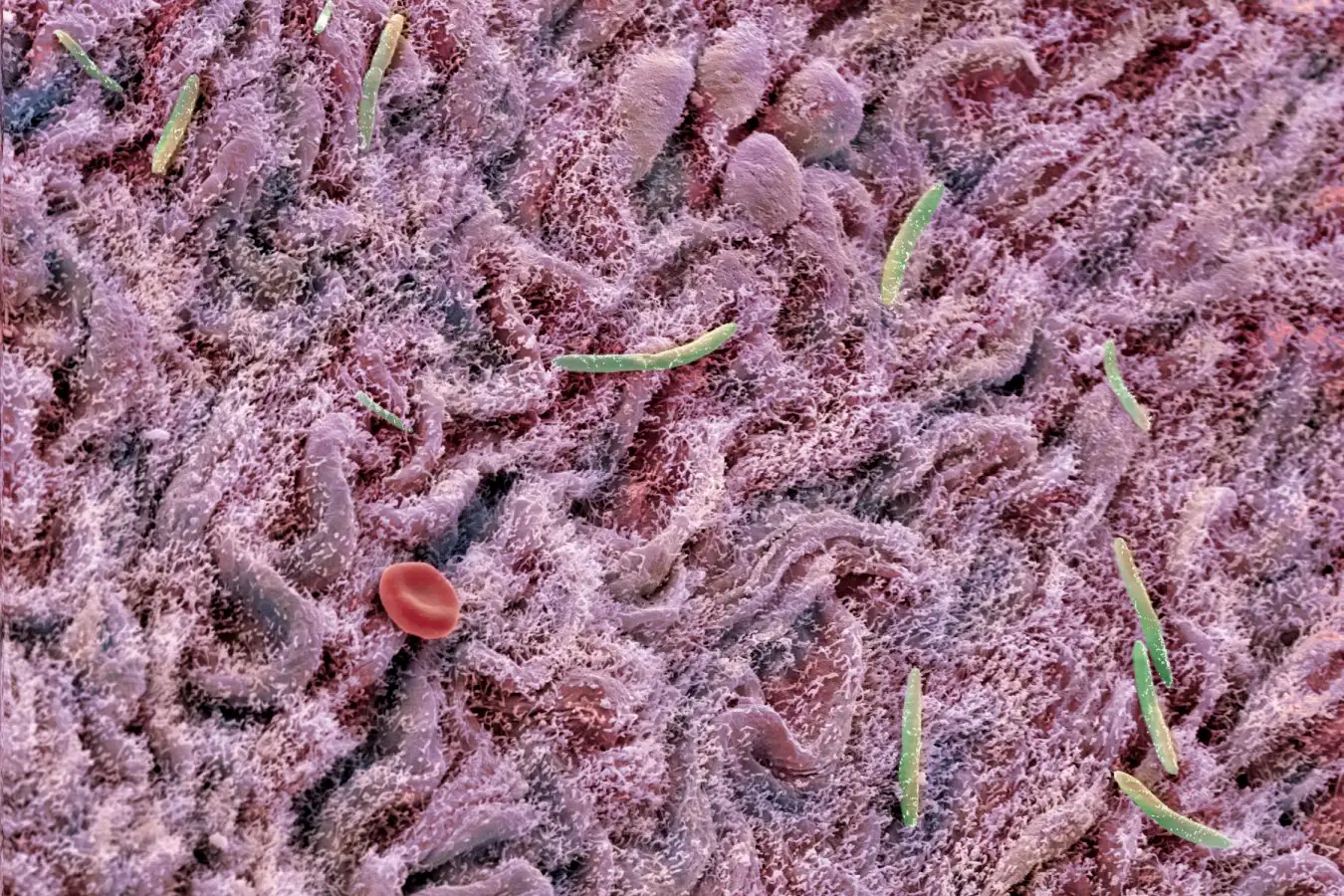

Scanning electron micrograph of the intestinal lining of a mouse. Several bacteria (green) and one red blood cell (red) are present.
CJC Copyright: IKELOS GmbH/Dr. Christopher B. Jackson/Science Photo Library
Fecal Microbiome Transplantation (FMT) has shown promising potential in enhancing brain adaptability in aging organisms, similar to the plasticity observed in younger brains. The gut microbiome is increasingly recognized as a significant factor influencing mental health, including depression risk, and might play a role in shaping personality traits.
A groundbreaking study indicates that older mice receiving gut microbiome transplants from younger mice exhibited enhanced brain plasticity. This discovery suggests that FMT may enable older mice to overcome visual conditions typically treatable only during childhood, such as amblyopia (lazy eye).
“This study suggests that microbial communities may help regulate critical periods of brain development by defining when developmental windows of increased plasticity open and close.” says Parisa Gazelani, a professor at Oslo Metropolitan University in Norway, who was not involved in the study. “This implies that the gut microbiome could play an active role in shaping neural circuit maturation alongside sensory experience, immune activity, and genetic programming.”
Neuroplasticity, the brain’s capacity to reform itself, typically allows conditions like amblyopia in children to be addressed by temporarily covering the stronger eye, compelling the brain to forge new connections with the weaker eye. However, neuroplasticity peaks during youth and diminishes during adolescence due to the brain’s natural pruning of unused connections.
Researchers, including Paola Tonini from the Sant’Anna School of Advanced Studies in Pisa, Italy, explored the potential of manipulating the gut microbiome to boost brain plasticity in adulthood.
In their trials, 21-day-old mice were administered high doses of a broad-spectrum antibiotic for 10 days. This treatment led to significant alterations in their gut microbiota compared to control mice that received untreated water, specifically a decrease in bacterial families such as Lachnospiraceae, which are linked to the production of neuroprotective short-chain fatty acids.
After sealing one eye of each mouse for three days, imaging revealed that only control mice displayed signs of neuroplasticity, with heightened brain responsiveness to the open eye’s stimulation.
To further explore underlying mechanisms, the researchers conducted RNA sequencing to analyze gene expression in the visual cortex. “We observed significant changes in the antibiotic-treated animals,” noted Tonini, with over 1,000 genes expressed differently in these mice compared to controls. These genes were linked to myelination processes and blood-brain barrier permeability.
Ultimately, fecal microbiota from 30-day-old mice were transplanted into 4-month-old adult mice, while a control group received transplants from other adults. Notably, only the mice receiving the young microbiota exhibited neuroplasticity in response to the eye-closure experiment.
If these findings translate to humans, the implications could be transformative. Says Harriet Scherekens from University College Cork in Ireland, “This indicates that the microbiome is crucial not only for early brain development but may also be targeted later to enhance learning, recovery from injury, and resilience against aging and neurological disorders.” She emphasizes the need to pinpoint specific microbial metabolites or strains instead of relying on raw microbiota transplants.
However, Gazelani cautions that it is premature to apply these results directly to humans, given the complexity of our brains and diet and lifestyle’s significant influence on our microbiomes.
The research raises additional concerns regarding the long-term consequences of childhood exposure to high doses of antibiotics. Gazelani states, “While antibiotics are essential and should not be withheld when needed, these findings underscore the importance of using antibiotics judiciously during critical developmental periods.”
Topics:
Source: www.newscientist.com