


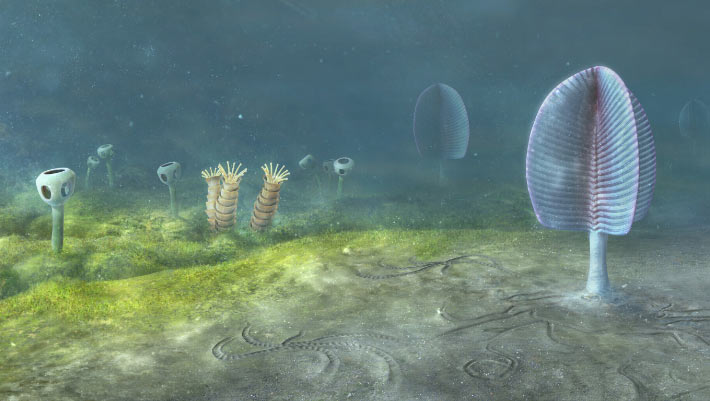
Animals May Have Evolved Hundreds of Millions of Years Earlier Than the Fossil Record Shows
The oldest undisputed animal fossils from the Ediacaran biota are approximately 574 million years old. However, chemical traces preserved in ancient rocks suggest that animals—possibly including sponges—may have existed more than 635 million years ago. A new molecular-clock study argues that the absence of older animal fossils does not necessarily mean animals had not yet evolved.
When did animals first evolve?
“The timing of the origin of animals on Earth has puzzled scientists for centuries,” said paleontologist Orin M. Roll Durbin of Virginia Tech and his colleagues.
The fossil record provides clear evidence of animal life by about 574 million years ago, near the beginning of the Ediacaran Period. This evidence includes the earliest examples of Ediacaran megafauna. Microfossils also do not provide definitive evidence of animals before the Ediacaran.
Yet lipid biomarkers—chemical compounds preserved in ancient rocks—have been interpreted as evidence that animals, including sponges, existed during the late Cryogenian Period, between approximately 717 million and 635 million years ago.
“Evidence for clear macrofossil animals extends to the earliest examples of the Ediacaran megafauna 574 million years ago, and the microfossil record similarly does not record definitive animals until the Ediacaran period,” the researchers said.
“However, lipid biomarkers suggest that animals existed during the Cryogenian terminal period 10 to 20 million years ago.”
Recent analyses have suggested that sponge-like chemical signatures are preserved in sufficient quantities in Neoproterozoic rocks to support the presence of early animals. This creates a major discrepancy between the molecular evidence and the fossil record.
A fossil deposit challenges a key assumption
To investigate this discrepancy, Roll Durbin and his colleagues reexamined geological deposits used to estimate the maximum possible age of animals. They focused on the Keseen biota, a collection of phosphatized microfossils from Mongolia dating to approximately 550 million to 526 million years ago.
Animals were already present elsewhere during this period, but the Keseen biota does not contain fossils that can be confidently identified as animals. Its fossils are preserved in a manner comparable to those from China’s Wen’an biota, which has been used as important evidence in studies of animal origins.
Dr. Ross Anderson, a researcher at Oxford University’s Natural History Museum, said the comparison challenges the assumption that an exceptionally well-preserved fossil deposit should contain animal fossils if animals existed at the time.
The Keseen and Wen’an assemblages share several fossil species and are similarly well preserved. Nevertheless, animal fossils are absent from Keseen even though animals were already evolving when the deposits formed.
This suggests that the absence of animal fossils from a particular fossil community may reflect ecological conditions, local environments or the way organisms were preserved—not necessarily the absence of animals from Earth.
Molecular clocks point to an older animal lineage
Molecular clocks estimate when evolutionary lineages diverged by comparing genetic differences between living species. The reliability of these estimates depends partly on fossil calibrations, which set minimum or maximum ages for evolutionary events.
The researchers argue that some younger deposits previously used to limit the origin of animals to the Ediacaran Period may be unreliable for that purpose. When older Tonian-age deposits were replaced with younger Ediacaran calibrations, the molecular-clock analysis produced a much older estimate for the origin of crown-group animals.
Depending on the calibration used, the estimated origin of crown-group animals ranged from approximately 800 million to 700 million years ago.
“No animal remains from before the Ediacaran period have yet been discovered, and this analysis does not prove that animals existed 800 million years ago,” Roll Durbin said.
“However, new fossil evidence from Mongolia undermines one of the main arguments that limits the origin of animals to the Ediacaran period. Our molecular-clock analysis shows how far back their evolutionary history can go.”
The exact origin of animals remains unknown
The study does not establish that animals were present 800 million years ago. Instead, it shows that the fossil record may be incomplete and that the absence of animal fossils from a well-preserved deposit cannot, by itself, be used to rule out their presence.
The researchers say future studies should examine fossil deposits from different regions and environments, as well as sites that preserve organisms through different fossilization processes.
They also recommend considering all available evidence for early animals, including body fossils, traces of animal activity and chemical biomarkers.
“Until that evidence is available, the exact birth date of the animal kingdom will remain unknown,” Anderson said.
The study was published in Science Advances.
_____
Orin M. Roll Durbin et al. 2026. “Reevaluating the maximum age calibration of molecular clocks restores estimates of pre-Ediacaran animal divergence.” Science Advances 12(40). DOI: 10.1126/sciadv.aeg6289.
Source: www.sci.news