Astronomers have uncovered the most compelling evidence to date that rocky exoplanets can maintain an atmosphere, a vital component for life as we understand it.
This groundbreaking discovery represents the first instance of scientists identifying an atmosphere enveloping a rocky planet beyond our solar system, situated within the habitable zone. This zone is an area around other stars where conditions may permit liquid water to persist on a planet’s surface. These findings were detailed in the July 16 publication of the journal Science, potentially narrowing the search for habitable worlds beyond our cosmic neighborhood.
“This is incredibly exciting,” said Edward Schwieterman, an associate professor of astrobiology at the University of California, Riverside, who was not part of the study. “We’re moving closer to studying the atmospheres of these worlds, where signs of life may appear in the observable spectrum.”
Latest videos from
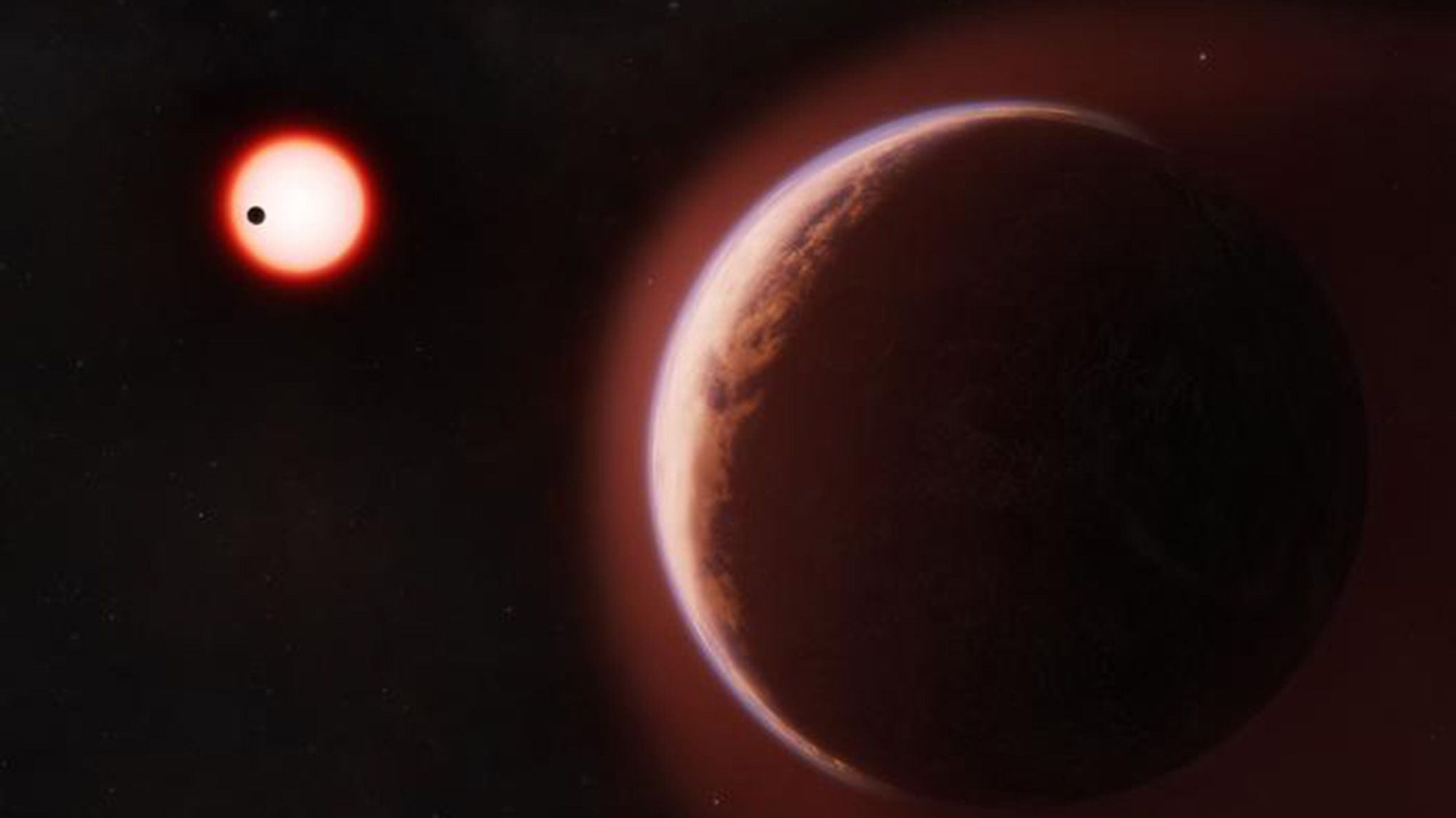
The planet, known as LHS 1140b, is located approximately 48 light-years from Earth and orbits a small, chilly red dwarf star. This exoplanet has a mass about 5.6 times that of Earth and is classified as a super Earth.
Earlier estimates indicated that Earth might receive less than half of the sunlight it does, with surface temperatures around -53 degrees Fahrenheit (-47 degrees Celsius). Despite this, such conditions are still regarded as potentially habitable by astronomers.
Space Gas Leak
Scientists have identified thousands of exoplanets, including many rocky worlds, in previous decades. However, determining whether these planets possess atmospheres has proven challenging due to the extremely thin atmospheres surrounding rocky planets compared to their gas giant counterparts, complicating detection efforts.
Instead of directly analyzing the atmosphere, the researchers employed a method to detect subtle signs of atmospheric presence: helium gas escaping into space. Utilizing the WINERED spectrometer on the Magellan Clay Telescope in Chile, they observed LHS 1140 b transiting its star, with a sliver of starlight filtering through the planet’s atmosphere on its way to Earth. This technique allowed the researchers to identify slight dips in starlight at infrared wavelengths that helium absorbs, indicating gas discharge from the planet.
Get the world’s most fascinating discoveries delivered straight to your inbox.
This prediction stemmed from a mathematical model previously unverified for rocky planets. However, in September 2024, the research team successfully captured LHS 1140 b and its smaller, hotter neighbor, LHS 1140c, passing in front of the stars in quick succession. A distinct helium signal was detected from LHS 1140 b, but none appeared for LHS 1140 c.
NASA concept art visualizing LHS 1140 b as a rocky super-Earth, the type of potentially habitable planet most akin to our Earth.
(Image credit: NASA)
The contrast between the two planets is noteworthy; LHS 1140 c orbits much closer to its star than LHS 1140 b, receiving approximately five times the radiation. However, its smaller size and weaker gravitational pull make detecting escaping gas easier. The absence of any detected atmosphere on LHS 1140 c suggests it may have lost its atmosphere long ago, while LHS 1140 b has managed to retain its atmosphere in a more stable, cooler environment.
This finding addresses a critical question astronomers have grappled with for decades.
“Twenty years ago, we questioned the existence of terrestrial planets,” remarked study co-author Robin Wordsworth, Professor of Earth and Planetary Sciences at Harvard University, in a statement. “With advancements, we discovered their abundance in habitability zones. The burning question became whether any could sustain an atmosphere. We can now confirm that at least one does.”
A Leap Forward in the Quest for Life
This discovery is especially significant given that red dwarfs like LHS 1140 can subject nearby planets to high-energy radiation that gradually depletes their atmospheres. Considering the star’s estimated age of over 3.1 billion years, the research team believes LHS 1140 b has maintained its atmosphere despite these harsh conditions, implying that some rocky planets around these prevalent stars may have retained their atmospheres much longer than previously thought.
Nonetheless, researchers emphasize that detecting helium does not confirm that the planet is inhabited or even habitable. The findings revealed merely the planet’s tenuous upper atmosphere without detailing its complete composition. Scientists are still unaware if LHS 1140 b has essential gases like oxygen, carbon dioxide, or water vapor, which could contribute to making its surface more Earth-like and conducive to life.
Rather, this discovery paves the way for enhanced studies of this distant rocky world.
“This study indicates that, under certain conditions, we can start to characterize the atmospheres of potentially habitable planets,” Schwieterman remarked. “If only rocky planets around Sun-like stars had atmospheres, we might need to wait 10 to 20 years for Earth to launch the Habitable World Observatory to search for biosignatures. I eagerly await what we may discover next!”
Future investigations will focus on the composition of LHS 1140 b’s atmosphere and whether it harbors oceans or other habitability indicators.
Cherubin, C., Visapragada, S., Cunningham, T., Meech, A. G., Charbonneau, D., Wordsworth, R., Householder, A., Teske, J., dos Santos, L., Wallach, N., Misner, W., Lin, Z., McWilliam, A., Chan, M., Dittman, J., and López-Morales, M. (2026). Helium release from the atmosphere of a nearby terrestrial planet in its habitable zone. Science,