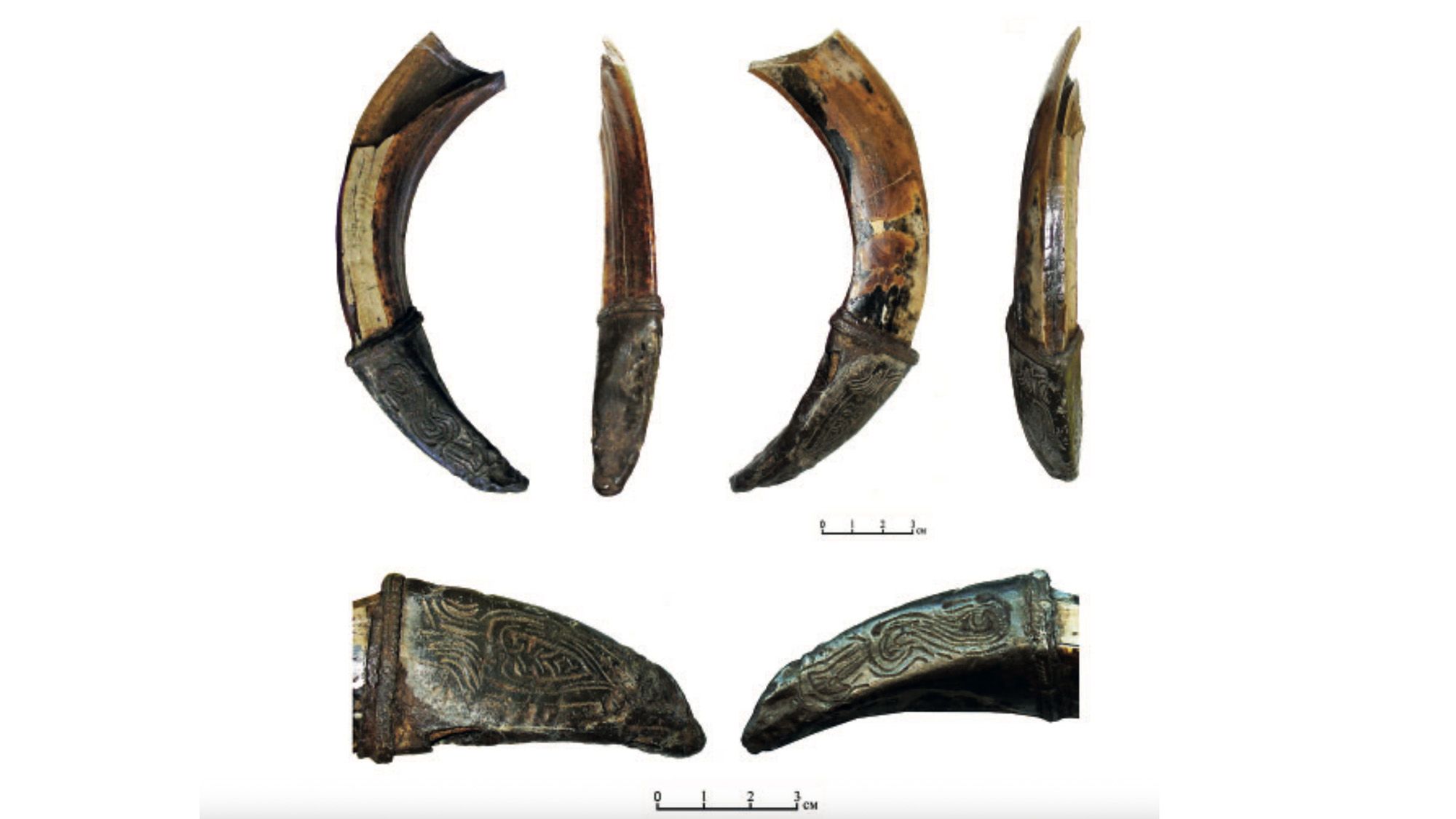
A remarkable discovery by Russian archaeologists reveals a rare medieval boar tusk, believed to have been utilized as a good luck charm by warriors and aristocrats, as reported by a recent study.
This extraordinary find, a large boar tusk adorned with a carved metal cap, dates back to the mid-12th to early 13th century and was unearthed in Novgorod the Great (also referred to as Veliky Novgorod), one of Russia’s oldest major cities. Notably, this amulet possesses a unique characteristic.
“Its size is extraordinary—very large,” says Natalia Eniosova, co-author of the study and a metallurgical scientist at the Faculty of Archaeology, Lomonosov Moscow State University. Although incomplete, the remaining tusk measures 3.9 inches (10 cm) in length and 1.1 inches (2.8 cm) in diameter at its widest point. Analysis revealed that the tusk belonged to a wild boar, aged at least 8 years and weighing over 220 pounds (100 kg).
Latest videos from
“It is unlikely that animals of this size were hunted for food,” Eniosova explained, noting that domestic pigs were a more practical food source during the period. The wild boar may have been consumed, but the researchers remain uncertain.
Another intriguing aspect of this amulet is its mount. Initially believed to be silver, Eniosova discovered it is nearly 100% tin, an alloy of tin and lead that simulates silver. Although tin wasn’t as valuable as silver, it was still relatively rare due to the limited sources in Europe at that time.
Close-up of the tin mount and its intricate decoration.
(Image credit: Tyanina EA et al., Archeology of the Volga River Region (2026))
Eniosova expressed fascination over the soft material used for the sculptural decoration. “Creating such ornamentation could not have been easy; it is indeed an intricately crafted item,” she remarked. “It exemplifies exceptional artistry.”
These unique characteristics align with artifacts discovered in the excavation site of Troitsky XVI, an area where affluent individuals resided. Eniosova suggested that this tusk might be a hunting trophy belonging to a noble, aristocrat, or military leader.
Get the world’s most fascinating discoveries delivered straight to your inbox.
According to a recently published study in the journal Archeology of the Volga region, historical accounts suggest that boar hunting in medieval Russia was exclusive to the “druzhna” (military retinues) and nobility. Regardless of whether the boar was eaten, its tusks were often extracted and metal-mounted. The researchers hypothesize it served as a talisman, particularly given its impressive size.
“These tusks likely acted as military or hunting talismans,” the researchers stated in their findings. “They conveyed the physical prowess of the beast to the hunter and symbolized good fortune.”
Eniosova observed that similar animal amulets featuring a hole for wearing as necklaces were prevalent in Novgorod during this era. The newly excavated boar tusk, though missing the top, may have once contained a hole.
An enlarged view of the intricate decoration carved into the boar’s tusk base.
(Image credit: Tyanina EA et al., Archeology of the Volga River Region (2026))
While boar tusk amulets were prevalent in earlier centuries, their rarity increased from the late 11th to early 13th centuries despite a continued belief in their magical properties.
Eniosova suggested the amulet might have ties to Scandinavian mythology, as early settlers of Veliky Novgorod came from that region. However, since the amulet was crafted over 150 years after their departure, she noted that this connection remains speculative.
Veliky Novgorod first appeared in historical documents from the 9th century and served as a significant trade hub during the era of the medieval Kievan Rus. Eniosova indicated that the city hosted landowners and those participating in the fur trade around the time the boar tusk amulets were made.
This remarkable discovery is “a very important and unusual find,” according to Alexei Gippius, a philologist at HSE University in Moscow who is acquainted with Novgorod archaeology.
Gippius noted that the study “illuminates the origins and significance of mythical beliefs held by the early elite of the Rus’.”
Археология, П. (n.d.). A boar’s tusk in a metal mount from the excavations of Troitsky XVI in Veliky Novgorod: a comprehensive study. Поволжская Археология.