


Ancient Asteroid Impact Created a 100-Meter Tsunami in the North Sea
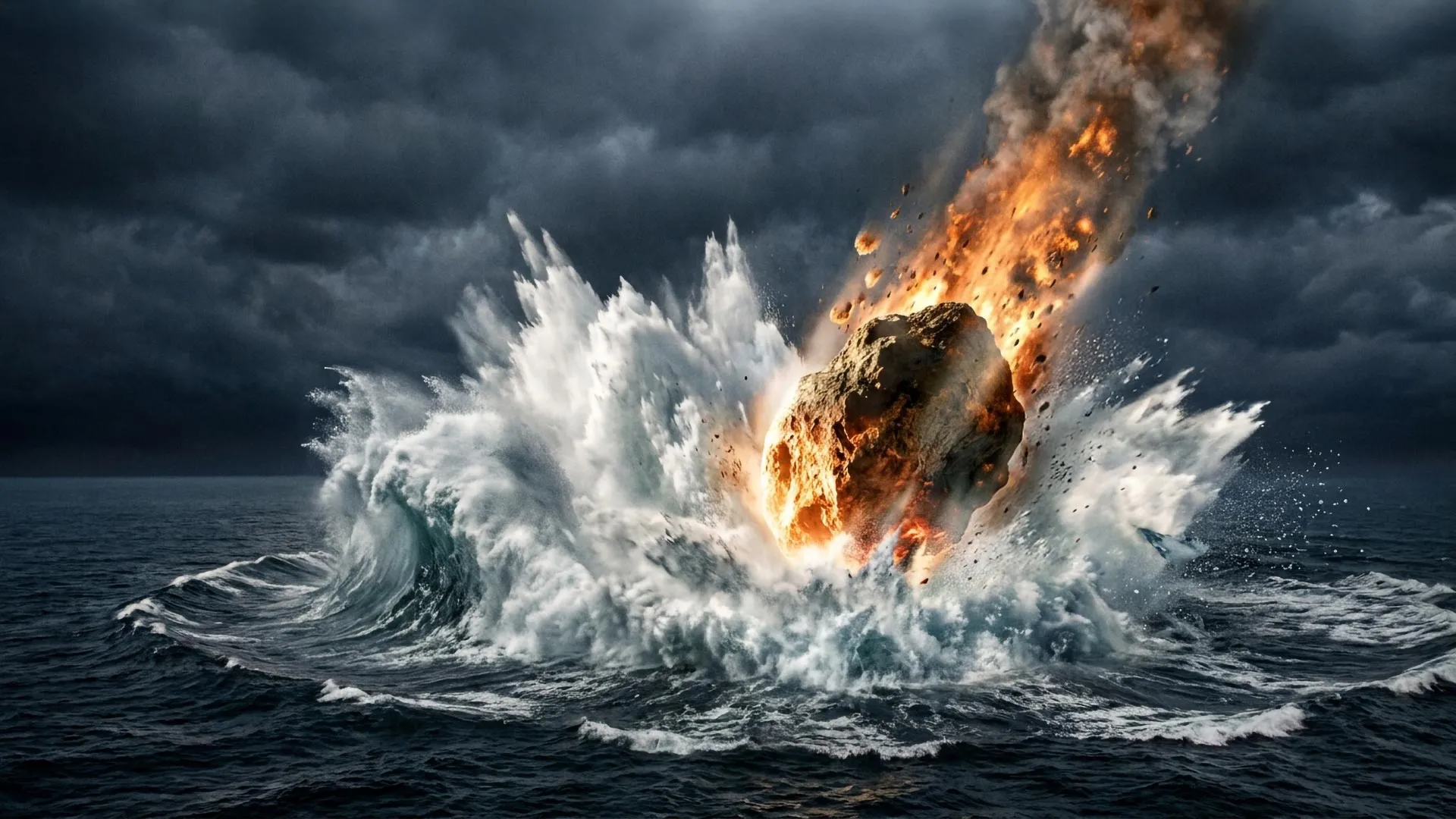
About 43 to 46 million years ago, a giant asteroid crashed into the North Sea and triggered a tsunami more than 100 meters (330 feet) high. After more than two decades of scientific debate, researchers have found convincing evidence that the impact created the buried Silverpit Crater.
The collision formed a huge geological structure deep beneath the ocean floor. Scientists first identified Silverpit Crater in 2002, but its origin remained controversial. Some researchers argued that geological processes, rather than an object from space, had created the formation.
A research team led by Dr. Wisdeen Nicholson of Heriot-Watt University in Edinburgh has now provided the strongest evidence yet that Silverpit Crater was formed by an asteroid or comet. By combining advanced seismic images, microscopic examinations of rock samples, and computer simulations, the scientists reconstructed the violent event and identified minerals formed under extraordinary pressure.
The study, published in Nature Communications, establishes Silverpit as one of the relatively few confirmed impact craters on Earth.
Where is Silverpit Crater?
Silverpit Crater lies about 700 meters below the ocean floor in the southern North Sea, approximately 130 miles off the coast of Yorkshire, England. The crater is about 3 kilometers in diameter and is surrounded by a wider circular fault zone measuring roughly 20 kilometers across.
A circular fault is a fracture in rock where movement has occurred. When scientists identified the formation in 2002, several features suggested that it had been created by a high-velocity collision with an asteroid or comet.
Its nearly circular shape, raised central peak, and surrounding ring of faults resembled structures found at other confirmed impact sites. A central peak can form when compressed rock rebounds upward after a powerful impact, similar to the way water rises in the center after an object splashes into a pool.
However, not all geologists accepted the impact explanation.
Some argued that the unusual landform was caused by underground salt deposits shifting and deforming the rock layers above them. Another theory suggested that volcanic activity caused part of the ocean floor to collapse, creating a structure that resembled an impact crater.
The disagreement continued for years. In 2009, geologists even voted on competing explanations, as described in the journal Geoscientist. Most participants rejected the asteroid-impact hypothesis.
Shocked minerals confirm an ancient asteroid impact
The latest research combines newly available seismic images with microscopic evidence recovered from beneath the ocean floor.
Seismic imaging allows geologists to investigate hidden underground structures by analyzing how sound waves travel through different rock layers. The technique can reveal buried faults, craters, and other formations that cannot be seen directly.
Using improved seismic data, Nicholson and his colleagues examined Silverpit’s internal structure in unprecedented detail. The most conclusive evidence, however, came from tiny mineral crystals in rock samples taken from oil wells near the crater.
Dr. Wisdeen Nicholson, a sedimentologist at Heriot-Watt University’s School of Energy, Earth Sciences, Infrastructure and Society, said:
“The new seismic images provide unprecedented observations of the crater.
“Samples taken from oil wells in the area also revealed rare ‘shocked’ quartz and feldspar crystals at the same depth as the crater floor.
“We were very lucky to find these. It was a real ‘needle in a haystack’ effort. They proved the impact crater hypothesis beyond any doubt, because they have structures that can only be created by extreme impact pressures.”
Shocked minerals are important evidence because their internal crystal structures have been altered by enormous pressure. These changes can occur when an asteroid strikes at great speed and generates a powerful shock wave through the surrounding rock.
Normal geological processes cannot usually produce these distinctive microscopic features. Their discovery at the same depth as the crater floor provides strong physical evidence that a violent impact occurred.
A 160-meter asteroid created a massive tsunami
After establishing the crater’s origin, the researchers used numerical modeling—a computer simulation based on the laws of physics—to recreate the impact.
The results suggest that an asteroid approximately 160 meters in diameter approached from the west and struck the ocean floor at a shallow angle.
Although it was much smaller than the asteroid associated with the extinction of the dinosaurs, an object of this size can still release enormous energy when traveling at cosmic speeds.
According to the simulations, the collision displaced huge amounts of rock and seawater. It created a towering curtain of debris that later collapsed back into the ocean.
Dr. Nicholson said:
“Our evidence shows that a 160-meter-wide asteroid hit the ocean floor at a low angle from the west.
“Within minutes, a 1.5-kilometer-high curtain of rock and water formed, which collapsed into the sea, creating a tsunami over 100 meters high.”
The impact sent material nearly a mile into the air before it fell back into the ocean, generating a tsunami higher than a 30-story building.
Unlike regular wind-driven waves, tsunamis involve the movement of vast amounts of water. They typically occur when water is suddenly displaced by an earthquake, underwater landslide, or asteroid impact.
The estimated height of the Silverpit tsunami comes from computer modeling rather than direct observations. Nevertheless, the reconstruction demonstrates how destructive even relatively small asteroids can be when they strike the ocean.
Decades-long scientific debate finally resolved
For Professor Gareth Collins of Imperial College London, the discovery concludes a controversy he had witnessed firsthand.
Collins participated in the 2009 debate over Silverpit’s origin and contributed to the numerical simulations used in the new study.
“I have always thought that the impact hypothesis is the simplest explanation and the one that is most consistent with observations,” Professor Collins said.
“It’s extremely rewarding to finally have found the silver bullet. With our amazing new data, we can now begin the exciting work of learning more about how impacts shape the planet below the surface, something that is very difficult to do on other planets.”
The findings do more than settle an old scientific debate. Silverpit provides researchers with a rare opportunity to study the subsurface damage caused by a high-velocity asteroid impact.
Most of the crater’s structures are buried and well preserved. This allows scientists to examine how the surrounding geological formations were destroyed, displaced, and reformed by the collision.
The observations could also help researchers interpret impact structures on other worlds, where it is often much more difficult to study the effects of impacts below the surface.
Why Silverpit Crater matters
Earth has experienced countless asteroid and comet impacts throughout its history, but relatively few recognizable craters remain.
Weathering, erosion, sediment deposition, and plate tectonics continually reshape the planet’s surface. Over millions of years, these processes can wear away, bury, or completely destroy evidence of ancient collisions.
That makes exceptionally well-preserved impact sites such as Silverpit especially valuable to scientists.
“Silverpit is a rare and exceptionally preserved hypervelocity impact crater,” Dr. Nicholson said.
“These phenomena are rare because Earth is a very dynamic planet. Plate tectonics and erosion destroy almost all traces of most of these phenomena.
“About 200 impact craters have been found on land, but only about 33 have been found on the ocean floor.
“These discoveries can be used not only to understand how asteroid impacts have shaped our planet throughout history, but also to predict what will happen if there is an asteroid impact in the future.”
Hypervelocity impacts occur when objects collide at extremely high speeds, typically several kilometers per second. At those speeds, an asteroid only a few hundred meters across can release devastating amounts of energy.
Silverpit now joins a small group of important submerged impact structures, including Mexico’s Chicxulub Crater, which is associated with the mass extinction that wiped out the nonavian dinosaurs, and Nadir Crater off the coast of West Africa, another recently identified asteroid impact site.
Together, these craters show that cosmic impacts have played a powerful role in shaping Earth’s geological and biological history.
By studying Silverpit’s well-preserved features, scientists hope to better understand what happens when an asteroid hits the ocean, how surrounding rocks respond, and what similar events could mean for Earth in the future.
This research was funded by the Natural Environment Research Council (NERC).
Source: www.sciencedaily.com