


1,200-Year-Old Peruvian Hairless Dog Mummy Reveals Ancient Wari Animal Traditions
Archaeologists excavating an ancient burial site in Peru have discovered surprising evidence of hairless dogs that lived more than 1,200 years ago, centuries before the rise of the Inca Empire. Naturally mummified remains, unusual skeletal features and chemical clues about the animals’ diets reveal how some dogs may have been bred, fed and treated by people in the Wari Empire.
The Peruvian Hairless Dog is a distinctive indigenous breed with a slender body, pointed ears and little or no hair. Dogs resembling the breed frequently appear in pottery created by ancient societies along Peru’s Andean coast. A modern variation is recognized by the American Kennel Club as the Peruvian Inca Orchid.
The dog is also an important national symbol in Peru and was officially designated as part of the country’s cultural heritage in 2000.
Research published in the Journal of Human Archeology reports the first physical evidence of Peruvian hairless dogs at Castillo de Huarme, the only known Wari Empire site discovered so far on Peru’s north coast.
Ancient dog remains discovered at a Wari Empire site
Located about 300 miles north of Lima, Castillo de Huarme covers approximately 110 acres. The site once served as an administrative and burial center of the Wari Empire and was occupied between 600 and 1050 AD—about 400 years before the rise of the Inca Empire.
Several major archaeological discoveries have already been made at Castillo de Huarme. In 2012, researchers discovered the first undisturbed tomb of the Wari elite. The tomb contained the remains of 58 high-ranking women, six human sacrifices and approximately 1,300 artifacts.
In 2022, archaeologists identified the nearby burial site of an elite craftsman accompanied by gold, silver and bronze tools. Together, these discoveries have helped researchers understand how the Wari Empire governed its territory.
The newly examined dog remains offer a different perspective, providing clues about daily life and the complex relationships between humans and animals at the site.
“Our findings show that humans and dogs coexisted at this Wari site, but their bonds are difficult to reconstruct because past emotions are difficult to capture with archaeological methods,” said lead author Weronika Tomczyk, a research fellow in Dartmouth College’s anthropology department and a postdoctoral fellow in the Ecology, Evolution, Environment, and Society Program.
“The aim of our study was not only to present data on dog burials in Castillo de Huarme, but also to highlight that, just as in the present, people in the past often had contradictory relationships with animals: a pet for one group of people could at the same time be considered a pest for their closest neighbors.”
A naturally mummified hairless dog preserved in the Peruvian desert
Castillo de Huarme lies in an extremely arid region along Peru’s Pacific coast. The desert’s exceptionally dry conditions helped preserve materials that would normally deteriorate, including hair, bones, clothing, leather, pigments and decorated pottery.
Artifacts from the site include a rare ceramic vessel showing a seated Peruvian hairless dog with human-like features. The animal appears to be holding an object resembling a musical instrument.
Excavations conducted between 2010 and 2025 also uncovered numerous remains of South American camelids, probably domesticated llamas and alpacas. Some items appear to have been placed as funeral offerings, while others seem to have been discarded as waste.
Researchers also recovered the remains of several dogs, although interpreting the discoveries was complicated by extensive damage and looting. A powerful earthquake in 1970 caused parts of Castillo de Huarme to collapse, exposing burial chambers filled with pottery and other valuable objects. Looters subsequently damaged much of the complex.
The deeper archaeological layers remained undisturbed, preserving their original Wari context. The upper layer, where many of the animal carcasses were discovered, contained mixed materials.
During excavations in the northern section of the site’s main ceremonial area, archaeologists identified three notable sets of dog remains.
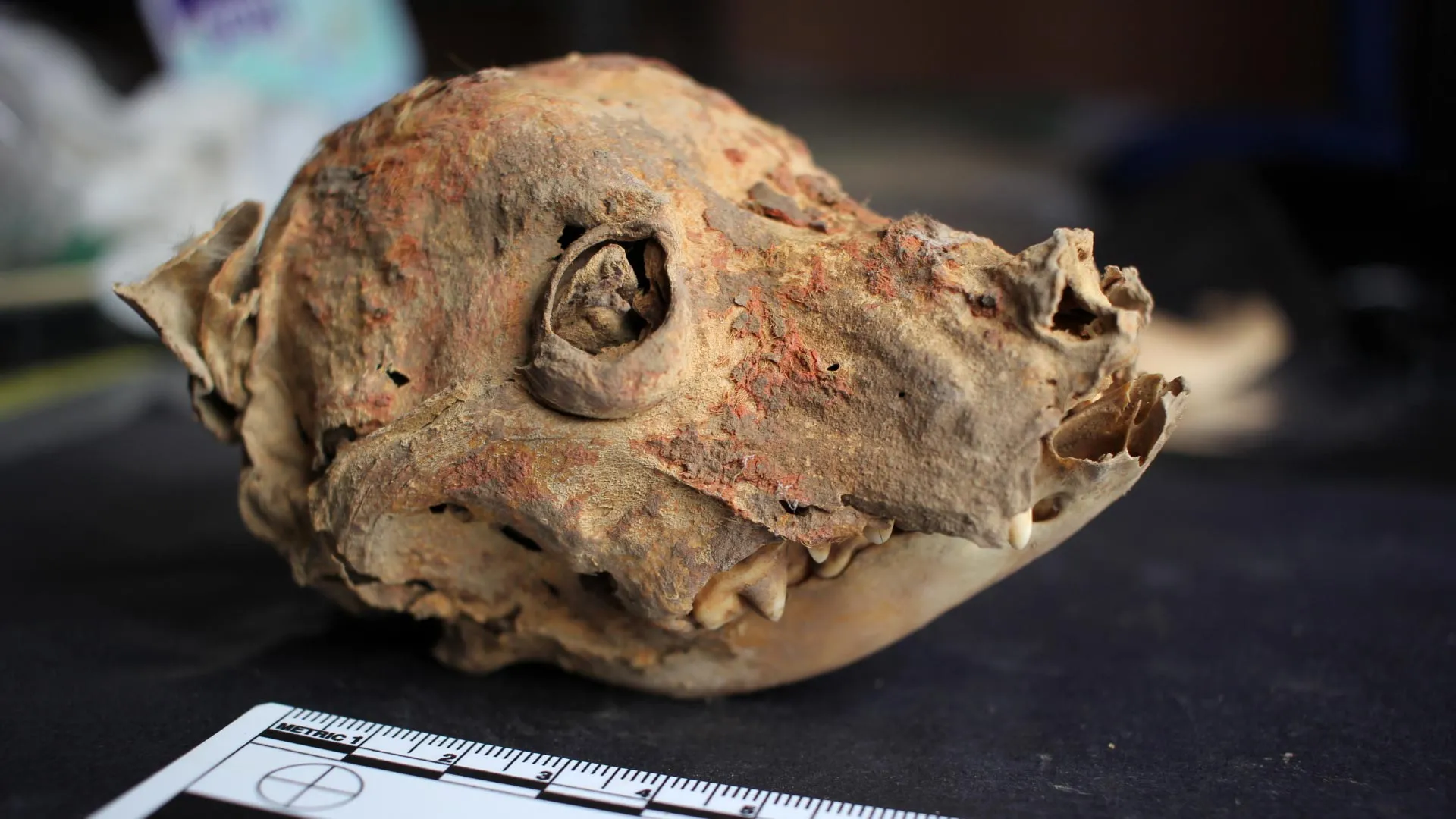
One was a naturally mummified skull with hairless skin and attached ears still visible. The skull had been colored with cinnabar, a bright red pigment commonly used in ancient Peruvian funerary traditions.
Researchers also found the skull of a second, larger dog and the nearly complete skeleton of a naturally mummified male dog buried in a shallow pit. Only the lower portions of the forelimbs were missing.
At first, researchers believed the mummified dog might have been buried relatively recently, perhaps around 50 years ago during the period of looting. However, Tomczyk noticed two important features: the animals had no hair, and all three lacked their first premolars.
Missing teeth helped identify ancient Peruvian hairless dogs
The missing teeth provided an unexpected clue to the dogs’ identities.
“What I noticed was that some of the dogs’ bones were missing teeth, and it wasn’t like they lost teeth during their lifetime,” Tomczyk said. “Some of the teeth, especially the first premolars and sometimes the last molars, just never came in. And we found in the literature that the same gene that causes hairlessness in dogs is responsible for the reduced number of teeth. This indicates that these are hairless dogs from Peru.”
The reduced number of teeth was therefore not necessarily caused by injury, disease or old age. Instead, it was linked to the same genetic trait responsible for hairlessness.
This biological association helped establish that the remains belonged to Peruvian hairless dogs rather than to other ancient dog populations.
To investigate the animals further, researchers used standard zooarchaeological techniques to estimate their ages and examine their physical characteristics. They also analyzed chemical traces preserved in the dogs’ bones and teeth.
This process, known as isotopic analysis, can reveal information about what animals ate and drank, as well as where they lived. The researchers examined isotopes of carbon, nitrogen, oxygen and strontium.
Different forms of these elements can preserve clues about diet and environmental conditions. Strontium is especially useful because its composition varies according to local geology, helping scientists investigate the geographic origins and movements of animals.
The researchers compared the results with similar measurements from human and camelid remains recovered at Castillo de Huarme.
“Isotope analysis of a dog’s teeth gives a signal of its life as a puppy, because a dog’s teeth grow very early, and the bones give a signal of more or less the last years of the dog’s life,” Tomczyk said. “Such a sampling strategy was aimed at providing signals from different stages of the dog’s life.”
Puppies were buried with elite members of Wari society
The excavation yielded 341 dog bone specimens representing at least 19 dogs, in addition to the complete mummified male dog.
Some remains were found in particularly significant burial contexts. The bones of a puppy estimated to be between 6 and 8 weeks old were discovered beside an elite craftsman known as the “Master Basket Maker.” Archaeologists also found the bones of an adult dog buried within the ruins of the palace.
Part of a puppy’s skeleton was found with a man identified as XY, who was probably sacrificed to serve as a tomb guard.
Most of the dogs were adults when they died, but their remains suggest that the animals did not all receive the same treatment. Some appear to have been intentionally buried, possibly reflecting a special role in Wari society. Others were found among discarded materials.
Only a few bones showed signs of slaughter, suggesting that dogs were not commonly consumed as food at the site.
Radiocarbon dating produced another important result. The fully mummified male dog was at least 1,200 years old, making it the oldest radiocarbon-dated specimen ever recovered from Castillo de Huarme.
The finding also provides an additional reference point for determining the age of the archaeological site.
Ancient hairless dogs may have shared the human diet
Isotopic evidence revealed striking similarities between the diets of some dogs and the people who lived at Castillo de Huarme.
Most of the dogs consumed at least some corn, or maize, a major food source throughout the pre-Hispanic Andes. Their diets therefore overlapped with those of humans.
A particularly interesting pattern appeared among the dogs believed to be hairless. When they were puppies, their diets likely resembled those of human children. As they grew older, their food sources became more diverse.
This pattern suggests that some puppies may have received special attention or been kept under controlled conditions, possibly as part of organized breeding practices.
“We don’t know if the dogs were intentionally fed corn or if they were just eating leftovers or garbage,” Tomczyk said. “However, the unique dietary patterns of hairless puppies provide insight into the possibility that systematic breeding may have taken place.”
Researchers emphasize that archaeological evidence cannot determine whether the dogs were beloved pets, working animals or served other purposes in Wari society.
Even so, differences in burial methods, physical characteristics and diets suggest that Peruvian hairless dogs occupied a distinctive position within the community.
“We’ll never know if the three dogs were pets or how people treated them, but it’s clear they were treated differently than other dogs,” Tomczyk said.
The discovery offers a rare glimpse into the lives of dogs and humans more than 1,000 years ago. It also shows that relationships between ancient societies and animals may have been as varied and complex as they are today.
Co-authors of the study include Miłosz Giersz, Wiesław Wienkowski and Roberto Pimentel Nita of the University of Warsaw, and Claire Evert of the University of Pittsburgh.
Source: www.sciencedaily.com