


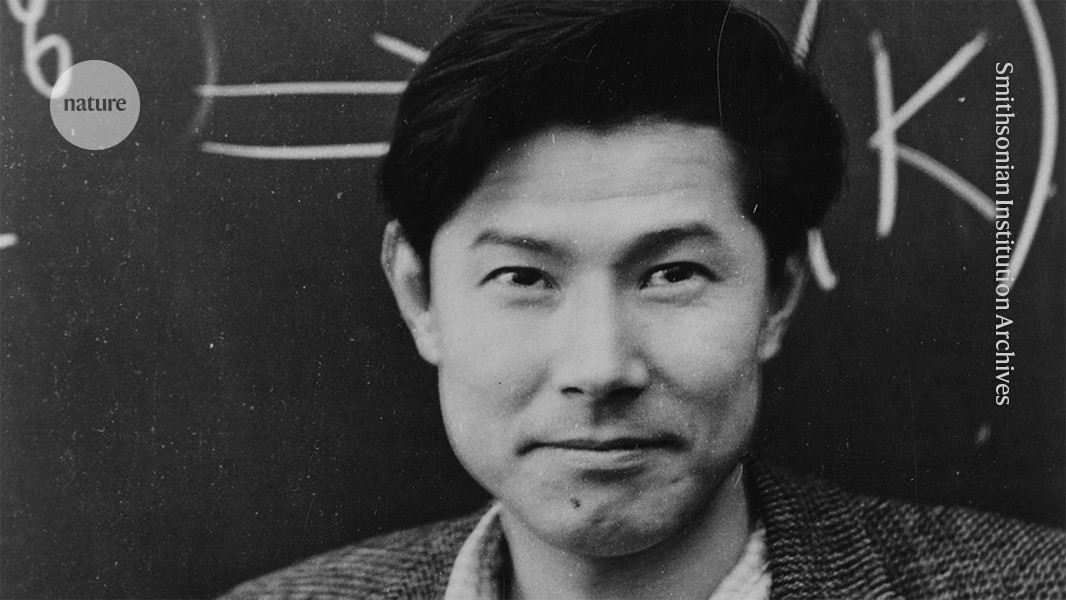
Credit: Smithsonian Institution Archives
Heisuke Hironaka, a pioneering mathematician in algebraic geometry, was best known for proving the resolution of singularities in 1964. His groundbreaking work established a way to transform complex geometric objects containing cusps, spikes and self-intersections into smoother forms. The result became a fundamental tool in modern mathematics and continues to influence research across numerous fields. Hironaka died at the age of 94.
The length and depth of Hironaka’s 1964 proof astonished mathematicians. He received the Fields Medal in 1970 for this achievement. Alexander Grothendieck, who was also awarded a Fields Medal in 1966 and served as one of Hironaka’s mentors, described the proof as “without a doubt one of the most difficult and most monumental proofs known to mathematics.”
Hironaka was born in Yamaguchi Prefecture, Japan, and grew up as one of 15 children. His father had hoped to pursue scholarship but instead took over the family textile business. On 6 August 1945, the atomic bomb was dropped on nearby Hiroshima. The Hironaka family lived roughly 100 kilometres away and was protected from the worst effects of the radiation.
How to prevent AI from negatively impacting mathematics
As a student at Kyoto University in the 1950s, Hironaka immersed himself in algebra. “But algebra itself is too abstract to be conveyed to the human mind,” he said in a 2005 interview. He became particularly interested in the connection between algebra and geometry through the work of Oscar Zariski, a leading figure in algebraic geometry who visited Kyoto in 1956. Zariski, a professor at Harvard University in Cambridge, Massachusetts, encouraged Hironaka to join him in the United States. Hironaka completed his doctorate at Harvard in 1960 under Zariski’s supervision.
Hironaka was also influenced by fellow students Michael Artin, Stephen Kleiman and David Mumford, all of whom later became prominent algebraic geometers. Alexander Grothendieck, who reshaped the foundations of algebraic geometry during the following decade, was another important influence. Grothendieck visited Harvard in 1958 and invited Hironaka to spend the 1959–1960 academic year at the Institute for Advanced Study near Paris.
Hironaka later held academic positions at Brandeis University in Waltham, Massachusetts, and Columbia University in New York City. He joined Harvard University as a professor in 1968. In 1975, he returned to Japan to become a professor at the Research Institute for Mathematical Sciences at Kyoto University. Although he retired from Kyoto in 1991, he continued contributing to education and public service, including serving as president of Yamaguchi University from 1996 to 2002.
Hironaka’s research focused on polynomials, mathematical expressions that describe relationships between numbers. The solutions to systems of polynomial equations form structures known as algebraic varieties. When represented geometrically, these varieties can be smooth, like a parabola or sphere, or they can contain singularities, such as sharp points, cusps and self-intersections.
“Singularities are everywhere,” Hironaka once said. “When you write a signature, without crossings or sharp points, it’s just a squiggly line.” He added: “If everything were smooth sailing, there would be no novels or movies. Singularities are what make the world so interesting.”
Source: www.nature.com