


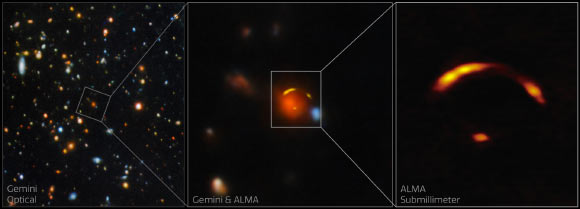
The dusty starburst galaxy JCMT0402-0424, situated approximately 11 billion light-years away, has emerged as a leading candidate for the origin of the high-energy neutrino event IC 210922A, according to a research team led by Yuji Urata from MITOS Science Co.
The astronomical link between dusty galaxies (with redshifts around z ≈ 1 to 4) and high-energy neutrinos remains obscure. Urata et al. report that JCMT0402-0424, a compact-core dusty star-forming galaxy at z = 2.988, lies within the 90% containment region of IceCube event IC 210922A, highlighting its potential significance. Image credits: International Gemini Observatory / NOIRLab / NSF / AURA / ALMA / ESO / NAOJ / NRAO / University of Alaska Anchorage TA Chancellor and NSF’s NOIRLab / D. de Martin and M. Zamani, NSF’s NOIRLab / Yuji Urata Mythos Science, Inc.
In 2021, the NSF’s IceCube Neutrino Observatory in Antarctica identified the high-energy neutrino event IC 210922A originating from the Eridanus constellation, prompting an urgent call for follow-up investigations.
This alert spurred observations across multiple wavelengths, aimed at identifying a corresponding signal to trace back the neutrino source.
Various research teams employed diverse telescopes and instruments for follow-up studies.
Despite extensive efforts, none detected convincing gamma-ray counterparts.
Days after the initial alert, Dr. Urata and his colleagues began studies using the James Clerk Maxwell Telescope (JCMT) and the Submillimeter Array (SMA), where they identified the star-forming galaxy JCMT0402-0424. Its position and luminosity rendered it a leading candidate for the neutrino source.
Further investigations with the Atacama Large Millimeter/Submillimeter Array (ALMA) revealed that this galaxy, referred to as Shadow Blaster, was magnified by a powerful gravitational lens.
This lensing phenomenon allows astronomers to dissect the structure of distant galaxies that would otherwise be too faint and distant for detailed observation.
However, to accurately utilize the lensing effect and gauge the extent of the neutrino signal amplification, researchers first needed to ascertain the lens galaxy’s distance, nature, and mass distribution.
To achieve this, astronomers utilized two advanced instruments on the Gemini North telescope: the Gemini Multi-Object Spectrograph (GMOS) and the Gemini Near-Infrared Spectrometer (GNIRS).
“Merging GMOS and GNIRS data enabled us to determine that the lens galaxy is a giant elliptical galaxy,” Dr. Urata explained.
“This insight was pivotal for estimating the mass distribution of the lens and crafting a gravitational lensing model.”
Approximately 10 billion years ago, galaxies akin to JCMT0402-0424 vigorously formed stars.
At this epoch, these galaxies theoretically generated substantial amounts of cosmic rays, which can produce neutrinos.
Nonetheless, due to their significant distance and obscuration by dense dust, acquiring observational evidence linking individual neutrino events to such galaxies has been a daunting challenge.
Fortunately, JCMT0402-0424’s unique positioning behind a gravitational lens facilitates this scientific inquiry.
“Shadow Blaster boasts a dense, gas-rich environment conducive to the production of high-energy neutrinos,” Dr. Urata remarked.
“Given the absence of a more compelling counterpart despite extensive follow-up, Shadow Blaster appears to be the most probable source of IC 210922A.”
“If validated, Shadow Blaster would be the first dusty star-forming galaxy directly linked to a high-energy neutrino event.”
Many compact star-forming galaxies similar to Shadow Blaster may proliferate throughout the universe.
Collectively, they could constitute a significant fraction of the high-energy neutrino background permeating the cosmos.
“Our findings suggest that this galaxy population could account for about 20% of the observed diffuse neutrino background recorded by IceCube,” Dr. Urata concluded.
For comprehensive insights, refer to the study published in Nature Astronomy today.
_____
Yuya Urata et al. The relationship between compact dusty starbursts during cosmic noon and their association with high-energy neutrinos. Nat Astron, published online June 17, 2026. doi: 10.1038/s41550-026-02884-9
Source: www.sci.news