


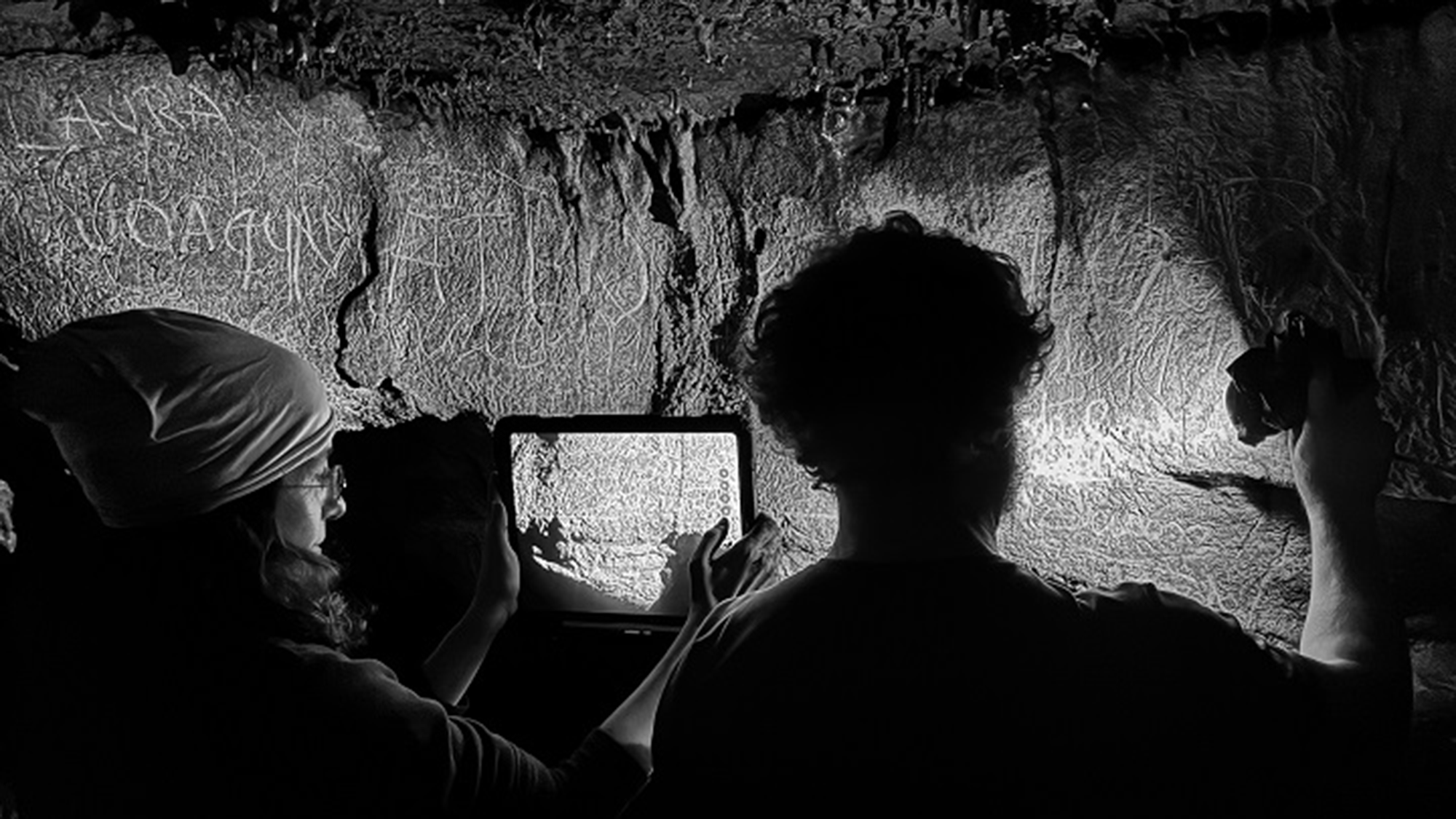
Archaeologists have uncovered more than 120 Latin inscriptions inside an underground Roman sanctuary at Cova de les Dones, or Women’s Cave, in eastern Spain. The discovery represents the largest known concentration of Roman inscriptions in a cave sanctuary anywhere in the Roman Empire. Five of the inscriptions refer to a previously unknown goddess known simply as Domina, meaning “The Lady.”
Researchers documented the inscriptions during excavations in 2026 at Cova de les Dones, near Valencia on Spain’s eastern coast. The findings dramatically expand the number of known Roman-era texts at the site, rising from the 15 inscriptions first recorded in 2024.
Most of the inscriptions date to the first and second centuries A.D. They were carved into the walls and ceiling of a deep chamber inside the cave, an area archaeologists have identified as an organized Roman sanctuary.
“The fact that the documents are concentrated in a specific, delimited area away from the cave entrance confirms that it is an organized cult,” Sergio Garcia-Dils, an archaeologist and speleologist from Spain’s National University of Correspondence in Seville, said in a translated statement.
from the latest videoslive science
Researchers believe the cave was used for a religious cult centered on a mysterious goddess worshiped under the name Domina, or “The Lady.”
Who was the Roman goddess known as “The Lady”?
Two inscriptions inside Cova de les Dones identify the goddess as “Domina,” or “The Lady.”
Image source: University of Alicante
A closer analysis of the inscriptions is beginning to reveal more about the unknown deity. Five texts mention Domina, while three also include the name “Marasi,” which may have been an adjective or epithet describing the goddess.
“There are certain aspects of this goddess that are probably related to water, and we are currently working on their final interpretation,” Sylvia Alfaie, a professor of ancient history at the University of Zaragoza in Spain, said in a statement.
The Roman sanctuary contains natural pools that collect groundwater. Visitors may have placed offerings in or near these pools, although archaeologists have not yet determined whether the offerings were dedicated specifically to Domina or to other deities.
Artifacts reveal women’s role in the Roman cave cult
Archaeologists also recovered a chalice-shaped vessel, two rings, a bracelet, pottery fragments, plant remains and other artifacts from the cave. Together with the inscriptions, these objects suggest that women played an active role in the sanctuary’s rituals.
Several inscriptions include women’s names. Researchers also found numerous spindle whorls, objects commonly associated with textile production in the ancient world. The evidence indicates that women may have participated directly in ceremonies, textile-related practices and the presentation of offerings at Cova de les Dones.
Many of the newly recorded inscriptions have not yet been fully deciphered. Future analysis could provide additional information about Domina, the meaning of the name “Marasi” and the people who worshiped at the underground sanctuary.
Cova de les Dones has a much older archaeological history extending beyond the Roman period. Archaeologists have previously identified more than 100 Paleolithic paintings at the site, including carvings believed to be over 24,000 years old.
“Each new discovery suggests that Cova de les Dones was a landmark for human populations living in the area for thousands of years,” project coordinators said in a statement. The cave’s permanent water, unusual underground landscape and accessible location may have helped make it an important place for ritual activity across many periods of human history.
Can you match these historical maps with the empires that ruled them? Test your geography skills with our ancient empire quiz!
Source: www.livescience.com