


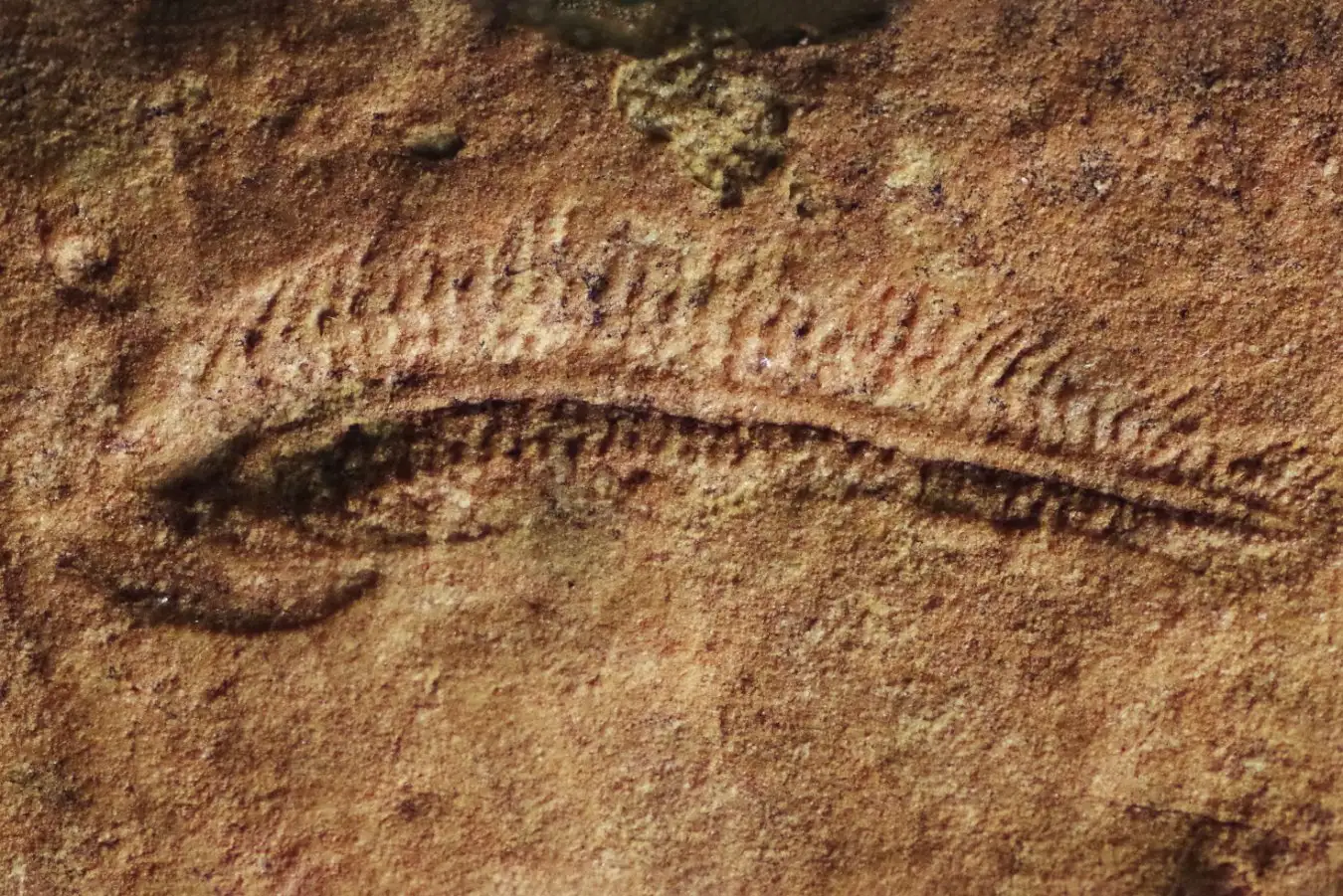

The right-turned Spriggina floundersi insect is preserved as a left-turned fossil.
Credit: Scott Evans/AMNH
A remarkable 555-million-year-old worm showcases a right-turning habit, potentially representing the earliest known instance of “handedness.”
Without limbs, these ancient creatures weren’t left or right-handed in the conventional sense. Yet, their preference indicates the presence of a complex nervous system.
This finding enhances our understanding of a nomadic lifestyle that continues today. Previously, such a trait was believed to emerge only during the Cambrian period, approximately 541 million years ago.
Scott Evans, a researcher at the American Museum of Natural History, along with colleagues, studied 100 fossilized specimens of the small flatworm-like creature, Spriggina floundersi, unearthed in South Australia over recent decades.
These organisms thrived during the Ediacaran period, marking a time when multicellular life flourished before the dramatic diversification of the Cambrian explosion.
Living in shallow seas around 500 million years ago, Spriggina foraged for food near the ocean floor, moving in a characteristic meandering fashion.
“We possess around 50 specimens. Spriggina is clearly curved,” Evans noted. Interestingly, there are twice as many fossilized specimens bending left compared to right. This suggests that the creature itself curved right, as the fossils mirror the animals buried in storm-induced sand.
“This trend appears statistically significant and aligns with contemporary biological research on handedness across species,” notes Evans. Some specimens exhibit bends on both sides, indicating a capability for flexible movement—crucial for avoiding circular paths.
While most appear right-handed, it’s challenging to conclude definitively about left-handedness. “It’s analogous to observing 100 people waving; it’s clear that more favor one hand, but their dominant side remains ambiguous,” he explains.
Such discoveries reveal that fundamental traits shared by numerous modern animals, including locomotion, bilateral symmetry, and handedness, began evolving during the Ediacaran period, claims Evans.
In the Cambrian era, these organisms developed further complexity, gaining legs for enhanced mobility, transitioning from alien-like forms to the major animal groups recognized today, as Evans elucidates. “This indicates that the Cambrian explosion, albeit significant, built upon pre-existing Ediacaran foundations.”
“The existence of handedness and various functional asymmetries deep within the fossil record sheds valuable light on the evolution of these behaviors and their historical emergence,” emphasizes Russell Bicknell from Flinders University in Adelaide, Australia.
Topic:
Source: www.newscientist.com