


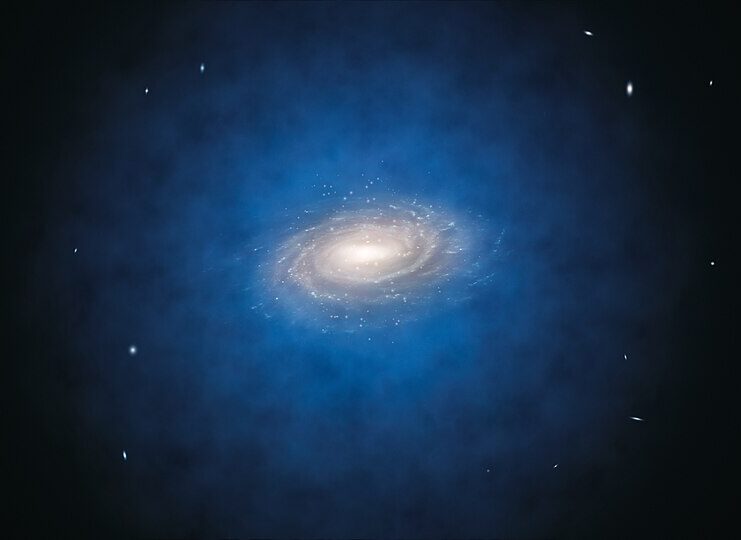
How Dark Matter Halos Shape the Size of Galaxies
In the 1970s, astronomer Vera Rubin analyzed observations showing how quickly different galaxies rotate. She discovered that galaxies were spinning much faster than expected based on the amount of visible matter detected through starlight. Rubin concluded that most of a galaxy’s mass must consist of an invisible form of matter.
Scientists now call this invisible substance dark matter. Although dark matter does not emit, absorb, or reflect light, it interacts through gravity. Observations indicate that dark matter moves much more slowly than light and accounts for roughly 85% of the matter in the universe. In an average galaxy, dark matter makes up most of the total mass.
What Is a Dark Matter Halo?
In the widely used cosmological model known as ΛCDM, pronounced “lambda-CDM,” dark matter played a major role in determining where galaxies formed. In the early universe, gravity caused dark matter to gather into dense regions before ordinary matter fully assembled. These structures created gravitational wells that attracted gas and other normal matter, eventually leading to the formation of galaxies, stars, and planets.
Today, dark matter and ordinary matter coexist within galaxies, although they are distributed differently. Ordinary matter tends to concentrate toward the center, forming the visible galactic disk. Dark matter extends much farther outward, surrounding the disk in a large structure called a dark matter halo. Because dark matter halos contain most of a galaxy’s mass, researchers Guangze Sun, Fangzhou Jiang, and Jing Wang used computer simulations to investigate how halo properties influence the size of galactic disks.
Simulating the Relationship Between Dark Matter and Galaxy Size
A more massive dark matter halo exerts a stronger gravitational pull and can attract more ordinary matter. To study this relationship, the researchers fixed the total mass of each simulated galaxy at 100 billion times the mass of the Sun. They then tested which dark matter halo properties produced the largest galactic disks.
The team examined four variables: the total density of dark matter in the halo, the dark matter density within the innermost 1% of the halo, the halo’s rotation rate, and the overall ratio of ordinary matter to dark matter. For each variable, they tested three or four values representing low, medium, and high conditions compared with a standard reference model. In total, the researchers ran 132 simulations to produce enough data for statistical analysis.
To model the complex physics of dark matter halos, the team used GIZMO, a simulation framework that models gravity, magnetic fields, and fluid dynamics. They combined it with FIRE-3, a model that simulates stellar explosions, metal production, and the heating and cooling of gas. The researchers ran each simulation for 3 billion model years and used the pynbody software to measure the radius of the simulated galaxy.
How Dark Matter Halo Properties Affect Galaxies
The simulations revealed that the rotation rate of a dark matter halo has a strong effect on galaxy size. When the halo rotated faster, the simulated galactic disk became larger, as shown in Scenario 1 below.
In Scenario 2, increasing the overall concentration of dark matter in the halo caused the central galaxy to shrink. Increasing only the dark matter density in the innermost region of the halo produced a weaker effect, but it generally reduced the size of the galactic disk, as shown in Scenario 3.
Finally, increasing the ratio of ordinary matter to dark matter made the galaxy smaller and caused stars to form closer to its center. This effect appears as a greater concentration of stars in Scenario 4.
This diagram summarizes the study’s four scenarios. The left column shows the baseline simulated galaxy, while the right column shows how the galaxy changed after researchers modified one dark matter halo property: 1) halo rotation speed, 2) total halo density, 3) inner halo density, or 4) the ratio of ordinary matter to dark matter. The dark matter halo is not drawn to scale and is represented by a red ring surrounding the galaxy. Illustration: Andrew Bizarre.
What the Findings Mean for Galaxy Formation
The results suggest a previously unrecognized connection between the properties of dark matter halos and the structure of galactic disks. In particular, a halo’s rotation rate, overall density, central concentration, and matter composition can influence how large a galaxy becomes and where its stars form.
However, the researchers noted that the simulations did not include every process that occurs in the real ΛCDM universe. Actual galaxies interact with one another, merge, and exchange gas and stars. The simulations instead modeled individual, isolated galaxies. In future research, the team plans to test galaxies surrounded by halos with different sizes, shapes, clumps, gaps, and other structural features.
Post views: 50
Source: sciworthy.com