


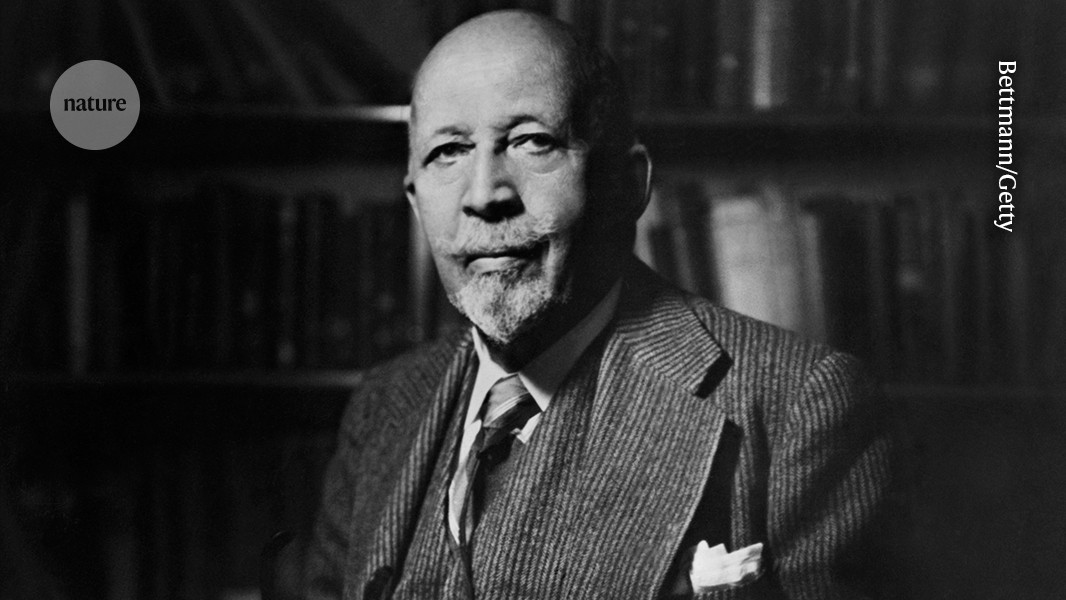
Civil rights activist W.E.B. Du BoisCredit: Bettman/Getty
In a 2026 book, humanist Jeffrey Galt Harpham traces two contrasting chapters in the history of scientific thinking about race: the 19th-century effort to classify humans into fixed biological groups, and the later research that challenged those ideas. His account shows how skull measurements, taxonomies and other supposedly objective methods were used to rationalize racism, but also how scholars eventually rejected biological race and reframed racial identity as social and cultural.
Harpham follows decades of work by scientists and scholars who tried to prove that humans belonged to distinct biological categories. They measured skulls and facial features, created systems for classifying people and developed hierarchies that ranked human groups.

Why Africans should tell the story of human origins
The first group of protagonists included the American anthropologist Josiah Nott and the French anthropologist Julien-Joseph Virey. They compared Black people’s skulls with those of monkeys and used claims about physical differences to place Black people at the bottom of a hierarchy of cultural worth. Harpham describes this as a myth constructed to conceal and justify racism.
The second story begins in 1900, when the direction of scientific debate began to change. Scholars published research challenging the oppressive theories of race scientists. The growing rejection of biological race came to represent a form of scientific self-correction.
These parallel histories illustrate both how science can be distorted and how flawed research can eventually be challenged by more reliable approaches. In the case of race, Harpham argues, inaccurate ideas persisted because they served political and social purposes.
Harpham guides readers through a large cast of figures and argues that this tragic period in science has a cautiously hopeful conclusion. As the natural sciences increasingly abandoned race as a biological reality, writers such as W.E.B. Du Bois recast race as a social and cultural identity, helping to promote solidarity among Black people.
A flawed system of classification
The confusion between race and species, and its enduring contribution to social divisions, can be traced in part to the Swedish naturalist Karl Linnaeus. His 1735 book Systema Naturae offered an impressive classification of living things for its time. But the system also raised questions about whether humans should be divided in ways similar to other species.
This field of research attracted considerable interest. Harpham writes that early race theorists such as Nott saw “an extraordinary opportunity to establish the capacity of empirical research and the scientific method to address problems of immediate national interest and importance, as well as those that would be valued by the nation.”

Physician Petrus Camper proposed that species could be distinguished by the angle between the jaw and forehead, a theory later used in scientific racism.Credit: Antiqua Print Gallery/Alamy
Nott took Linnaeus’s classification further, arguing that humans were not merely environmentally shaped varieties of a single family, but distinct, fixed species created separately by God. He claimed that interbreeding between “distant” races produced weak, disease-prone and infertile offspring. He also used mortality data to argue that Black Americans lived contented lives under chattel slavery in the South but died after gaining freedom in the colder northern cities.
Harpham presents Nott’s views as part of a broader intellectual movement rather than the isolated product of one man. In the 1830s, the American physician Samuel George Morton published work arguing that the size and shape of the skull reflected brain size and intellectual ability. Morton ranked cultures according to the average size of their skulls, placing whites at the top, followed by Mongolians, Malays, Native Americans and Ethiopians, a collective term he used for Black people, at the bottom.

How ‘systematic pillage and plunder’ drove Britain’s Second Scientific Revolution
Harpham emphasizes that these studies cannot be understood without the context of slavery. Nott and Morton both argued that the relationship between enslaved people and the physical characteristics associated with racial groups had remained unchanged since ancient Egypt. Their claims presented racial hierarchy as a permanent law of nature rather than a temporary social arrangement. At the time, the ideas attracted little opposition, in part because they served the interests of slaveholders and helped justify the system of slavery.
Source: www.nature.com