


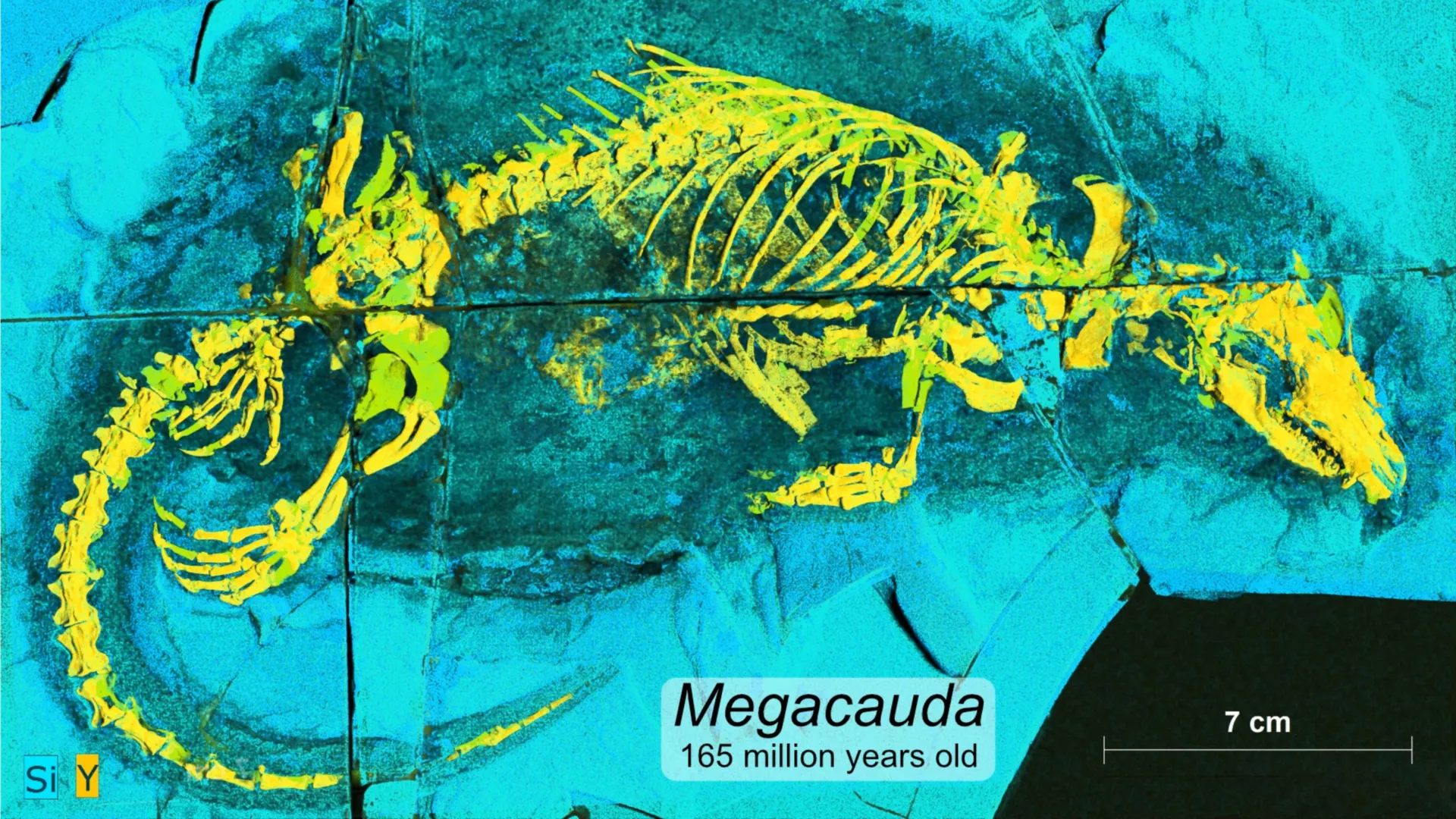
Megacauda sungei: How a 165-Million-Year-Old Aquatic Mammal Reveals the Evolution of Swallowing
A furry predator that lived 165 million years ago is giving scientists an unexpected glimpse into mammalian evolution. Known as Megacauda sungei, this ancient hunter measured about 0.5 meters (20 inches) from snout to tail, making it significantly larger than most of its Jurassic relatives.
The small predator hunted underwater and used teeth with backward-curving tips to seize slippery prey. However, its most important feature was hidden inside its mouth: evidence of a sophisticated soft palate that separated the mouth from the pharynx, the passageway connecting the mouth and throat.
This anatomical development may have allowed the animal to swallow while continuing to breathe—an essential adaptation for mammals raising their young. The findings, made by researchers from Shenyang, Chicago and Bonn, were published in the journal Nature.
How an ancient predator reveals the evolution of swallowing
Many animals lack a complex soft palate and instead rely on the relatively simple arrangement of the hyoid bone in the throat. Without the specialized swallowing mechanisms found in mammals, feeding can require very different movements.
Crocodiles, for example, lift their heads and use sudden jerking movements to force unbitten food down their throats.
“This is achieved with the help of gravity,” explains paleontologist Professor Thomas Martin of the University of Bonn.
Mammals have a more elaborate hyoid structure that allows them to swallow even when gravity is not helping. Humans, for example, can drink water through a straw while upside down and still continue breathing.
This ability played an important role in mammalian evolution. It allows young mammals to consume nutrient-rich milk safely while helping prevent liquid from entering the nasal passages. The adaptation provided major survival benefits by supporting effective nursing.
“This adaptation enabled the development of the brain that eventually led to humans,” Martin emphasizes. “The shape of the soft palate and the oral cavity and pharynx are directly related to mammalian evolution.”
Remarkably, Megacauda sungei provides evidence that this anatomical development existed millions of years before modern mammals appeared.
A 165-million-year-old predator built for swimming
With short fur and a wide, flat tail, Megacauda sungei may have looked somewhat similar to a modern otter, beaver or platypus. Its body was adapted for movement through water.
Scientists used computed tomography scans of the fossil to create detailed three-dimensional reconstructions of its anatomy. The models suggest that the animal propelled itself through the water by paddling with its front legs and undulating its tail. Its hind legs may have helped it change direction.
“This is the earliest evidence of aquatic life in mammals,” says the University of Bonn paleontologist.
The animal’s teeth revealed another unusual adaptation. Along with backward-curving tips that helped it catch aquatic prey, it had specialized canine teeth with three roots—a unique feature that surprised the researchers.
By comparing the fossil with other prehistoric specimens and living animals, the researchers determined that Megacauda sungei belonged to the docodontids, an extinct group of early mammalian relatives. Docodontids became especially widespread during the Jurassic Period.
The fossil was discovered in Xiayingzi, in China’s Inner Mongolia Autonomous Region.
The little giant of the dinosaur era
“The new species Megacauda sungei is the largest Jurassic mammal,” says Thomas Martin.
At about half a meter long and weighing approximately 2 kilograms, this prehistoric “apex predator” would seem small compared with modern giants such as elephants, rhinos and whales.
But in the Jurassic world, size was relative.
The Mesozoic Era lasted from about 230 million years ago to 66 million years ago and was dominated by dinosaurs. Early mammalian relatives generally remained small, with many weighing only a few grams.
Against that background, Megacauda sungei was unusually large. Although small by modern standards, this aquatic hunter was a giant among the early mammalian relatives that shared Earth with dinosaurs.
How the fossil was discovered in Inner Mongolia
The scientific importance of Megacauda sungei might never have been recognized without a series of fortunate events.
A few years ago, the Liaoning Provincial Museum of Paleontology in Shenyang, China, acquired the fossil after it had been excavated in Inner Mongolia. Its remarkable characteristics emerged when three scientists investigated the specimen together: Dr. Changfu Zhou of Shandong University in China, Dr. Zhe-Xi Luo of the University of Chicago in the United States, and Professor Thomas Martin of the University of Bonn.
After recognizing the specimen as a previously unknown species, the researchers decided to honor Professor Sun Ge, honorary director of the Liaoning Provincial Museum of Paleontology.
The scientific name combines the term for “big tail,” Megacauda, with the species designation sungei: Megacauda sungei.
Establishing the animal’s identity required years of detailed analysis, comparison, classification and documentation.
“This is the result of many years of teamwork,” says Thomas Martin.
What Megacauda sungei reveals about early mammalian evolution
The study provides important new insights into the early history of mammals, particularly how their ancestors developed specialized bodies and lifestyles.
Fossils of other Jurassic docodonts show that members of this group were already adapted to very different environments. Some lived in trees, while others, like moles, burrowed underground. Megacauda sungei was adapted to life underwater.
“This shows how widely distributed docodonts were in the Northern Hemisphere, and how this diverse group of animals developed very different lifestyles at an incredibly early stage,” Martin summarizes.
Taken together, these discoveries show that ancient mammals were already experimenting with different survival strategies long before modern mammals became dominant.
Source: www.sciencedaily.com