


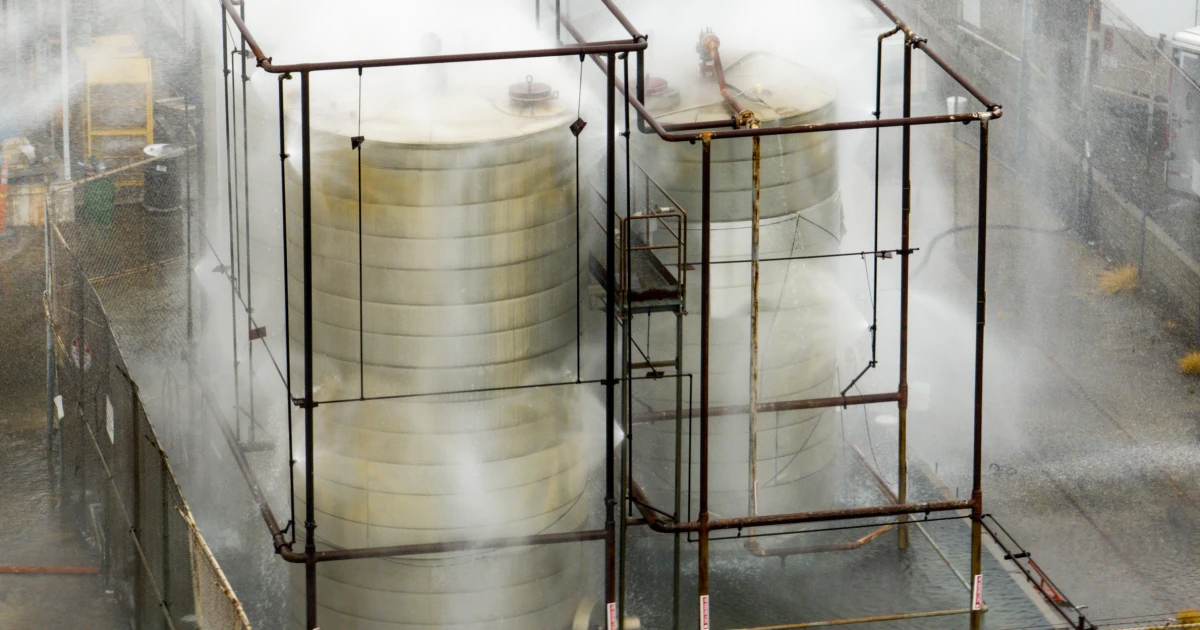
A chemical storage tank in Garden Grove, California, overheated due to a malfunctioning valve, raising alarms about a potential disaster that could release toxic plumes and destroy nearby buildings.
Subscribe to read this story without ads
Gain unlimited access to ad-free articles and exclusive content.

Since Thursday, officials in Southern California, alongside state and federal agencies, have been working tirelessly to prevent what could have been one of the worst chemical accidents in California’s history. This state of emergency required the evacuation of thousands of residents in the city, located southeast of Los Angeles, with no set date for their return.
Thankfully, by Monday evening, fire officials reported that the risk of a boiling liquid expanding vapor explosion (BLEVE) had been successfully mitigated.
Here’s what you need to know about the incident.
Understanding Methyl Methacrylate
The concern revolves around a storage tank at the GKN Aerospace facility, which holds approximately 7,000 gallons of methyl methacrylate.
This toxic chemical is commonly used in creating resins and plastics, including plexiglass.
Exposure to methyl methacrylate can lead to eye and skin irritation, while inhaling it may result in symptoms like coughing, wheezing, dizziness, headaches, and shortness of breath.
Assessing the Risks
The Orange County Fire Department highlighted that the storage tank began heating up and expanding late last week.
This situation raised fears of two critical scenarios: either the tank pressure could cause a crack and leak chemicals, or a rupture could lead to a vapor explosion. Experts were additionally concerned that an explosion might trigger nearby methyl methacrylate tanks to also explode.
“We were dealing with either a leaking tank or a potentially explosive tank,” stated Fire Chief Craig Covey, the incident commander.
Fire officials confirmed they had quelled the BLEVE threat by Monday morning, averting a scenario in which the flammable liquid inside the tank could exceed its boiling point and result in an explosion.
Andrew Welton, a civil, environmental, and ecological engineering professor at Purdue University, likened the situation to leaving a soda can in a hot car during summer.
“If left sealed, the pressure inside the can will build and eventually explode,” he explained. “However, if a vent is made, some gas can escape.”
Authorities in Southern California confirmed a crack in the tank had relieved pressure; however, there were no chemical leaks, and the internal temperature was decreasing. Firefighters employed sprinklers and hoses to cool the tank.
About 60,000 residents were evacuated due to safety concerns; by Monday evening, that number had been reduced to approximately 16,000.
What Caused the Tank to Overheat?
Officials attributed the overheating to an issue with a valve in the tank’s recirculating cooling system, which initiated a perilous chain reaction.
“The recirculating cooling system was supposed to maintain a temperature of 50 degrees,” explained Covey. “But one of the valves froze, preventing circulation.”
Consequently, the tank’s temperature began to rise.
Garden Grove Mayor Stephanie Klopfenstein assured residents that a transparent investigation into the incident will take place.
Is the Risk Eliminated?
At its peak, internal temperatures reached at least 100 degrees Fahrenheit, with the potential actual temperature possibly higher. The boiling point of methyl methacrylate is approximately 212 degrees. By Monday, however, the temperatures had dropped to 93 degrees.
“A decreasing temperature is promising as it indicates that no new heat is being produced within the tank,” remarked Welton.
However, he cautioned that the risk of a chemical spill or minor explosion remains, given the uncertainty about the conditions inside the tanks. Some chemical engineers suggested the methyl methacrylate might have reacted with itself, forming solid molecules.
“When this occurs, the material ceases to be a threat. This might explain the drop in temperatures,” Welton stated.
By Monday, some of the chemical had solidified, providing positive news for firefighters and responders.
Orange County Interim Fire Chief TJ McGovern reported that the catastrophic explosion threat appears to have passed, but response efforts continue.
Chief McGovern noted that while the immediate explosion risk had diminished, concerns of fire, minor explosions, and possible spills still need to be managed.
Environmental Concerns
Chris Myers, an Environmental Protection Agency federal field coordinator, reported that air monitoring from 20,000 instruments in the vicinity detected no harmful levels during the incident.
The crack is located at the top of the tank, which theoretically could allow steam or gas to leak, according to Welton.
On Monday, President Donald Trump signed a presidential emergency declaration for California, enabling access to additional resources, including personnel and equipment from the Federal Emergency Management Agency. Governor Gavin Newsom also declared a state of emergency for Orange County on Saturday.
White House representatives confirmed that FEMA teams have deployed to state emergency operations centers and initiated the Interagency Modeling and Atmospheric Assessment Center to evaluate airborne transmission risks. The Environmental Protection Agency has set up air monitoring at 20 different locations nearby.
The Orange County District Attorney’s Office is conducting an investigation, and two local residents have filed a class-action lawsuit against GKN Aerospace, the facility’s owner.
In an official statement, a GKN Aerospace spokesperson informed NBC News that technical experts collaborated with the Orange County Fire Department to stabilize the tank.
“The insulation was carefully and safely removed from the tank to aid in cooling its contents,” the statement noted, adding, “We apologize for the disruption this incident has caused and prioritize a safe resolution, allowing residents to return home swiftly.”
Covey indicated on Friday that authorities were able to neutralize a neighboring tank using a chemical compound, but similar efforts for the critical tank were blocked due to a “broken” and “gummy” valve.
“These events underscore the importance of thorough inspections by environmental regulators,” stated Judith Enck, former EPA regional administrator and president of Beyond Plastics, an organization dedicated to eliminating plastic pollution. “The key questions for the EPA and the South Coast Air Quality Management District are regarding the last inspections of this tank and their findings.”
Welton emphasized the need for investigators to evaluate the frequency of tank maintenance and cleaning, as well as whether the chemical had solidified and clogged the valve.
“We hope this situation merely serves as a critical emergency for everyone involved, with no chemicals released and no property damage,” he added. “That remains our desired outcome and is currently under assessment.”
Source: www.nbcnews.com