


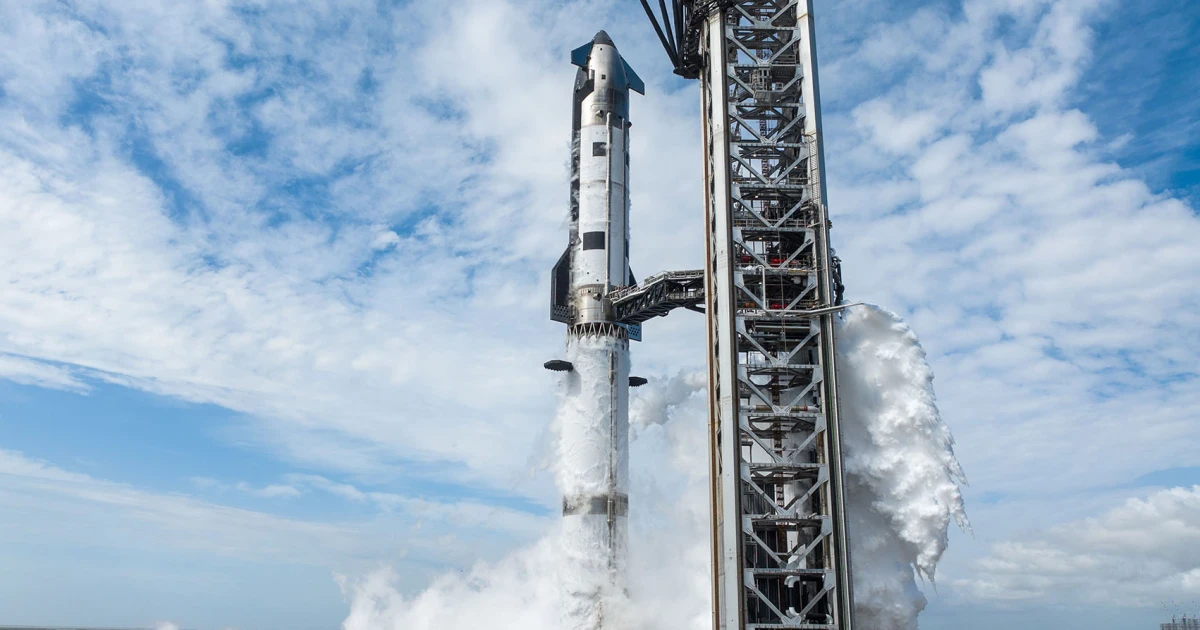
SpaceX aimed to launch its cutting-edge Starship mega-rocket prototype—a vehicle poised to assist NASA in landing astronauts on the moon—on Thursday. However, Elon Musk’s rocket firm had to abort the launch at the last moment of the countdown due to technical issues.
Subscribe to read this story without ads
Get unlimited access to ad-free articles and exclusive content.

An issue with a component of the launch tower that links the rocket to ground support systems led to multiple launch delays. Ultimately, flight controllers opted to abort the launch to diagnose the situation.
No new launch date has been shared yet. Musk noted that he may attempt to launch Starship again on Friday, contingent on resolving the underlying issue swiftly.
This test flight would have marked Starship’s 12th overall launch, and it would have been the first for the new third-generation model, dubbed V3. This upgraded version is larger, more powerful, and designed for complete reusability.
The 408-foot-tall rocket was fully fueled at a new launch site in SpaceX’s Starbase facility, located in southern Texas.
Given NASA’s goal to use Starship for lunar landings, each launch attempt is meticulously monitored, with every complete test flight deemed critical. Within the Artemis program, both SpaceX and Jeff Bezos’ Blue Origin are developing lunar landers for a possible NASA moon landing mission in 2028. NASA aims to evaluate these new probes in low Earth orbit during the Artemis III mission, slated for late next year.
Furthermore, Musk confirmed on Wednesday intentions to take SpaceX public, which could lead to the largest initial public offering (IPO) in history. He plans to maintain 85% of the company’s voting rights and remain in his current roles post-IPO, potentially setting the stage for him to become a trillionaire.
During the Thursday launch broadcast, SpaceX revealed plans for future missions involving Starship flying around Mars with cryptocurrency entrepreneur Chun Wang onboard, although specifics were sparse.
Before this ambitious flight can occur, SpaceX must validate Starship’s capability to reach the moon.
Since Starship’s last test flight seven months ago, significant enhancements have been made to both the rocket’s booster, known as Super Heavy, and its upper stage, dubbed Ship. New engines have been added, allowing them to generate approximately 18 million pounds of thrust in unison.
Additional upgrades include a reduction in the number of booster “grid fins,” which assist in returning the rocket’s first stage to Earth, and an increase in the propellant tank capacity of Starship.
Plans for Thursday’s suborbital test flight included deploying 22 Starlink mock satellites and reigniting one of the upper stage’s six Raptor engines in space— a critical step for vehicles executing deorbit burns to safely return from space.
The entire test was projected to last around 65 minutes, with the upper stage expected to finalize its descent in the Indian Ocean. Ultimately, SpaceX’s objective is to achieve a reusable system that can be “captured” by a mechanical arm on a launch tower at its Texas facility.
SpaceX has previously demonstrated a similar catch maneuver with Starship’s Super Heavy booster, but this time the booster was scheduled to land in the Gulf of Mexico according to SpaceX.
The timeline for Starship’s development is tight. Since its debut flight in 2023, the rocket has experienced numerous failures, including an uncontrolled atmospheric re-entry and two mid-air explosions as it ascended. Nevertheless, SpaceX aims to have Starship prepared for the Artemis III mission next year, intending for the rocket’s upper stage to join NASA’s Orion capsule in orbit— the same vehicle that aims to deliver Artemis II astronauts to lunar orbit.
If all progresses smoothly, SpaceX is working towards certifying NASA’s Starship for astronaut transport to the moon in 2028.
Source: www.nbcnews.com