


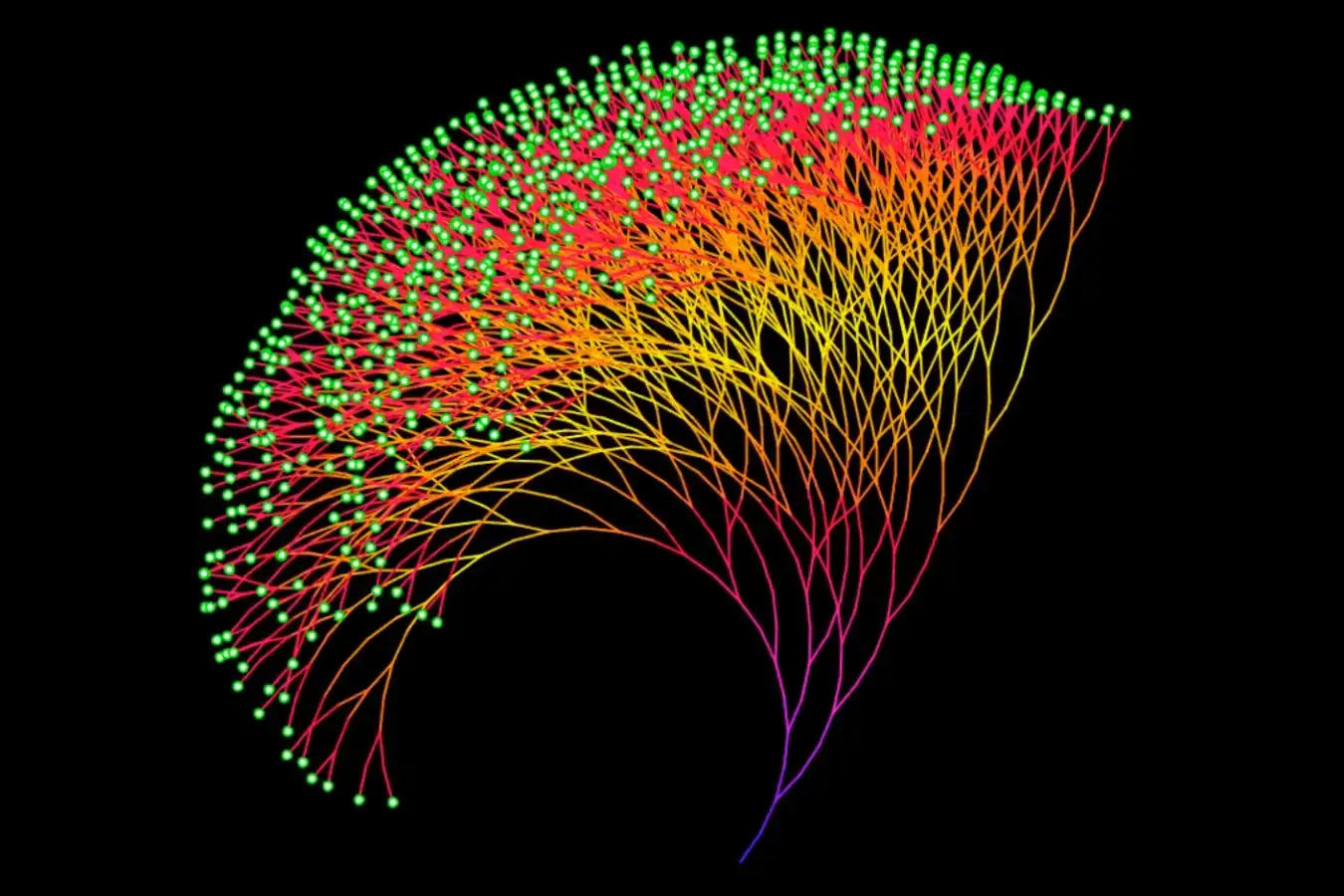

The tree-like shape emerges from the numerical relationships in the renowned mathematical puzzle known as the Collatz conjecture.
Marzio de Biasi/Algolito Malte
The Collatz conjecture, formulated nearly a century ago, presents a deceptively simple yet profoundly puzzling mathematical challenge that has intrigued mathematicians over generations. This problem has morphed into a meme, captivating minds and prompting countless individuals to claim solutions—only to be met with disappointment as the complexities unfold. Watch out; once you grasp the rules, you’ll find yourself eager to solve it yourself, and I won’t be held liable for the time you may squander.
It begins with a fascinating premise: choose any positive integer. If the number is even, divide it by 2; if odd, multiply it by 3 and add 1. Repeat this process with the resulting numbers, and there’s a persistent belief that this sequence will ultimately lead to the number 1.
This assertion, however, remains an unproven hypothesis known as the Collatz conjecture, named after mathematician Lothar Collatz, who first proposed it in the 1930s. Surprisingly, answering whether this holds true for all positive integers is a significant challenge. The esteemed mathematician Paul Erdős once remarked, “Mathematics may not be ready for such problems.”
So, why does the Collatz conjecture defy proof? When you first hear about it, you might instinctively reach for your calculator to test it with various integers. Mathematicians have indeed utilized computers to verify all numbers up to 271, yet this is a tiny fraction of the infinite possibilities to evaluate, complicating the search for conclusive evidence.
The unpredictable behavior of numbers compounds the challenge. For instance, starting from 1 leads to 1, while from 2, halving lands you back at 1. However, starting with 3 opens up a chain: 10, 5, 16, 8, 4, 2, and finally, 1. Starting from 7 demonstrates a lengthy trajectory back to the same conclusion. Interestingly, this chain includes a sequence that originates from 3; hence, subsequent evaluations of previously encountered numbers become unnecessary—an appealing aspect of the Collatz conjecture.
These complexities are catnip for mathematicians, leading many to lose focus as they ponder this intriguing issue. Just as the xkcd webcomic humorously suggests, some brains tend to malfunction when confronted with captivating problems, often abandoning all else to grapple with them.

Collatz’s conjecture has perplexed countless enthusiasts.
xkcd.com/356/
Defining the Unknown
The origins of the Collatz conjecture are as elusive as its proof. In a letter from 1980, Collatz mentioned that he had initiated his investigation “nearly 50 years ago.” This problem remained relatively obscure until around 1950 when Collatz engaged informally with peers at the International Congress of Mathematicians, where it began to gain traction.
Through various mathematical circles, the conjecture re-emerged under different aliases, including the Syracuse problem and the Hasse algorithm. According to Jeffrey Lagarias, the conjecture first appeared in print in 1971, characterized as a “piece of mathematical gossip.” It gained significant notoriety following Martin Gardner’s coverage in his column for Scientific American, where he popularized it among both recreational and research mathematicians.
This conjecture straddled the line between recreational and rigorous mathematics for decades. A notable article from 1983, titled “Don’t Try to Solve These Problems,” lists the Collatz conjecture among other unsolved theories, cautioning mathematicians against giving in to temptation.

Mathematician Lothar Collatz dedicated over five decades to exploring his conjecture.
Oberwolfach Photo Collection
One significant milestone was achieved in 1976 when Terrace Riho demonstrated pivotal results. When starting from an even number, the first action to halve guarantees that the Collatz sequence will remain below the starting number. However, for odd numbers, the first operation elevates the number, leading to questions about how long it takes to return to below the starting point on the path to 1. Terrace termed this the “stop time” and proved that, in most instances, this stop time is finite, meaning the numbers decline rather than escalate indefinitely.
Yet this insight cannot prove the Collatz conjecture; a single colossal counterexample that avoids reaching 1 would suffice to disprove it. Naturally, broad generalizations pose challenges in an infinite context. In 2002, further precision was achieved: Ilya Krasikov and Lagarias established that for any given number \(x\), at least \(x^{0.84}\) numbers lower than \(x\) will eventually reach 1. This means that, for example, if \(x\) is 100, it suggests that at least 47 of the integers less than 100 will arrive at 1, although, as of now, we know all numbers below 100 do indeed reach it—this provides a specific upper boundary to the enigma of the Collatz conjecture.
The most significant breakthrough came in 2019 when Terence Tao, recognized as one of the leading mathematicians of our time, decided to tackle this notorious problem. He reinforced Terras’ findings, demonstrating that not only will “almost all” numbers eventually fall below their starting values, but one can effectively drive them as low as desired. This revelation feels remarkably close to proving the Collatz conjecture, yet it still leaves the possibility of elusive counterexamples lurking further along the numerical continuum.
So, what lies ahead for the Collatz conjecture? As I pen this, reports emerge that OpenAI has harnessed advanced language models to address a longstanding conundrum in mathematics, not by validating the conjecture but by identifying unforeseen counterexamples. Might the same fate befall the Collatz conjecture? While I hesitate to speculate, it would be ironic if challenges that have captivated human intellect for decades were eventually resolved by AI.
Topics:
Source: www.newscientist.com