


Close Menu
HitechubHitechub
    What's Hot
    Science

    How Plants Altered Magma Chemistry: Insights from Sciworthy

    Science

    Revealing Evidence: We May Not Be Earth’s First Advanced Civilization

    Wheels

    Microlino – Is this the perfect city car?

    Important Pages:
    • About Us
    • Privacy Policy
    • Terms & Conditions
    Facebook X (Twitter) Instagram Pinterest
    Facebook X (Twitter) Instagram
    HitechubHitechub
    Saturday, June 6
    • Technology
      1. AI
      2. Gadgets
      3. View All

      This is the most popular CEO in the world

      Sectors in which “Chat-GPT” is most often used

      AI Pioneer Expresses Concern About Potential for AI to Surpass Humanity

      Artificial intelligence has begun to “swallow” professions

      What’s new in Android 14

      Europeans have about 700 million old mobile phones in their drawers

      Here’s how you can tell if your phone is being tapped

      “Sneaker X” – computer case in the shape of a sneaker

      Russian Gamers Unite to Prevent Nuclear War: Join the Fight Online

      Challenges of Space Travel: Why Journeying to Space is So Difficult

      NASA Astronaut Casts Historic Vote from Space

      Discover the Future of Comfort: What If You Could Wear a Chair?

    • Science
      1. Space
      2. Wheels
      3. View All

      Galaxies in the universe are growing more slowly than they should

      “Espace” presented the new lander “Apex 1.0”

      The largest asteroid sample ever collected has arrived on Earth

      (VIDEO) Incredible flight of the Parker Solar Probe

      Toyota wants to make a new generation battery with a range of up to 1,200 km

      Meet Toyota’s lunar “baby” that could make exploring the Moon easier

      Microlino – Is this the perfect city car?

      Alfa Romeo 4C gets an electric successor

      SpaceX Postpones Launch of New Starship Prototype: Here’s What You Need to Know

      Can Your Brain Communicate While You Sleep? Discover Findings from This Fascinating Experiment

      Revealing Evidence: We May Not Be Earth’s First Advanced Civilization

      Exploring the Health Benefits of Turmeric and Curcumin: Do They Really Deliver?

    HitechubHitechub
    Home » Jupiter’s Electron Acceleration Near-Light Speed: Unveiling the Origins of Cosmic Rays
    Science

    Jupiter’s Electron Acceleration Near-Light Speed: Unveiling the Origins of Cosmic Rays

    Share Facebook Twitter Pinterest WhatsApp
    Share
    Facebook Twitter LinkedIn Pinterest WhatsApp

    Recent analysis of data from NASA’s Juno spacecraft reveals that Jupiter’s bow shocks not only deflect the solar wind, but also function as powerful particle accelerators, propelling electrons to relativistic energies exceeding 1 MeV.


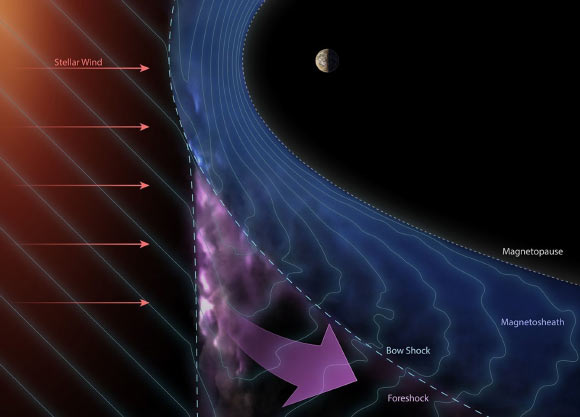
    As planets and stars traverse streams of charged particles in space, their magnetic fields create obstacles. Incoming particles are slowed and redirected, forming a boundary known as a bow shock. Just beyond this boundary lies the foreshock, where fluctuating magnetic conditions can accelerate particles to near-light speeds. Image credit: Ben C. Smith, Johns Hopkins Applied Physics Laboratory.

    A shock occurs when an object moves through a fluid faster than the local speed of sound, causing a sudden change in pressure at the interface of the two mediums.

    One of the classic examples is the bow shock, where a planet’s atmosphere interacts with the solar wind, akin to the impact created by a ship’s bow in water.

    Most shocks in space plasma are collisionless due to the low particle density, which prevents direct collisions from converting impact energy into heat. Instead, electromagnetic forces facilitate this process.

    Collisionless shocks are believed to be the sites where cosmic rays can achieve relativistic speeds, a phenomenon known as relativistic electron acceleration.

    Despite this understanding, scientists’ insights into how these structures operate remain limited due to insufficient direct observational evidence.

    “Since cosmic rays were discovered over 100 years ago, astronomers have endeavored to pinpoint their origins,” stated Dr. Savas Raptis from the Johns Hopkins University Applied Physics Laboratory.

    “These high-energy particles can originate from diverse sources, such as supernovae and solar eruptions.”

    “When solar cosmic rays reach Earth, they can induce space weather events disrupting satellites, communications, and power systems.”

    “The NASA mission illuminated how certain electrons gain high energy in regions near Earth, termed foreshocks, where solar particles first encounter Earth’s magnetic field.”

    “Scientists have long suspected that a similar acceleration process occurs for high-energy particles in the foreshocks of other planets and astrophysical systems, but confirmation has been elusive.”

    Researchers examined data collected as Juno approached Jupiter on October 1, 2023.

    Prior to entering the bow shock, the spacecraft navigated through a foreshock—a turbulent area formed upstream where the solar wind first detects the planet’s magnetic influence.

    Within about 20 minutes, Juno identified a significant bubble-like disturbance referred to as a foreshock transient.

    The spacecraft utilized three onboard instruments to measure electrons accelerating to energies up to 1 MeV in this region.

    “Utilizing these observations, we propose a universal scaling law for the Hyras limit that empirically connects the size of observable transients to maximum particle energy,” the researchers noted.

    “This scaling applies across various environments, from planetary bow shocks to protostellar jets and supernova remnants, offering a straightforward model for determining maximum particle energies ranging from MeV to tens of GeV and TeV, respectively, thus providing a method to constrain cosmic ray energies in astrophysical shocks.”

    The team’s study was published in the journal Nature on June 3, 2026.

    _____

    S. Raptis et al. 2026. Relativistic electron acceleration in Jupiter’s bow shock and beyond. Nature 654, 47-51; doi: 10.1038/s41586-026-10473-z

    Source: www.sci.news

    Share. Facebook Twitter Pinterest LinkedIn WhatsApp
    Previous ArticleReviving Frozen Rat Chromosomes in Mice: A Breakthrough in Genetic Research
    Next Article Exploring the Health Benefits of Turmeric and Curcumin: Do They Really Deliver?

    Related Posts

    Science

    SpaceX Postpones Launch of New Starship Prototype: Here’s What You Need to Know

    Science

    Can Your Brain Communicate While You Sleep? Discover Findings from This Fascinating Experiment

    Science

    Revealing Evidence: We May Not Be Earth’s First Advanced Civilization

    Science

    Exploring the Health Benefits of Turmeric and Curcumin: Do They Really Deliver?

    Science

    Reviving Frozen Rat Chromosomes in Mice: A Breakthrough in Genetic Research

    Science

    Arrest Made in Rape and Murder Case of 40-Year-Old Woman Linked to Forensic Genealogy Investigation

    Science

    Discover the Truth: ‘Everyone is Lying to You for Money’ – An Essential Cryptocurrency Exposé

    Science

    21 Gray Whales Found Dead in 3 Months: Understanding the Surge of Carcasses on Pacific Beaches

    Add A Comment
    Leave A Reply Cancel Reply

    Stay In Touch
    • Facebook
    • Twitter
    • Instagram
    • Pinterest
    Top Picks
    Gadgets

    The Best Phones to Buy in 2023: Our Top 10 Picks

    In an era where smartphones are an integral part of our daily lives, choosing the right one can be a daunting task. Here are the best phones to buy in 2023

    HONOR won 36 awards at IFA 2023 – Honor Magic

    How fast commercial airplanes really are?

    21 Gray Whales Found Dead in 3 Months: Understanding the Surge of Carcasses on Pacific Beaches

    NASA Unveils Three Unmanned Moon Exploration Missions in 2023 to Support Lunar Base Construction

    Most Popular
    AI

    AI created opening credits for the series “Friends”

    Technology

    This is the northernmost photovoltaic plant in the world

    Categories
    • AI (13)
    • Gadgets (10)
    • Science (91)
    • Space (9)
    • Technology (37)
    • Wheels (9)
    Our Picks
    AI

    What the most advances humanoid robot predicts for the human race in 100 years?

    Science

    Revolutionary Mathematics AI Solves Decades-Old Research Problems in Just Weeks

    © 2026 Hitechub.
    • Home
    • About Us
    • Privacy Policy
    • Terms & Conditions

    Type above and press Enter to search. Press Esc to cancel.

    We are using cookies to give you the best experience on our website.

    You can find out more about which cookies we are using or switch them off in .

    Ad Blocker Enabled!
    Ad Blocker Enabled!
    Our website is made possible by displaying online advertisements to our visitors. Please support us by disabling your Ad Blocker.
    Go to mobile version
    Hitechub
    Powered by  GDPR Cookie Compliance
    Privacy Overview

    This website uses cookies so that we can provide you with the best user experience possible. Cookie information is stored in your browser and performs functions such as recognising you when you return to our website and helping our team to understand which sections of the website you find most interesting and useful.

    Strictly Necessary Cookies

    Strictly Necessary Cookie should be enabled at all times so that we can save your preferences for cookie settings.