


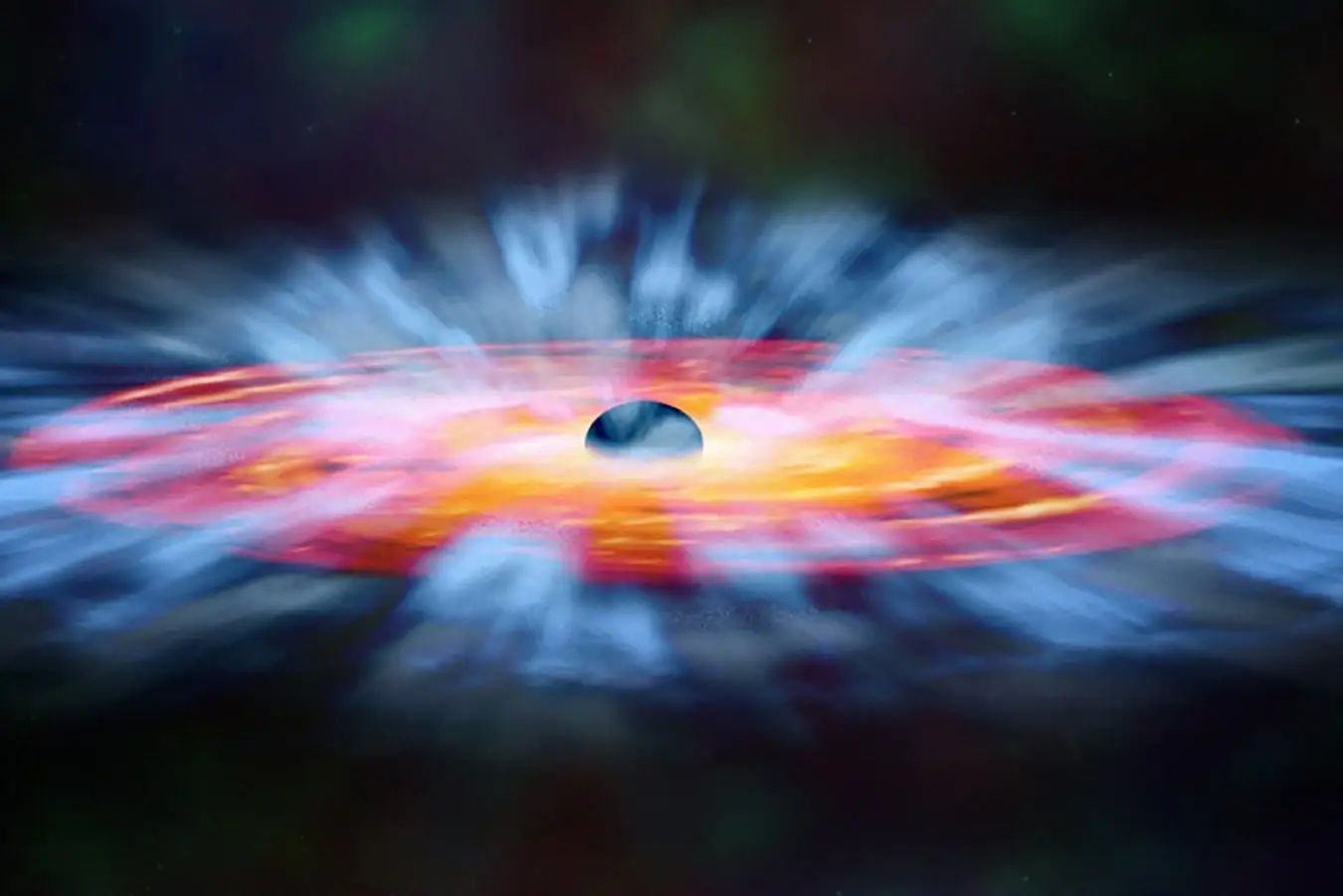

A disk of matter swirling around a supermassive black hole could give rise to many planets
NASA and M. Weiss/Chandra X-ray Center
The active centers of galaxies are intriguing realms of planet formation, where millions of new worlds emerge.
Nearly all galaxies, including our Milky Way, harbor supermassive black holes at their cores. Typically, these black holes remain dormant, lacking material to consume. However, during active phases, they absorb substantial amounts of dust and gas, particularly during galactic mergers, transforming into active galactic nuclei for extended periods.
Barry McKernan and his team at the City University of New York simulated a disk of dust and gas surrounding a typical active galactic nucleus. Their findings suggest this environment is ideal for planetary formation, where dust coalesces into larger entities, leading to a proliferation of unique planets.
“This presents a surprising new pathway for the formation of diverse planets,” McKernan explains. “These newly formed worlds could be radically different from the planets we currently know.”
Active galactic nuclei contain significantly more dust than the protoplanetary disks that develop around young stars, enabling the creation of massive planets. This process could yield gigantic rocky planets comparable to Jupiter or even larger, which are not observed elsewhere in the universe. Frequent collisions among these planets may result in surfaces often covered in lava.
McKernan posited that some of these planets could grow so massive that they reach nuclear fusion at their cores, transforming into “very strange aliens” composed of rock or accumulating substantial gas to form intermediate-mass black holes.
The extensive dust disk surrounding an active galactic nucleus can span tens of light-years, implying the scale of this phenomenon is vast. “There could be millions of planets orbiting a central supermassive black hole,” asserts McKernan.
While it has long been understood that planets and stars can form near black holes, the examination of planet formation on such a scale is unprecedented. As Sean Raymond from the University of Bordeaux points out, this makes active supermassive black holes potentially one of the prime sites in the universe for new worlds to come into existence.
“What else transpires when there’s this much material around a supermassive black hole?” questions Raymond. “It appears almost certain.”
Many of these planets can interact with each other, leading to scenarios where they are either drawn into black holes or ejected into other galaxies. By observing the gravitational distortion of light from distant stars, these interactions could potentially be detected through a method called microlensing.
Upcoming telescopes like NASA’s Nancy Grace Roman Space Telescope, anticipated to launch this September, could facilitate these discoveries. “We are on the brink of an era where microlensing will play a crucial role,” states Benne Holwerda from the University of Louisville.
McKernan also noted that many active galactic nuclei exhibit flickers, possibly resulting from “swarms of small objects passing nearby,” such as planets. “These phenomena should exist,” he asserts. “The question is, can we observe them?”
Topic:
Source: www.newscientist.com