


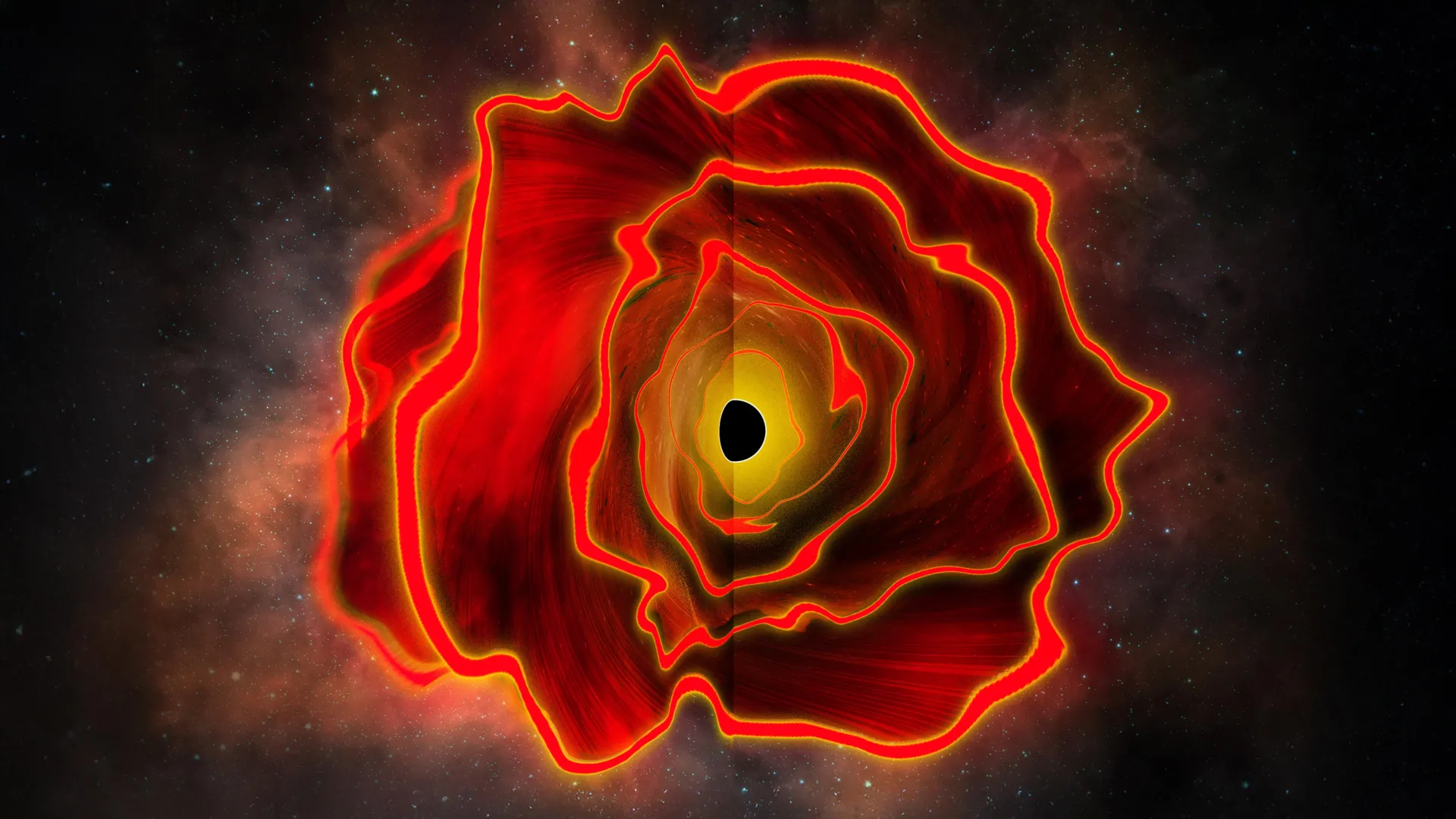
Astronomers at MIT and other institutions have discovered an extraordinarily bright red object from the early universe. At first glance, the object resembles a massive star roughly the size of our solar system. However, its energy output is astonishing: it radiates about 100 billion times more energy than any known star can produce, placing its power closer to that of an actively feeding black hole.
This unusual combination has led researchers to propose a completely new type of astrophysical object, which they have named a “black hole star.”
In research announced on August 12 in Nature, the team describes its analysis of the object and observations collected by NASA’s James Webb Space Telescope (JWST). JWST detected the bright red point of light in the early universe, just a few hundred million years after the Big Bang.
A black hole hidden inside a giant stellar cocoon
Researchers believe the most likely explanation is an unprecedented combination of a black hole and a star. Instead of being powered by nuclear fusion like ordinary stars, the object may be a dense cloud of gas energized by a massive black hole at its center.
“The whole picture of this object is evolving very rapidly,” says lead author Rohan Naidu, a NASA Hubble Fellow and Pappalardo Fellow at MIT’s Kavli Institute for Astrophysics and Space Research (MKI). “We think there is a central black hole about 100,000 times the mass of the Sun. Around this black hole is an extremely extended envelope of gas that appears star-like and is nearly the size of our solar system. It’s enormous.”
If this interpretation is correct, the discovery could also help explain the mysterious “little red dots” appearing throughout deep-space images captured by JWST.
“These little red dots seemed to be everywhere in the early universe, but they have essentially disappeared by the present day,” Naidu says. “What these objects actually are has become one of the most debated questions of the JWST era.”
MIT co-authors include MKI Director Robert Simcoe, Bruno B. Rossi Professor of Experimental Physics, and Wendy Sun ’26, along with researchers from several other institutions.
An unexpected discovery in the early universe
Naidu and his colleagues were not initially searching for black hole stars. Their goal was to identify some of the earliest and most distant galaxies through surveys known as “Mirages or Miracles” (MoMs). Using JWST, they examined distant regions of space as they appeared when the universe was only a few hundred million years old.
“There was a puzzle because so many bright galaxies appeared to exist at such an early time,” Naidu says. “We discovered that some objects that look like exceptionally bright early galaxies, or ‘miracles,’ may actually be ‘mirages.’”
While reviewing JWST images for potential targets, the team noticed one source that stood out from the others. It appeared unusually red and significantly brighter than expected.
“When we see something very red in space, we often think it is surrounded by dust, such as soot or ash,” Simcoe explains. “Just as wildfire smoke can make Boston’s skies appear red, cosmic objects can look redder than their natural color when viewed through a veil of dust.”
However, other features of the object’s light did not match the signature scientists typically associate with dust. The researchers also identified a striking pattern in its spectrum: the object was extremely bright at some wavelengths, yet its light disappeared completely below a specific wavelength.
A record-breaking Balmer break
This sudden decrease in light is known as a “Balmer break.” The feature is usually associated with dense gas that absorbs photons in the atmospheres of stars hundreds of millions of years old. Vega, one of the brightest stars visible from Earth, displays a similar pattern.
“The break observed in this object is the deepest ever recorded in any astronomical source, ruling out normal stars as the explanation,” Naidu says. “But it made me wonder whether we were seeing a new kind of stellar atmosphere on a much larger scale.”
The object was also unusual because its light showed very little evidence of metals or elements heavier than hydrogen and helium.
“It was truly unique in so many ways,” Naidu says.
Testing the source of the unusual red light
To determine what could produce the object’s distinctive appearance, the researchers modeled several possible astrophysical scenarios and compared the results with JWST observations.
“We began asking whether it was possible to create such a red object without dust, using only hydrogen,” Simcoe says. “Surprisingly, we found that a very dense layer of hydrogen could produce this effect. It would be so dense that it would resemble the surface of a giant star rather than a thin interstellar nebula.”
The simulations suggested that the red source may contain an extremely powerful energy source concealed within a dense hydrogen cocoon. This structure could explain both the pronounced Balmer break and the lack of elements other than hydrogen and helium.
One major mystery remained: the model also had to explain the object’s extraordinary brightness.
“It’s somewhat like a star, but 100 billion times brighter,” Naidu says. “That means it cannot be powered by nuclear fusion, the energy source at the center of ordinary stars.”
A massive black hole provides the missing energy
Black holes can release enormous amounts of energy as they accrete, or pull in, surrounding matter. The team therefore added an actively accreting black hole to its model of the dense hydrogen cocoon. Researchers varied the black hole’s mass and other properties, then compared the simulated brightness with JWST measurements of the red object.
The closest match indicated that a black hole star was the most likely explanation.
According to the team’s model, the object contains a central black hole with a mass approximately 100,000 times greater than the Sun. Surrounding it is an extremely dense, star-like envelope of hydrogen that extends to nearly the size of our solar system.
The researchers named the object MoM-BH*-1 after the survey that discovered it. They also gave it the nickname “Black Hole Star-1,” suggesting it could be the first identified member of a larger population.
Could black hole stars explain JWST’s little red dots?
Researchers suspect that black hole stars could explain many of the small red dots observed in JWST images. Although these sources are not as bright as MoM-BH*-1, they may possess a similar structure.
“The little red dots are all consistent with being black hole stars embedded within typical early galaxies,” Naidu says. “What makes MoM-BH*-1 special is that the black hole star outshines its host galaxy, allowing us to see the black hole-powered light directly.”
If this interpretation is confirmed, MoM-BH*-1 could provide important clues about one of the most significant mysteries of the JWST era. It may also represent the first direct example of an entirely new type of cosmic object.
This research was supported in part by the MIT Department of Physics, NASA, and the Space Telescope Science Institute.
Source: www.sciencedaily.com