


Essential Facts about Centauri A
What is it: Centauri A Galaxy (NGC 5128)
Where is it: Located 11 million light-years from Earth in the Centaurus constellation
When shared: July 6, 2026
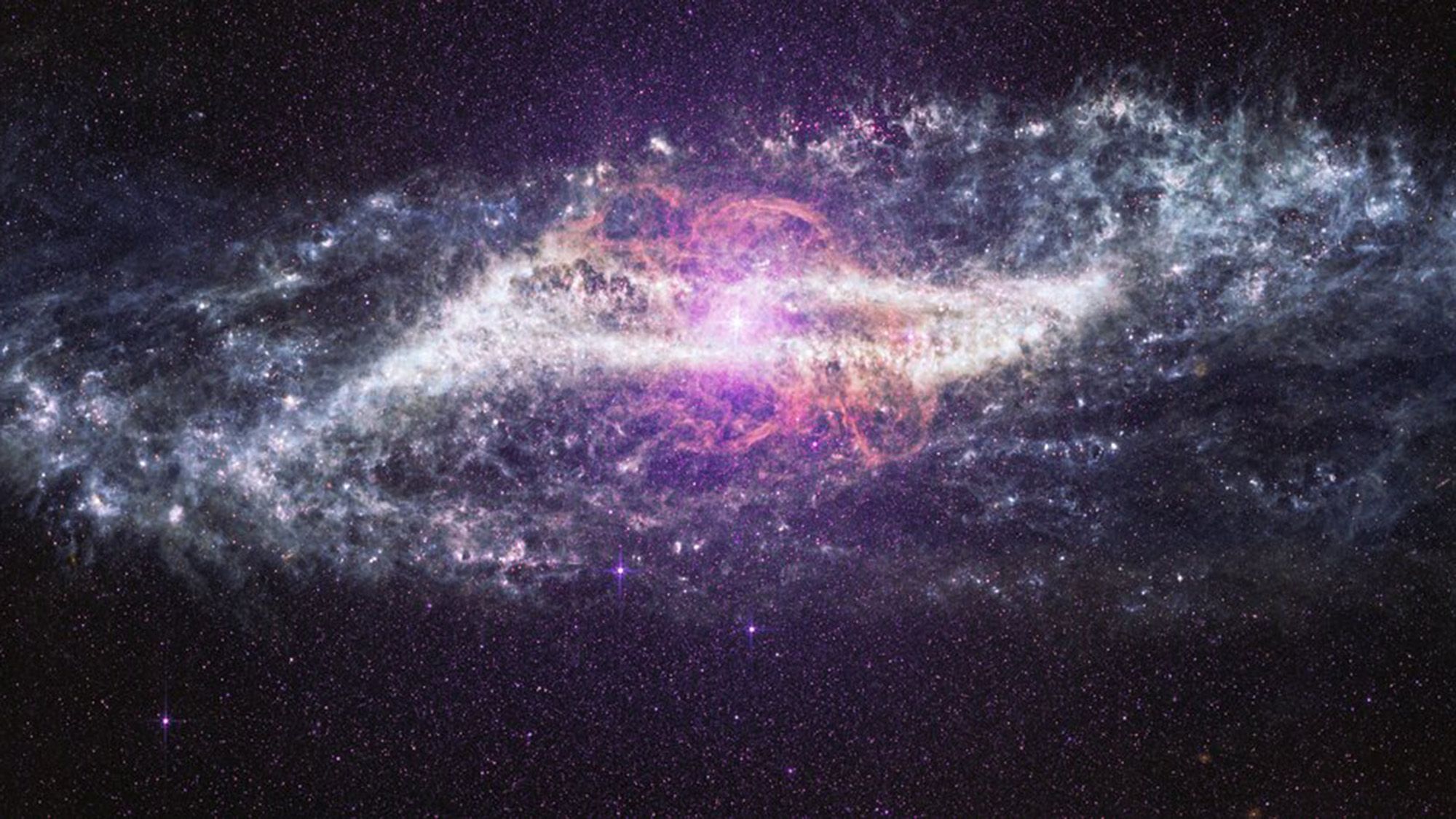
This image from the James Webb Space Telescope (JWST) offers unprecedented insights into Centauri A, a highly active galaxy that is relatively close to Earth. The JWST has detected wavelengths of light beyond human vision, unveiling a galaxy shaped by chaos and violent cosmic events.
Being situated near the Milky Way, JWST was able to observe Centauri A in extraordinary detail. Unlike typical galaxies, it is the remnant of a colossal cosmic collision characterized by a supermassive black hole at its center, enveloped by thick clouds of dust that narrate the galaxy’s tumultuous history.
In visible light, observations from the Lasilla Observatory and the Very Large Telescope in Chile show a dense dust lane obscuring Centauri A’s center, concealing part of its turbulent narrative. Telescopes like Hubble and Spitzer, which can observe in near-infrared wavelengths, have captured images of this galaxy primarily focused on dust. However, JWST’s mid-infrared instruments have penetrated this dust, revealing the galaxy’s glowing center in shades of white and pale pink, along with filaments, loops, and clouds of warm dust that illustrate its complex structure.
Scientists theorize that Centauri A underwent a galactic collision around 2 billion years ago, leaving distinct scars visible in JWST’s detailed imagery. The complex gray and white parallelogram formation crossing the galaxy, alongside pink and lavender curves, indicate the extensive rearrangement of dust and gas, sparking new star formation and influencing the galaxy’s evolution over eons. This illustrates how galactic mergers shape cosmic ecosystems.
Hubble’s perspective of Centauri A is largely obscured by dust, masking its turbulent center.
(Image credit: NASA, ESA, Hubble Heritage (STScI/AURA), and the collaboration among ESA/Hubble. Acknowledgments: R. O’Connell (University of Virginia) and the WFC3 Science Monitoring Committee)
This image further emphasizes how nearby supermassive black holes influence star formation. When matter spirals toward the black hole at the heart of Centauri A, it emits intense energy and drives powerful jets that shape the surrounding gas and dust.
This image is part of the Amazing Images for July 2022. The James Webb Space Telescope was launched on December 25, 2021, and is expected to operate for around 20 years.
Enhance your knowledge of the world’s most powerful telescope with our interactive tool. Take the James Webb Space Telescope Quiz!
Receive the world’s most fascinating discoveries directly in your inbox.
Topics
Source: www.livescience.com