


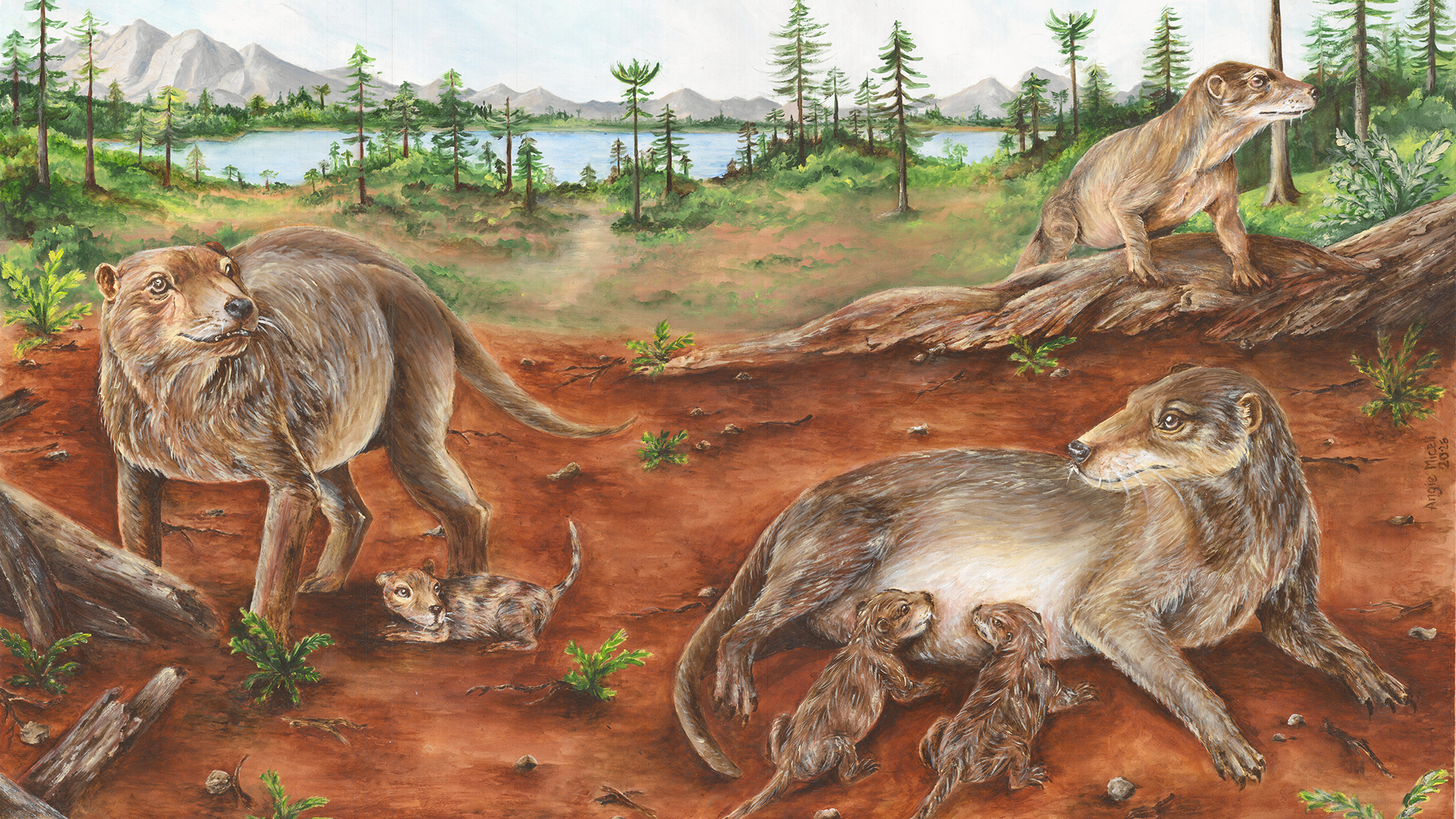
Ancient Dog-Sized Predator May Have Given Birth to Live Young 236 Million Years Ago
A dog-sized carnivore that lived about 236 million years ago may have given birth to live young, according to a new study. The finding suggests that viviparity—the reproductive strategy in which embryos develop inside the mother and offspring are born alive—could have evolved in the mammalian lineage 90 million to 95 million years earlier than scientists previously believed.
Researchers identified evidence of early growth patterns in the fossilized bones of Chinicodon theotonychus, a carnivorous cynodont that lived in what is now northwestern Argentina during the Triassic Period. Cynodonts were ancient mammal relatives and members of the group that eventually gave rise to modern mammals.
“This is the first time we have evidence of how the ancestors of these mammals reproduced,” said lead study author Leandro Gaetano, a paleontologist at Argentina’s National Council for Scientific and Technical Research. The study was published Aug. 13 in Frontiers in Mammal Science.
Mammals, their extinct ancestors and their close relatives belong to the cynodont group, which first appeared during the Late Permian Period about 260 million years ago. Cynodonts survived the end-Permian mass extinction roughly 252 million years ago and diversified during the Triassic as ecosystems recovered.
From the latest videosLive Science
Fossil bones reveal clues about reproduction
Gaetano and his colleagues examined unusual growth marks in the fossilized bones of Chinicodon theotonychus. The animal was approximately the size of a modern dog and lived about 236 million years ago.
By comparing the fossil evidence with the bones of living animals, the researchers concluded that the marks may represent growth rings made from disorganized bone tissue. Similar structures form when young land animals experience a rapid growth spurt shortly after hatching or birth.
“When they’re in the egg or in the mother’s womb, there’s very little space and growth is very slow,” Gaetano told Live Science. “When they hatch or are born, they have a lot of space in their bodies and start growing very quickly.”
These growth patterns can help scientists estimate how large an animal was at birth and compare its size with its adult body mass. The researchers estimated that the Chinicodon specimen weighed approximately 26 pounds (12 kilograms) when it died and about 3.7 pounds (1.7 kilograms) at birth. That means the newborn was roughly 14% of the animal’s adult weight.
How large were the newborns?
To test whether the estimated newborn size was consistent with live birth, the researchers compared the fossil measurements with data from 1,869 living mammal species, 2,619 nonbird reptiles and 782 bird species.
The comparison revealed a significant difference between mammals and egg-laying animals. Modern reptiles weighing between 17.6 and 32 pounds (8 and 14.5 kilograms) as adults typically produce hatchlings that are only 0.1% to 0.6% of their adult body weight. Birds weighing between 17.6 and 47 pounds (8 to 21.5 kilograms), including some cranes and vultures, produce young that are generally 1.3% to 4.5% of adult body mass.
In contrast, mammals weighing between 17.6 and 33 pounds (8 and 15 kilograms) can give birth to offspring that weigh as much as 20% of the adult body mass. The estimated newborn size of Chinicodon theotonychus is much closer to this mammalian pattern than to the pattern seen in birds and reptiles.
Skull of Chinicodon theotonychus, the species examined in the study.
Image credit: Leandro Gaetano
The researchers said that the similarity between the fossil animal and modern mammals that give birth to relatively large offspring supports the possibility that Chinicodon was viviparous. However, the evidence is not conclusive because fossilized bones cannot directly show whether an animal laid eggs or gave birth to live young.
Why might live birth have evolved in the Triassic?
Live birth may have offered important advantages during the Triassic, a challenging period when ecosystems were recovering from a major mass extinction. Competition for food and other resources was intense, predators were widespread and many regions experienced hot, dry conditions.
Developing embryos inside the mother could have provided greater protection than developing in exposed eggs. Unlike eggs, newborn animals can also move away from predators immediately after birth.
“Eggs cannot leave predators, but young animals can, which is a huge advantage,” said Anne Weil, a vertebrate paleontologist at Oklahoma State University who was not involved in the research.
Modern vertebrates display a wide range of reproductive strategies. Some fish, reptiles and birds lay eggs, while mammals such as platypuses and echidnas also lay eggs. Other mammals, including kangaroos, give birth to extremely small offspring that continue developing in a pouch.
Live birth may be much older than scientists thought
Until recently, scientists generally thought that viviparity evolved relatively late in the mammalian lineage, possibly after an intermediate reproductive stage similar to the strategy used by modern marsupials. However, recent studies have increasingly suggested that live birth may have appeared much earlier.
The possible evidence from Chinicodon theotonychus predates the split between the ancestors of marsupials and placental mammals. If the interpretation is correct, live birth may have been established near the beginning of mammalian evolution rather than emerging much later.
“This may be evidence for a general switch from laying eggs to producing live young early in the mammalian lineage, but further evidence is needed,” Gaetano said.
Emily Rayfield, a paleontologist at the University of Bristol who was not involved in the study, agreed that additional fossils will be needed before scientists can draw firm conclusions.
“Our view is that birth appeared earlier than we thought, but we need more evidence to be really sure of that,” Rayfield told Live Science.
Ancient cynodonts were more mammal-like than once believed
The study adds to growing evidence that early mammal ancestors possessed many traits once considered unique to modern mammals. Fossils of ancient cynodonts have revealed clues about specialized teeth, rapid growth, hair and possibly lactation.
These discoveries are changing the traditional image of mammal ancestors as small, reptile-like animals. Instead, they appear to have been a diverse group with increasingly mammal-like anatomy, behavior and reproductive biology.
Future discoveries of fossilized embryos, pregnant individuals or additional growth-stage specimens could help determine whether early cynodonts laid eggs or gave birth to live young. For now, Chinicodon theotonychus provides one of the earliest potential clues that viviparity evolved deep in mammalian history.
Source: www.livescience.com