


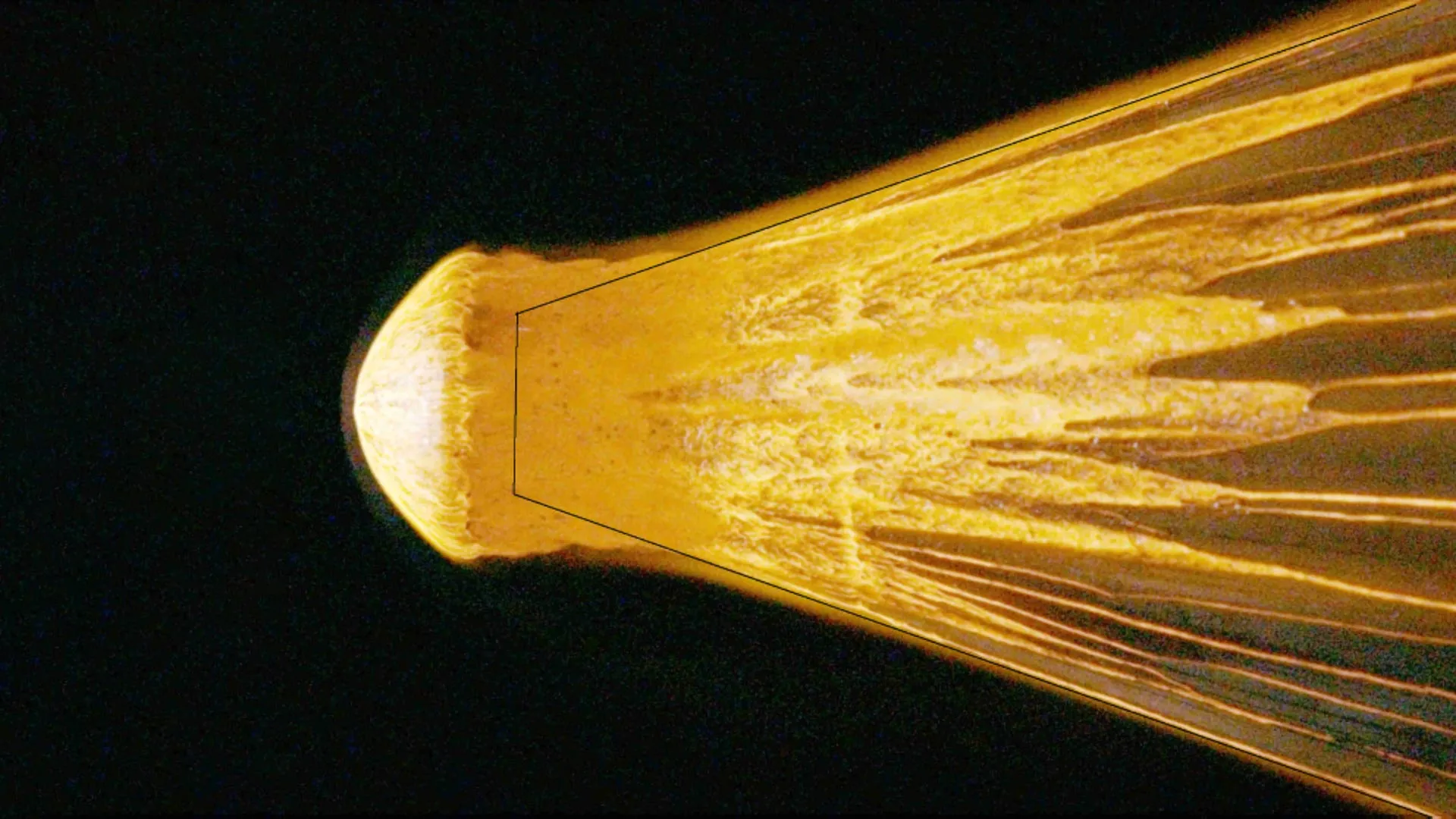
Scientists have developed a clearer picture of what happens when rocks from space enter Earth’s atmosphere and survive to reach the ground. After analyzing videos and photographs of 75 meteorite falls, researchers identified seven stages in the transformation from incoming space rock to meteorite. Their findings show that melting and fragmentation play a much larger role than previously thought in determining how much mass a rock loses, how quickly it slows, and where its fragments land. The research was published in Meteoritics and Planetary Science.
“We thought solid rocks would be vaporized by the tremendous heat and bright light produced by midair collisions,” said meteor astronomer and lead author Dr. Peter Jenniskens of the SETI Institute and NASA Ames Research Center. “Instead, we found that first melting and then fragmentation control the loss of rock mass.”
The researchers found that rocks entering from space pass through seven stages as they travel through the atmosphere. Each stage is governed by different physical processes that affect the object’s appearance, behavior and eventual fate.
How space rocks become bright meteor fireballs
Stages 1 and 2: Heating and brightening
The journey begins in Phase 1, high above Earth, when the atmosphere becomes dense enough for a flying rock to create a shock wave in front of it. Collisions with air molecules heat both the rock’s surface and the surrounding gas, causing them to glow. The resulting streaks of light are commonly called meteors or “shooting stars.”
During Phase 2, the object moves through increasingly dense air and becomes brighter. Some meteors repeatedly vary in brightness, a pattern that can reveal how quickly they are rotating. Among the fastest-rotating objects in the study, a complete rotation took between 0.5 and 5 seconds.
Stages 3 and 4: Melting and mass loss
In Phase 3, the meteor becomes even brighter and develops into a fireball. Melting becomes the main process removing material from the rock. Powerful airflow strips molten material from the surface, forming droplets that continue to evaporate after separating from the main body.
Eric Stern, formerly of NASA Ames and now principal investigator at Hyperspace Technologies, said that laboratory experiments cannot reproduce the amount of radiation produced during natural atmospheric entry. “The rock could actively fragment and erode, but in that case we would not expect the systematic changes in the brightness of the fireball that we observed,” he said.
The bolide enters Phase 4 at an altitude of about 60 kilometers (about 40 miles), when the melting process reaches a relatively stable balance. The fireball’s brightness remains approximately constant or increases at a steady rate. According to the researchers, melting alone could ultimately remove as much as 40 percent of the rock’s original mass.
Why meteors break apart near Earth
Stage 5: Fragmentation and rapid deceleration
As the fireball descends into denser layers of the atmosphere, rising pressure causes the rock to begin breaking apart. This marks the start of Phase 5. Pieces separate from the main body and can produce repeated bursts of light.
One surprising finding was how early this breakup can begin. The researchers found that fractures may form when the air pressure acting on the front of the rock reaches about one-fifth of the pressure measured in meteorites recovered on Earth. They suggest that heating during atmospheric entry, combined with weakening from cracks created by earlier collisions in space, may explain this behavior.
At this stage, the remaining body begins to contract rapidly and undergoes significant deceleration. The more extensive the fragmentation, the faster the object loses speed.
“We were able to connect fragmentation-induced slowing with previous mathematical descriptions based on ablation,” said co-author Stu Pilorz of the SETI Institute.
The shape of the remaining rock can also influence where small fragments land. If the rear of the body remains intact, a decompression region forms in its wake and draws small pieces toward it.
“Our modeling shows that as long as the back surface of a space rock remains intact, it tends to draw a subsequent vacuum and debris flows into it,” said co-author Darrell Robertson of NASA’s Ames Research Center. “Those small meteorites fall in a narrow strip of the ground.”
The final explosion and journey to the surface
Stage 6: The last major breakup
Phase 6 begins when the rear section of the main rock finally fractures. This last major rupture produces a bright flare and scatters debris at a higher relative velocity. Because the meteor has already slowed substantially, these final flashes generally appear red, rather than the bright green often seen earlier in the descent.
“That final disruption causes debris to fly off at a higher relative velocity,” Jenniskens said. “We noticed that in past falls, meteorites that weighed more than about 20 grams tended to be scattered over a wide area, and many of them came close to the surface of the original space rock, which would have been the back side.”
The fragments that survive to reach Earth’s surface began as relatively large pieces. They continue to melt and fragment while losing speed before landing.
Stage 7: Dark flight and landing
In Phase 7, these processes continue until the remaining debris slows enough to stop producing visible light. When melting ends, a thin outer coating called fusion crust remains on the surface. The blackened fragments then complete their descent, with atmospheric winds carrying them away from the path defined by their original orbit. Some may ultimately land as meteorites.
What meteorite falls reveal about dangerous asteroids
The researchers examined 75 recorded meteorite falls involving several types of space rocks. By comparing their behavior, they determined the altitudes at which different materials enter each of the seven stages.
The observations help explain not only how small meteorites reach the ground, but also how much larger asteroids behave. Larger objects can range from the size of cars to entire city blocks and can produce powerful explosions in the atmosphere.
By measuring how different solid rocks slow down and fragment during atmospheric entry, scientists can improve their understanding of the processes that govern potentially dangerous asteroid airbursts.
“Asteroids that reach tens of meters in size also tend to rotate faster than larger debris-pile asteroids, so they are also solid rocks,” Jenniskens said. “The 20-meter-diameter asteroid that caused an atmospheric explosion over Chelyabinsk, Russia, in 2013 went through the same stage.”
Source: www.sciencedaily.com