


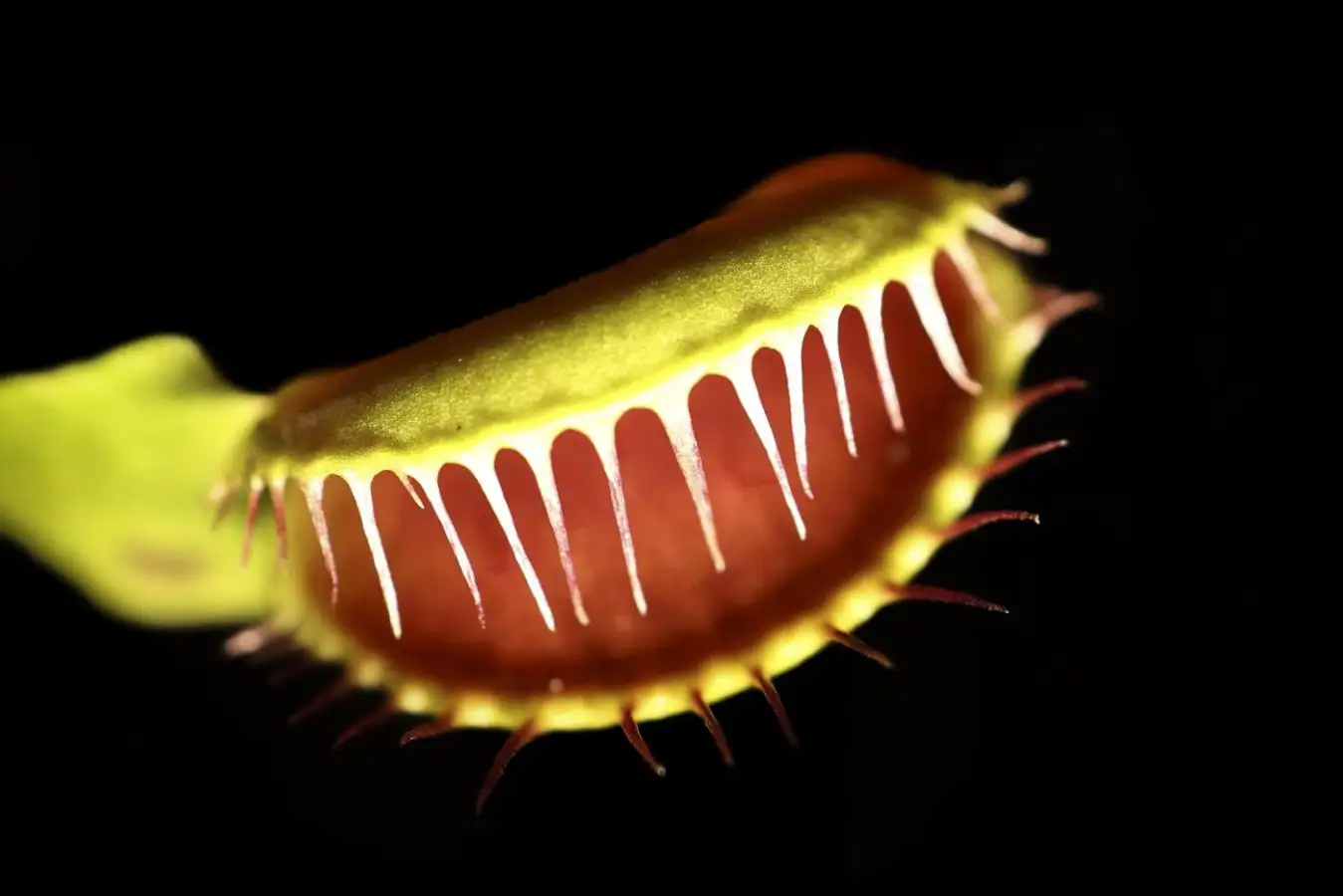
Venus Flytraps Snap Shut to Capture Insects and Spiders
Jeanne Bourdier, Corentin Maurier
The captivating mechanism behind how Venus flytraps rapidly close to capture unsuspecting insect prey has been partially uncovered by researchers.
The Venus flytrap (Dionaea muscipula) is renowned for its unique ability to snap shut when its sensitive hairs are touched twice in quick succession. Although it can ensnare various insects, including a tiny frog, the intricate workings of its mechanism remained elusive to scientists since the time of Charles Darwin.
Traditionally, it was believed this mechanism was due to water movement from one side of the trap to the other, causing differential pressure that leads to rapid closure. However, recent research suggests this theory may not fully explain the speed at which the trap possesses.
Researchers from the University of Aix-Marseille, led by Yoel Forterre, set out to investigate the time required for water to traverse the trap’s tissues. They found it takes approximately 30 to 60 seconds for water to migrate across, far too slow to account for the quick capture of insects.
Upon closer examination, the scientists noted that the surface of the trap exhibits increased bumpiness post-trigger, indicative of reduced cell wall stiffness. By utilizing fine probes to measure mechanical forces in the epidermal cells, they sought to determine if this alteration was what permitted quick closure.
“We discovered that activation of the trap causes the cell walls of the outer epidermis to soften rapidly,” Forterre explained.
When triggered, electrical impulses and calcium ion waves are dispatched through the plant, akin to neural signals in animals. “These signals relay information about tactile contact to adjacent cells almost instantaneously,” Forterre remarked. As the mechanical rigidity of the outer surface diminishes, internal tension releases, facilitating the further expansion of pressurized internal cells. This process allows the trap to bend closed efficiently, with the inner surface remaining firm.
Despite these advancements, the specific molecules responsible for these rapid changes in cell wall stiffness remain unidentified. Forterre notes, “While we understand the initiation of the touch-sensing mechanism and the resultant movement of the trap, the precise molecular interactions linking these two events are still a mystery.”
Critics, including Sergei Shabara, a professor at the University of Western Australia, express skepticism regarding the proposed mechanism. Shabara argues that the assumption of continuous water movement through cells is questionable, asserting that simultaneous transport may also occur.
He further posits that the rapid changes in cell wall stiffness might not occur as quickly as suggested, estimating a timeframe of several minutes. “Consequently, although the team’s measurements are sophisticated, they do not conclusively refute the original hypothesis that water movement is the driving force,” Shabara commented.
In response, Forterre stated that direct measurements of tissue swelling in the trap corroborate the claim that water movement is indeed overly slow to account for the rapid closure. Instead, the surprisingly swift decrease in cell wall stiffness is highlighted as the primary factor enabling this unique mechanism.
Topic:
Source: www.newscientist.com