


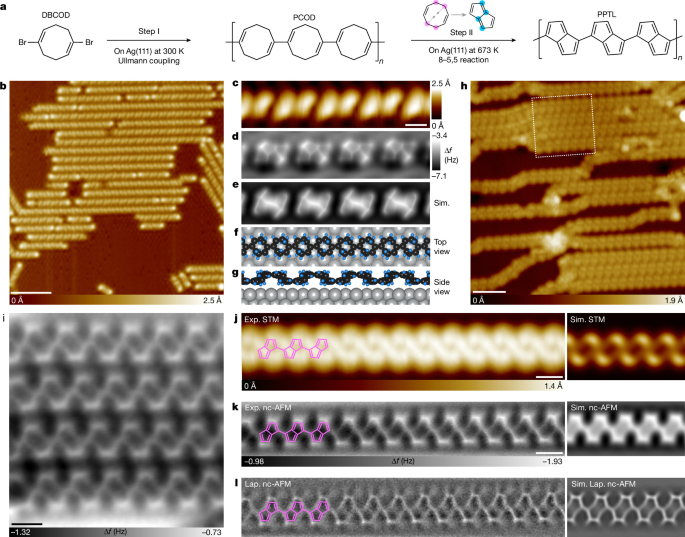
Research on graphene nanoribbons and related carbon nanostructures spans atomically precise synthesis, topological and magnetic states, electronic transport, carbon allotropes, and computational modelling. The references supplied here trace that development from early predictions of carbon-based metals and graphene’s electric-field effects to recent work on single-ribbon devices, localized excitons, polyene conductivity and a 2026 dataset on a narrow carbon pentaheptite nanoribbon.
Graphene nanoribbons and carbon allotropes
- Rizzo, D. J. et al. “Inducing metallicity in graphene nanoribbons via zero-mode superlattices.” Science 369, 1597–1603 (2020). Article
- Fan, Q. et al. “Biphenylene network: a nonbenzenoid carbon allotrope.” Science 372, 852–856 (2021). Article
- Zhang, J. et al. “Contacting individual graphene nanoribbons using carbon nanotube electrodes.” Nat. Electron. 6, 572–581 (2023). Article
- Frank, S., Poncharal, P., Wang, Z. L. & de Heer, W. A. “Carbon nanotube quantum resistors.” Science 280, 1744–1746 (1998). Article
- Crespi, V. H., Benedict, L. X., Cohen, M. L. & Louie, S. G. “Prediction of a pure-carbon planar covalent metal.” Phys. Rev. B 53, R13303–R13305 (1996). Article
- Deza, M., Fowler, P. W., Shtogrin, M. & Vietze, K. “Pentaheptite modifications of the graphite sheet.” J. Chem. Inf. Comput. Sci. 40, 1325–1332 (2000). Article
- Qin, S. et al. “All-carbon hybrids for high-performance electronics, optoelectronics and energy storage.” Sci. China Inf. Sci 62, 220403 (2019). Article
- Cesano, F., Uddin, M. J., Lozano, K., Zanetti, M. & Scarano, D. “All-carbon conductors for electronic and electrical wiring applications.” Front. Mater. 7, 219 (2020). Article
Atomically precise synthesis and quantum states
- Cai, J. et al. “Atomically precise bottom-up fabrication of graphene nanoribbons.” Nature 466, 470–473 (2010). Article
- Ruffieux, P. et al. “On-surface synthesis of graphene nanoribbons with zigzag edge topology.” Nature 531, 489–492 (2016). Article
- Gröning, O. et al. “Engineering of robust topological quantum phases in graphene nanoribbons.” Nature 560, 209–213 (2018). Article
- Rizzo, D. J. et al. “Topological band engineering of graphene nanoribbons.” Nature 560, 204–208 (2018). Article
- Kolmer, M. et al. “Rational synthesis of atomically precise graphene nanoribbons directly on metal oxide surfaces.” Science 369, 571–575 (2020). Article
- Mishra, S. et al. “Observation of fractional edge excitations in nanographene spin chains.” Nature 598, 287–292 (2021). Article
- Gu, Y., Qiu, Z. & Müllen, K. “Nanographenes and graphene nanoribbons as multitalents of present and future materials science.” J. Am. Chem. Soc. 144, 11499–11524 (2022). Article
- Son, Y.-W., Cohen, M. L. & Louie, S. G. “Half-metallic graphene nanoribbons.” Nature 444, 347–349 (2006). Article
- Blackwell, R. E. et al. “Spin splitting of dopant edge state in magnetic zigzag graphene nanoribbons.” Nature 600, 647–652 (2021). Article
- Jiang, S., Neuman, T., Boeglin, A., Scheurer, F. & Schull, G. “Topologically localized excitons in single graphene nanoribbons.” Science 379, 1049–1054 (2023). Article
Spintronics, transport and electronic behaviour
- Han, W., Kawakami, R. K., Gmitra, M. & Fabian, J. “Graphene spintronics.” Nat. Nanotechnol. 9, 794–807 (2014). Article
- Wang, H. et al. “Graphene nanoribbons for quantum electronics.” Nat. Rev. Phys. 3, 791–802 (2021). Article
- Novoselov, K. S. et al. “Electric field effect in atomically thin carbon films.” Science 306, 666 (2004). Article
- Hou, I. C.-Y. et al. “On-surface synthesis of unsaturated carbon nanostructures with regularly fused pentagon–heptagon pairs.” J. Am. Chem. Soc. 142, 10291–10296 (2020). Article
- Fan, Q. et al. “Nanoribbons with nonalternant topology from fusion of polyazulene: carbon allotropes beyond graphene.” J. Am. Chem. Soc. 141, 17713–17720 (2019). Article
- Bally, T., Chai, S., Neuenschwander, M. & Zhu, Z. “Pentalene: formation, electronic, and vibrational structure.” J. Am. Chem. Soc. 119, 1869–1875 (1997). Article
- Lawrence, J. et al. “Probing the magnetism of topological end states in 5-armchair graphene nanoribbons.” ACS Nano 14, 4499–4508 (2020). Article
- Koch, M., Ample, F., Joachim, C. & Grill, L. “Voltage-dependent conductance of a single graphene nanoribbon.” Nat. Nanotechnol. 7, 713–717 (2012). Article
- Young, S. M. & Kane, C. L. “Dirac semimetals in two dimensions.” Phys. Rev. Lett. 115, 126803 (2015). Article
- Bradley, C. J. & Cracknell, A. P. The Mathematical Theory of Symmetry in Solids (Clarendon Press, 1972).
- Tian, M. et al. “Creation of the dirac nodal line by extrinsic symmetry engineering.” Nano Lett. 20, 2157–2162 (2020). Article
- You, S. et al. “Quantifying the conductivity of a single polyene chain by lifting with an STM tip.” Nat. Commun. 15, 6475 (2024). Article
Related molecular and surface-structure studies
- Seliverstov, A., Muzychenko, D., Volodin, A., Janssens, E. & Haesendonck, C. V. “Atomic structure and peculiarities of the electronic properties of Br layers on Ag(111) at different coverages.” Surf. Sci. 734, 122304 (2023). Article
- Ong, A. et al. “Azulene-fused acenes.” Angew. Chem. Int. Ed. 61, e202209286 (2022). Article
- Yang, Y., Davidson, E. R. & Yang, W. “Nature of ground and electronic excited states of higher acenes.” Proc. Natl Acad. Sci. USA 113, E5098–E5107 (2016). Article
- Zeng, W. & Wu, J. “Open-shell graphene fragments.” Chem. 7, 358–386 (2021). Article
- Van Hove, L. “The occurrence of singularities in the elastic frequency distribution of a crystal.” Phys. Rev. 89, 1189–1193 (1953). Article
- Ma, C. et al. “Evidence of van Hove singularities in ordered grain boundaries of graphene.” Phys. Rev. Lett. 112, 226802 (2014). Article
- Mahan, G. D. Many-Particle Physics: Physics of Solids and Liquids (Springer, 2013).
- Tang, Z. K. et al. “Superconductivity in 4 angstrom single-walled carbon nanotubes.” Science 292, 2462–2465 (2001). Article
- Barja, S. et al. “Charge density wave order in 1D mirror twin boundaries of single-layer MoSe2.” Nat. Phys. 12, 751–756 (2016). Article
- Bockrath, M. et al. “Luttinger-liquid behaviour in carbon nanotubes.” Nature 397, 598–601 (1999). Article
- Gross, L., Mohn, F., Moll, N., Liljeroth, P. & Meyer, G. “The chemical structure of a molecule resolved by atomic force microscopy.” Science 325, 1110–1114 (2009). Article
- Fan, Q. “Narrow carbon pentaheptite nanoribbon as a covalent metal.” [Dataset]. Zenodo (2026). Dataset
- Ju, H. et al. “Interplay between interfacial structures and device performance in organic solar cells: a case study with the low work function metal, calcium.” ACS Appl. Mater. Interfaces 8, 2125–2131 (2016). Article
Computational and microscopy methods
- Kresse, G. & Furthmüller, J. “Efficient iterative schemes for ab initio total-energy calculations using a plane-wave basis set.” Phys. Rev. B 54, 11169–11186 (1996). Article
- Kresse, G. & Furthmüller, J. “Efficiency of ab-initio total energy calculations for metals and semiconductors using a plane-wave basis set.” Comput. Mater. Sci. 6, 15–50 (1996). Article
- Kresse, G. & Joubert, D. “From ultrasoft pseudopotentials to the projector augmented-wave method.” Phys. Rev. B 59, 1758–1775 (1999). Article
- Perdew, J. P., Burke, K. & Ernzerhof, M. “Generalized gradient approximation made simple.” Phys. Rev. Lett. 77, 3865–3868 (1996). Article
- Grimme, S., Ehrlich, S. & Goerigk, L. “Effect of the damping function in dispersion corrected density functional theory.” J. Comput. Chem. 32, 1456–1465 (2011). Article
- Monkhorst, H. J. & Pack, J. D. “Special points for Brillouin-zone integrations.” Phys. Rev. B 13, 5188–5192 (1976). Article
- Smidstrup, S. et al. “QuantumATK: an integrated platform of electronic and atomic-scale modelling tools.” J. Phys. Condens. Matter 32, 015901 (2020). Article
- Troullier, N. & Martins, J. L. “Efficient pseudopotentials for plane-wave calculations.” Phys. Rev. B 43, 1993–2006 (1991). Article
- Hapala, P. et al. “Mechanism of high-resolution STM/AFM imaging with functionalized tips.” Phys. Rev. B 90, 085421 (2014). Article
- Krejčí, O., Hapala, P., Ondráček, M. & Jelínek, P. “Principles and simulations of high-resolution STM imaging with a flexible tip apex.” Phys. Rev. B 95, 045407 (2017). Article
- Enkovaara, J. et al. “Electronic structure calculations with GPAW: a real-space implementation of the projector augmented-wave method.” J. Phys. Condens. Matter 22, 253202 (2010). Article
Source: www.nature.com