


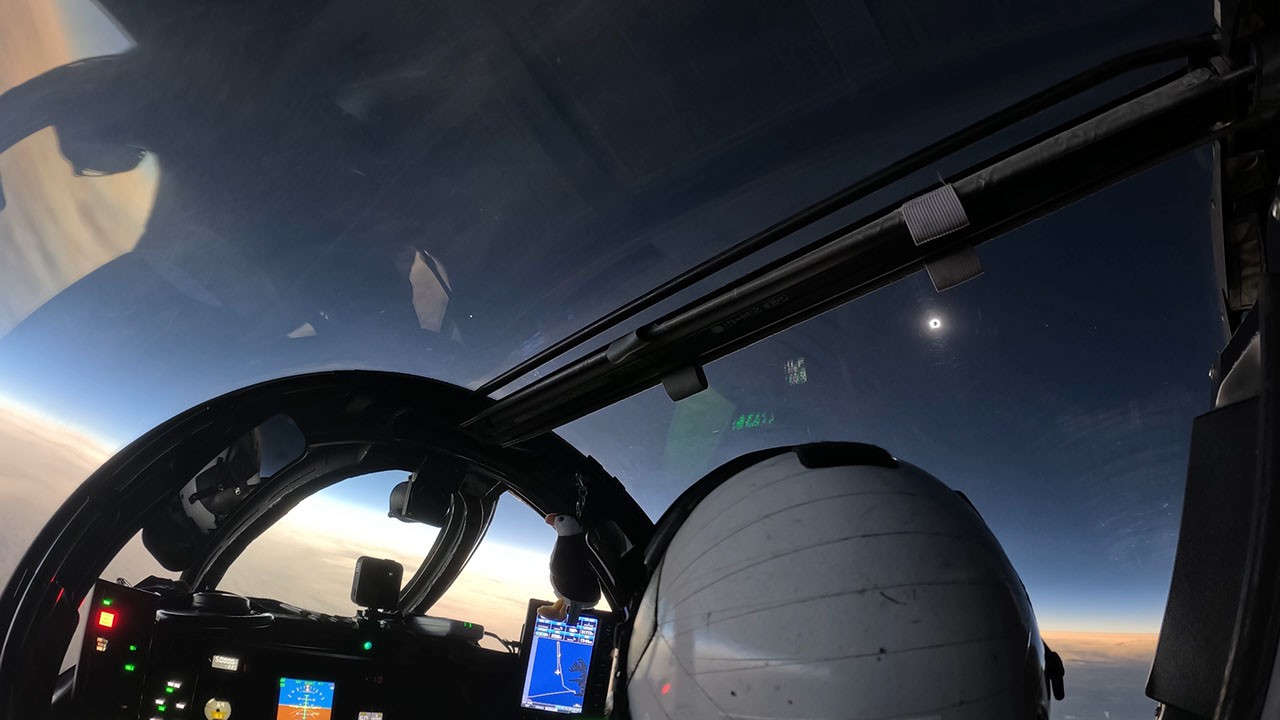
Explanation: Chasing the Moon’s Shadow — On August 12, NASA’s WB-57F high-altitude research aircraft flew off the coast of Iceland to study a total solar eclipse. Cruising at an altitude of 50,000 feet, the aircraft followed a precisely calculated trajectory through the Moon’s shadow, maximizing the time available to observe totality. From above the clouds, dust, and atmospheric water vapor that can interfere with ground-based observations, the aircraft’s high-resolution cameras captured valuable data about the solar corona. This cockpit view, recorded during the flight, shows the corona emerging at the beginning of totality. The sky appears dark because of the Moon’s shadow. Venus shines to the left of the video’s center, while Jupiter and Mercury are visible just to the right of the eclipsed Sun. Along the distant horizon, the sky remains bright because the Moon’s shadow does not extend that far.
NASA’s official Astronomy Picture of the Day website is on the move: Visit apod.nasa.gov or go to science.nasa.gov/apod.
Tomorrow’s photo: Strengthening Pluto
Source: science.nasa.gov