


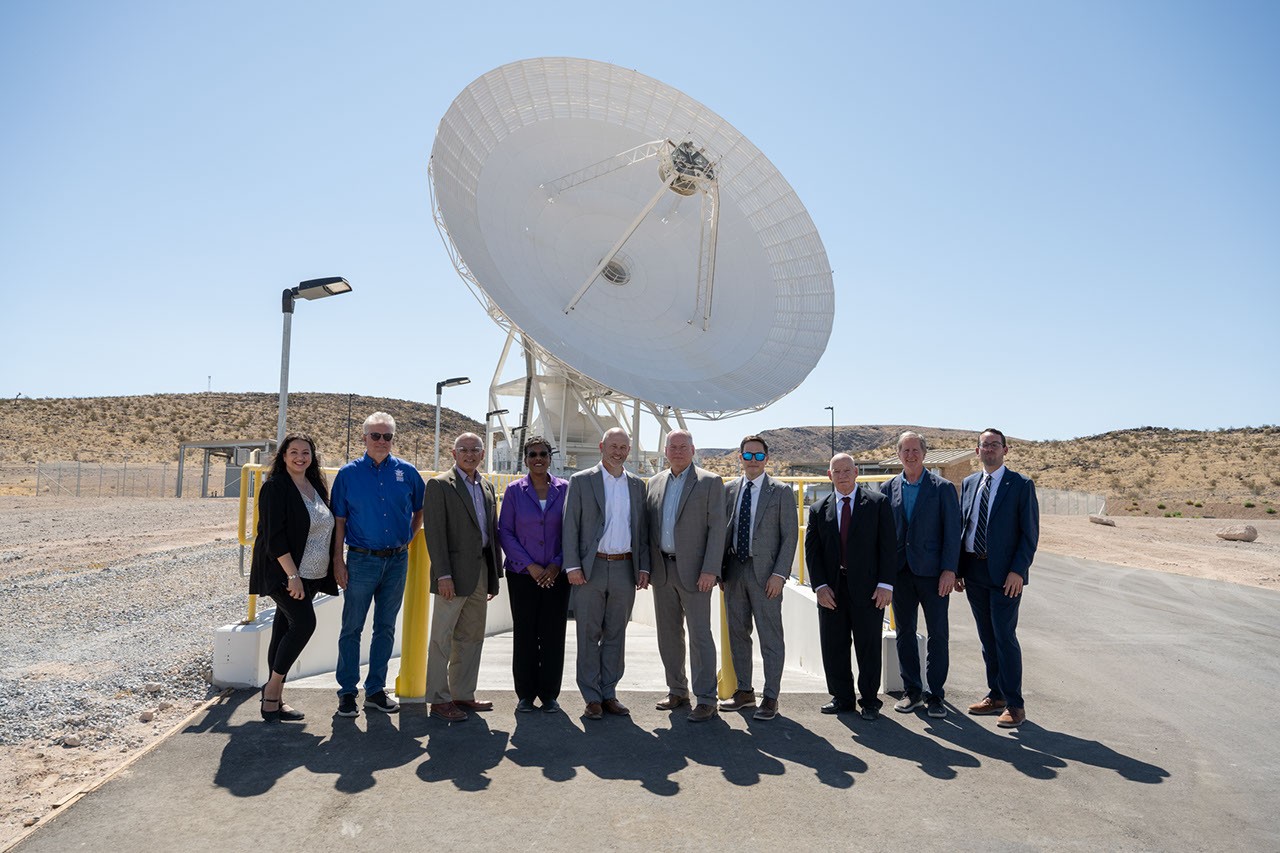
NASA and Jet Propulsion Laboratory (JPL) leaders recently gathered to celebrate the completion of Deep Space Station 23 (DSS-23), a new 34-meter antenna at the Deep Space Network’s Goldstone Complex near Barstow, California. The ribbon-cutting ceremony took place on August 25, 2026.
From left are Germaine Aziz, Project Manager for the DSN Aperture Enhancement Project at JPL; Bradford Arnold, JPL Telecom Program and Oversight Manager; Keyur Patel, JPL Associate Lab Director for Flight Projects and Mission Success; Wanda Peters, Deputy Administrator of the Research and Technology Mission Directorate at NASA Headquarters; Jimmy Kenyon, RTMD Deputy Administrator at NASA Headquarters; John McCullough, Acting Director of NASA’s Space Communications and Navigation (SCaN) Program; Gregory Heckler, NASA Headquarters SCaN representative; William Marinelli, NASA Headquarters SCaN Development Manager; Michael Levesque, DSN JPL Project Manager; and Frank Kaufrod, NASA Glenn Research Center Project Manager.
DSS-23 is the latest antenna completed through NASA’s Deep Space Network Aperture Enhancement Project. Launched in 2009, the project is expanding and upgrading the global network with six new 34-meter (114-foot) antennas. DSS-23 is a multifrequency beam waveguide antenna, allowing it to support multiple space missions operating across different radio frequencies.
NASA’s Deep Space Network (DSN) tracks spacecraft across vast distances, sends commands, and receives scientific data from missions throughout the solar system. The network is managed by NASA’s Jet Propulsion Laboratory, a division of the California Institute of Technology in Southern California. NASA’s Space Communications and Navigation Program is based at NASA Headquarters within the Research and Technology Mission Directorate.
For more information about NASA’s Deep Space Network, visit:
Source: science.nasa.gov