


Close Menu
HitechubHitechub
    What's Hot
    Technology

    Magnesium Supplements May Not Reach the Brain Despite Label Claims

    Science

    Paid Peer Review: Companies Pay Researchers to Evaluate Journal Manuscripts

    Science

    Light Signals Could Help Discover Extraterrestrial Life | Sciworthy

    Important Pages:
    • About Us
    • Privacy Policy
    • Terms & Conditions
    Facebook X (Twitter) Instagram Pinterest
    Facebook X (Twitter) Instagram
    HitechubHitechub
    Thursday, November 26
    • Shop
      • Fashion
        • Mens
        • Womens
        • Accessories
          • Handbags
          • Keychain
          • Masks
          • Money clicps
          • Neck Pillow
          • Rings
          • Towels
          • Wallets
        • Jewelry
        • Watches
        • T-shirts
        • Hawaiian shirts
        • Vests
        • Swim trunks
        • Swimsuits
      • Fun
        • Magic cubes
        • Magnifiers
        • Misc
        • Photo books
        • Puzzles
        • Toys
      • Home
        • Cleaning/Care
        • Mailbox covers
        • Mugs
        • Pot Holders
        • Spoon
      • Office and Electronics
        • Chairs
        • Office Supplies
        • IPad cases
        • Laptop stickers
        • Mouse pads
        • Notebooks
        • Pencil bags
        • Pens
        • Phone cases
      • Personalized
      • Pets
      • Sports
        • Cycling
          • Balaclava Mask
          • Bike Bell
          • Bike Computer
          • Bike Fender
          • Bike Grips
          • Bike Kickstand
          • Bike Light
          • Bike Locks
          • Bike Mitts
          • Bike Pumps
          • Bike Repair Stand
          • Bike Seat
          • Bike Trainer
          • Bike Wheels
          • BIKES
            • Folding Bikes
            • Road Bikes
          • Carbon Fiber Bike Products
          • Cycling Mask
          • Kid’ Bike Helmets
          • Inner Tube
          • Motorcycle Bag
          • Nylon Pedals
          • Adult Helmets
          • Photochromic Sunglasses
          • Soft Coolers
          • Suction Cup Bike Rack
          • Tool accessories
          • Winter Cloth
          • Heart Rate Monitor
        • Outdoors/Camping
          • Outdoor Bags
        • Sweatband
    • Technology
      1. AI
      2. Gadgets
      3. View All

      This is the most popular CEO in the world

      Sectors in which “Chat-GPT” is most often used

      Artificial intelligence has begun to “swallow” professions

      The unusual robot conductor of a concert in Seoul

      Here’s how you can tell if your phone is being tapped

      PlayStation 5 becomes a completely silent console and gets more space

      This is the first phone that can be used to park a car

      Best Gaming Laptops 2023: Powerful Portables for PC Games

      Top 30 Early Black Friday Deals 2026: Best Picks and Ultimate Buying Guide

      Kagi Announces Gmail Rival After Challenging Google Search

      European Spacecraft Discovers Chaotic Asteroid Impact Site After Deflection Test

      Iowa Lead Explosion Investigation: Scientists Begin Studying Its Environmental Impact

    • Science
      1. Space
      2. Wheels
      3. View All

      Space Perspective: A Journey to the Edge of Space

      5 Fascinating Facts About Space

      Space Exploration: Unveiling the Wonders of the Universe

      Toyota wants to make a new generation battery with a range of up to 1,200 km

      Meet Toyota’s lunar “baby” that could make exploring the Moon easier

      What does a night drive look like with one of the most beautiful cars in the world: the Rolls-Royce Ghost

      Coherent Fermion-Parity Oscillations in Coupled Minimal Kitaev Chains

      Iowa Explosion Lead Contamination Concerns Persist Despite Official Assurances

      Einstein’s 120-Year-Old Theory May Be Missing a Major Clue About the Big Bang

      Physicists Use Gravity to Send Unblockable Messages Through Brick Walls

    HitechubHitechub
    Home » Indonesia’s Most Dangerous Underground Fires Continue to Burn
    Science

    Indonesia’s Most Dangerous Underground Fires Continue to Burn

    Share Facebook Twitter Pinterest WhatsApp
    Share
    Facebook Twitter LinkedIn Pinterest WhatsApp

    Indonesia’s tropical peatland fires are among the most dangerous and persistent wildfires on Earth. Instead of spreading rapidly through trees and vegetation, peat fires can smolder underground through dried peat soils and massive carbon-rich deposits. Burning at relatively low temperatures, these fires are difficult to extinguish and can release hazardous air pollution for weeks or even months.

    According to published research, peat fires produce about three times more particulate matter than other tropical forest fires. They also release approximately five times more sulfur dioxide, three times more organic carbon, and twice as much methane and carbon monoxide.

    Satellite images reveal Indonesia’s 2026 fire season

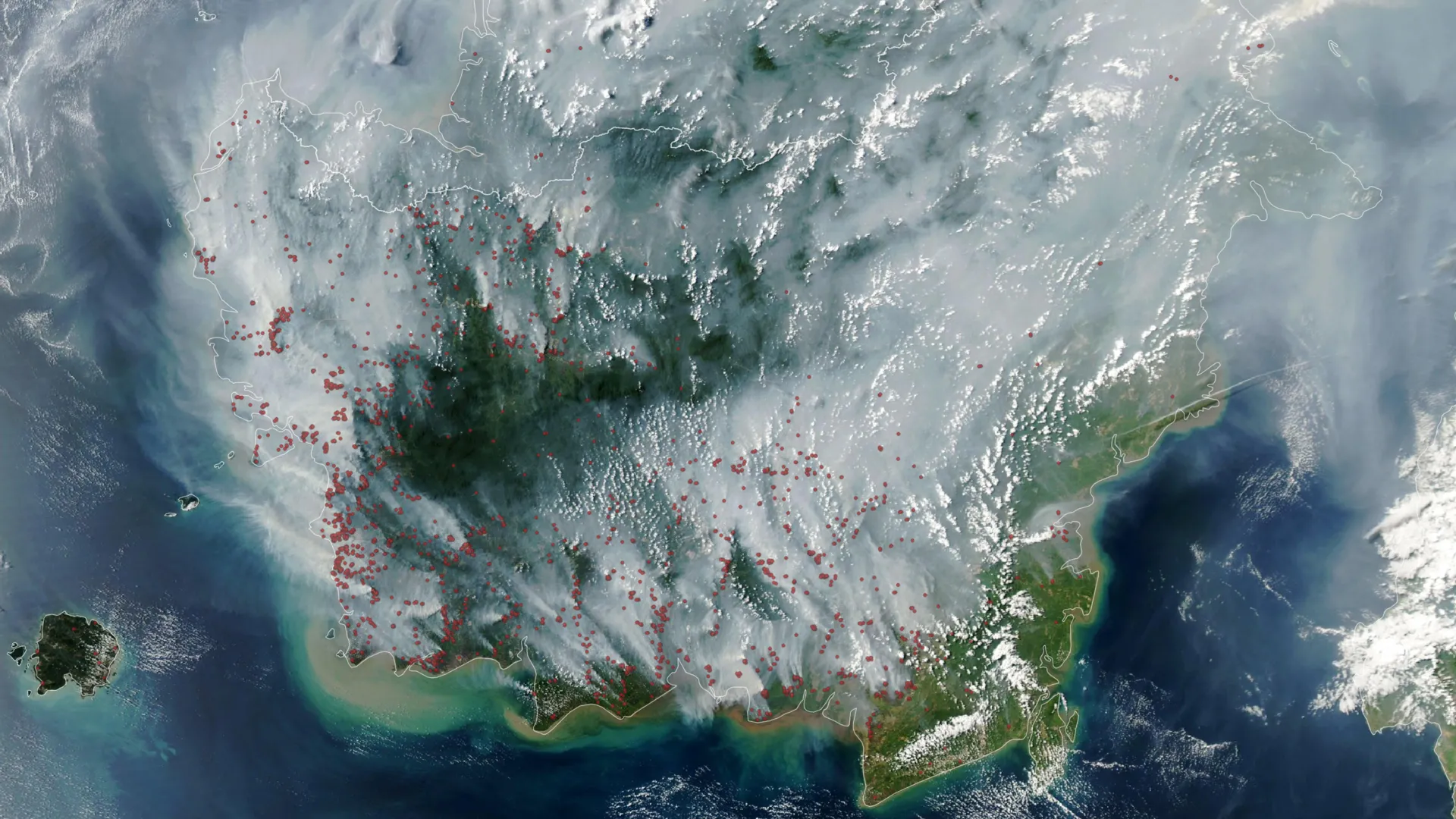
    Indonesia’s 2026 fire season was already underway when the MODIS (Moderate Resolution Imaging Spectroradiometer) instrument aboard NASA’s Aqua satellite captured images of the region on September 1, 2026.

    In this annotated satellite map, each red dot represents a fire detection. Satellite sensors and computer algorithms identify these locations as pixels containing thermal anomalies associated with active fires. A single fire can generate multiple detections.

    Peat fires are a long-standing environmental threat in Indonesia, which contains approximately 36% of the world’s tropical peatlands. During severe droughts, normally waterlogged landscapes can dry out enough to ignite. Over the past three decades, these conditions have repeatedly triggered long-lasting fires that blanketed large areas in toxic smoke and disrupted the lives of millions of people.

    El Niño intensifies Indonesia’s dry season

    Wildfires occur in Indonesia every year, but the most destructive fire seasons in recent decades have coincided with El Niño, particularly in 1997 and 2015.

    NOAA has assessed that El Niño is currently present and could strengthen during August 2026. This climate pattern typically reduces rainfall across Indonesia. Dry conditions could become even more severe if El Niño develops alongside the Indian Ocean Dipole, which is also active.

    A researcher at Columbia University uses the World Fire Weather Database to generate experimental, near-real-time fire weather forecasts.

    “A strong El Niño is causing drier dry seasons and worsening fires in fire-prone areas of the country, just as we expected,” he said.

    Comparisons with the 2015 disaster highlight the potential scale of Indonesia’s 2026 fires. Indonesia’s wildfires in 2015 released an estimated 1.75 billion tons of greenhouse gases after burning for more than three months—more than Japan emits in an entire year. By September 2, 2026, the current fire season had continued for about a month and had already released an estimated 10% of the emissions produced during the 2015 crisis.

    Underground peat fires can burn for months

    Indonesia experienced severe and widespread drought during the summer of 2026, similar to conditions in 2015. Data from the Indonesian Meteorological Department showed that approximately 90% of the country received little or no rainfall in early August.

    Under normal conditions, peat deposits in Kalimantan, Sumatra, and Papua are too wet to sustain underground fires. Drought can dramatically alter that situation, allowing flames to penetrate the peat and continue smoldering beneath the surface.

    “Surface fires are less of a concern, but once they move underground, they can be extremely difficult to stop,” Field said. “They will continue to burn until substantial rain arrives, potentially in October or November.”

    Indonesia uses NASA and NOAA satellite observations to monitor active fires in near real time. MODIS and VIIRS are among the primary instruments used for this work. Operated by Indonesia’s Ministry of Forestry, the SiPongi fire monitoring platform uses MODIS and VIIRS data and recorded 946 hotspots on August 31, 2026.

    The most intense peat fires can be hardest to detect from space

    Satellite monitoring has important limitations. MODIS and VIIRS can struggle to detect fires concealed by thick smoke or clouds, burning beneath forest canopies, or smoldering deep inside peat deposits.

    In fact, the number of fires detected by MODIS and VIIRS can decline when Indonesia’s fires become especially intense because dense smoke blocks the satellites’ view of the ground.

    “Paradoxically, the worst smoke events are the most difficult to observe from space using MODIS and VIIRS,” said Mark Cochrane, an ecologist at the University of Maryland Center for Environmental Science who has conducted field research on Indonesian peat fires for nearly a decade.

    Some of Indonesia’s vulnerability to peat fires can be traced back decades. According to Cochrane, large-scale irrigation canal construction and peat-swamp drainage during the 1990s lowered water tables across the region. The failed mega-rice project left many wetlands drier and more flammable. Oil palm plantations and other forms of plantation forestry have also expanded across parts of the region.

    Following the unusually severe 2015 fire season, governments and other organizations began efforts to restore damaged peatlands and reduce fire risk. These measures include blocking drainage canals to raise water tables, strengthening firefighting capacity, and expanding programs to prevent accidental and human-caused fires.

    Indonesia’s 2026 fire season could test prevention efforts

    “This year will be a real stress test of the measures put in place since 2015,” said Shi Jun Wee, a graduate student at the University of Maryland.

    Wee is part of a team working with NASA and MapBiomas to improve the detection of subsurface peat fires that MODIS and VIIRS may miss. The team’s approach uses shortwave-infrared observations from Landsat and Sentinel-2 satellites.

    As the 2026 fire season continues, Wee plans to use several NASA and global fire-monitoring resources to track conditions, including the Worldview data browser, FIRMS (Fire Information for Resource Management System), HLS (Harmonized Landsat and Sentinel-2) observations, and GFED (Global Fire Emissions Database).

    Toxic smoke is disrupting daily life

    The effects of Indonesia’s peat fires are already being felt by communities across Indonesia and in neighboring countries. Indonesian authorities have warned that large portions of the population are being exposed to hazardous smoke.

    News reports indicated that some schools had switched to remote learning, nine national parks had closed, and several flights had been delayed because of heavy smoke and poor visibility.

    Cochrane warned that peat fires often receive intense public attention during major El Niño seasons, only to fade from view when weather conditions improve.

    “During El Niño events, people tend to focus on these fires and then forget about them,” Cochrane said. “Solving this problem requires continued attention, even during less severe years. These fires produce a tremendous amount of exhaust gas.”

    Source: www.sciencedaily.com

    Share. Facebook Twitter Pinterest LinkedIn WhatsApp
    Previous ArticleChelmsford Stuffed Bear Museum Helps Combat Wildlife Crime
    Next Article AI Controls Fusion Plasma Faster Than Humans Can React

    Related Posts

    Science

    Coherent Fermion-Parity Oscillations in Coupled Minimal Kitaev Chains

    Science

    Iowa Explosion Lead Contamination Concerns Persist Despite Official Assurances

    Science

    Einstein’s 120-Year-Old Theory May Be Missing a Major Clue About the Big Bang

    Science

    Physicists Use Gravity to Send Unblockable Messages Through Brick Walls

    Science

    Engineering Signaling Centers for Human Trunk Morphogenesis In Vitro

    Science

    NASA Expands Supplier Program With New Mentor-Protégé Agreements

    Science

    Single-Cell Variant-to-Enhancer-to-Gene Map of Coronary Artery Disease Genetics

    Science

    8 Universities Dominate Nobel Prizes and Top Economics Awards

    Add A Comment
    Leave A Reply Cancel Reply

    Stay In Touch
    • Facebook
    • Twitter
    • Instagram
    • Pinterest
    Top Picks
    Technology

    End the Frustration: Discover All ISP Fees with Transparency Now

    According to the FCC, these fees “represent costs that providers opt to pass on to…

    Archaeologists Discover Unique 11,000-Year-Old Figure Riding a Leopard at One of the World’s Oldest Settlements

    Naturepedic Promo Code: Get 20% Off Plus a Free Pillow

    Anti-Oligarch Activists to Expose Hundreds of Homes Linked to Elon Musk and Other Billionaires

    Unlocking the Secret to Human Brain Evolution: The Surprising Role of Your Fingers

    Most Popular
    Science

    Los Angeles Earthquake Risk Map Reveals Areas Most Vulnerable to The Big One

    Technology

    Melt, Transform, and Reuse Materials for a Sustainable Future

    Categories
    • AI (9)
    • Gadgets (6)
    • Science (3,594)
    • Space (3)
    • Technology (3,237)
    • Wheels (3)
    Our Picks
    Science

    Oldest Known Martian Meteorite Suggests Mars Lost Its Water Over 4 Billion Years Ago

    Technology

    Russian Drone Attacks Target Ukrainian Data Center by Exploiting Air Defense Weaknesses

    © 2026 Hitechub.
    • Home
    • About Us
    • Privacy Policy
    • Terms & Conditions

    Type above and press Enter to search. Press Esc to cancel.

    GDPR Cookie Banner

    We are using cookies to give you the best experience on our website.

    You can find out more about which cookies we are using or switch them off in .

    Ad Blocker Enabled!
    Ad Blocker Enabled!
    Our website is made possible by displaying online advertisements to our visitors. Please support us by disabling your Ad Blocker.