


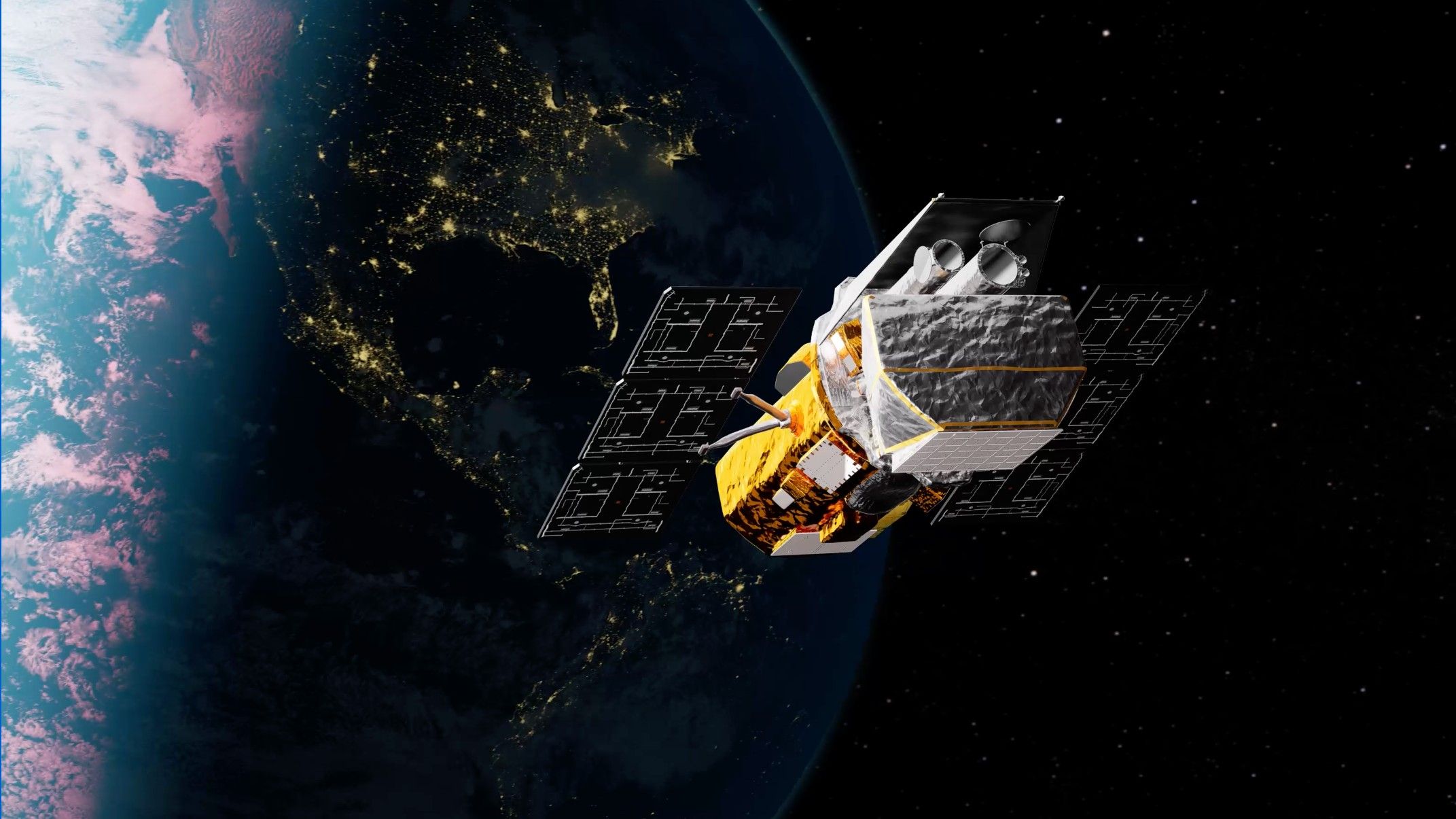
NASA says the decommissioned Neil Gehrels Swift Observatory is rapidly falling from orbit and could re-enter Earth’s atmosphere as early as tonight, November 3. The approximately 3,200-pound (1,450-kilogram) spacecraft is expected to re-enter around 3:30 a.m. ET on Wednesday, November 4, although NASA gives an uncertainty of plus or minus 11 hours.
NASA shared its latest estimate on November 2. An independent analysis by the nonprofit Aerospace Corporation puts the re-entry at 5:12 a.m. ET on Wednesday and estimates that the event will take about eight hours. Both projections suggest that Swift could be gone by Wednesday morning.
Most of Swift is expected to burn up
NASA says most of the observatory will burn up as it passes through the atmosphere. Any surviving debris is expected to fall somewhere between 20.6 degrees south and 20.6 degrees north latitude. That area includes Mexico, the Caribbean, Central and South America, parts of the Arabian Peninsula, India, Africa and Oceania, as well as large areas of ocean.
NASA estimates that the chance of Swift debris landing in a populated area is about 1 in 2,100. For comparison, the National Weather Service estimates that the chance of a person being struck by lightning during their lifetime is 1 in 15,300.
NASA will continue updating its forecast as the time of atmospheric re-entry approaches.
What was the Swift observatory?
The Neil Gehrels Swift Observatory is a space telescope that observes the universe across optical, ultraviolet and X-ray wavelengths. It launched in November 2004 to study phenomena including supernovae, gamma-ray bursts and eruptions caused by black holes.
The telescope was originally designed for a two-year primary mission but operated for more than 10 times that long. Its observations contributed to more than 7,000 scientific papers, according to NASA. That total is expected to grow as researchers process Swift’s final observations, including data related to powerful explosions in the universe.
Why is Swift falling from orbit?
Swift has been losing altitude rapidly for more than a year. Increased solar activity has expanded Earth’s upper atmosphere, increasing atmospheric drag on aging spacecraft and accelerating Swift’s orbital decay.
A mission involving a private spacecraft was also intended to accelerate Swift’s orbit, but it failed shortly after launch. By then, the observatory had fallen too low to maintain a stable orbit and continue observing the sky. Swift’s scientific activities have now officially ended.
Source: www.livescience.com