


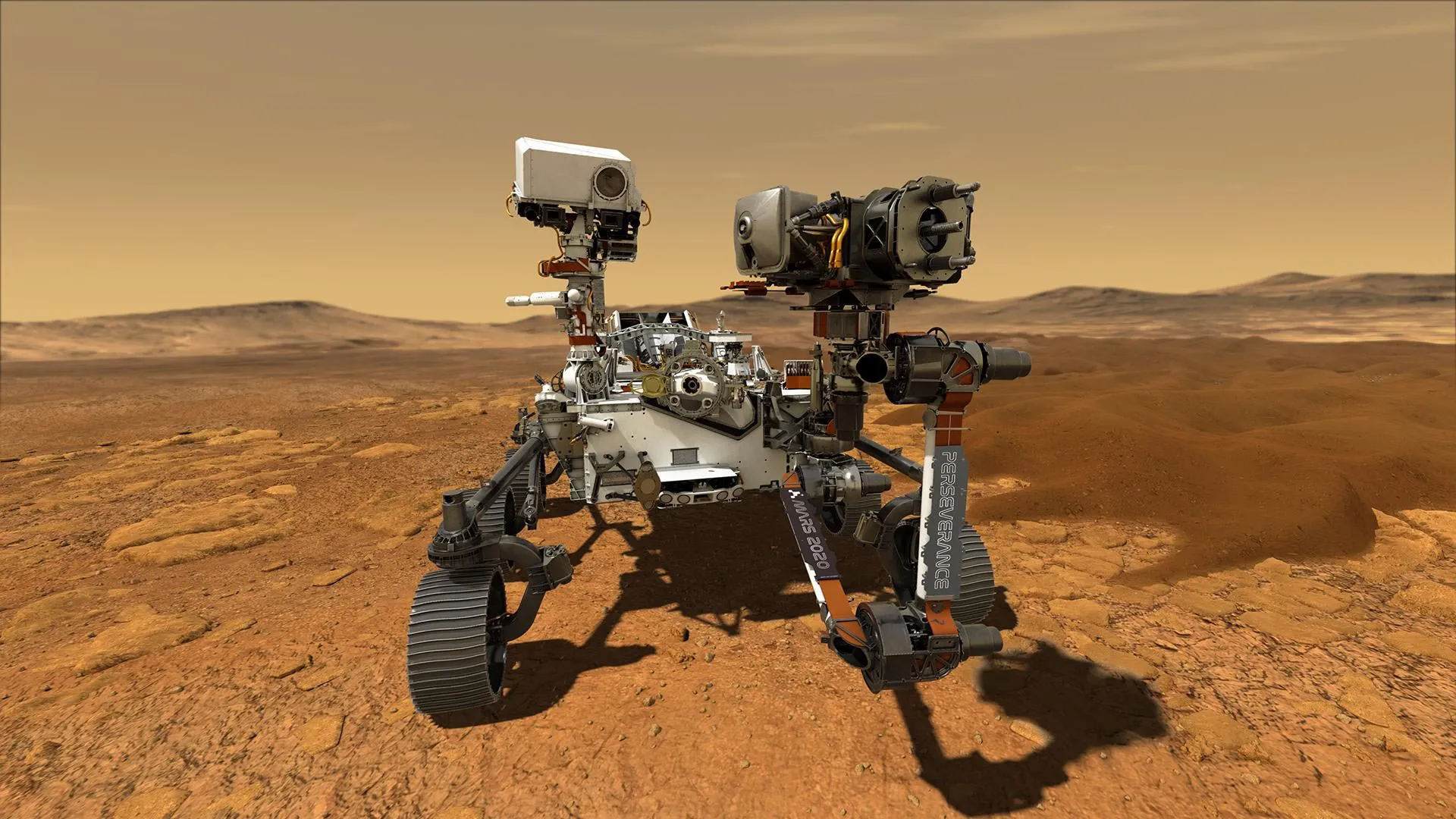
NASA’s Perseverance Rover Sets New Mars Driving Record After Traveling 28.10 Miles
NASA’s Perseverance rover has traveled farther across another world than any vehicle in history, officially setting a new extraterrestrial driving record. On October 11, Perseverance reached 28.10 miles (45.22 kilometers), surpassing the previous record of 28.06 miles (45.16 kilometers) set by NASA’s Opportunity rover, which explored Mars from 2004 to 2018.
Perseverance achieved the milestone in just five and a half years. Opportunity took nearly 15 years to cover its record distance. The new record was set on Perseverance’s 2,006th Martian day, known as a sol.
The rover broke the record while traveling beyond the western rim of Jezero Crater, through an area known as Lac de Charme and toward Idubi. The region contains what scientists believe may be some of the oldest landforms ever explored in the solar system.
These ancient rocks offer a glimpse into Mars’ distant past. Similar formations on Earth have largely disappeared because of erosion and the ongoing movement of Earth’s crust through plate tectonics. Mars does not have plate tectonics.
At Idubi, scientists hope to find evidence of ancient hydrothermal systems. Heated water may once have circulated through the rocks, creating chemical conditions that could have supported life.
How Perseverance’s self-driving system broke the Mars distance record
One of the main reasons Perseverance has traveled so far is its sophisticated autonomous navigation system, known as AutoNav.
AutoNav allows the rover to navigate large areas of Mars without waiting for detailed driving instructions from Earth. As Perseverance moves, it captures images of the landscape, creates a three-dimensional map of potential obstacles, and selects safe routes between destinations chosen by mission planners.
NASA engineers describe the process as “thinking while driving.” The system operates while Perseverance is moving at or near its maximum speed, allowing the rover to cover as much as 1,351 feet (412 meters) of Martian terrain in a single day.
More than 90% of Perseverance’s travel distance includes an AutoNav assessment of the terrain. By comparison, early autonomous navigation systems used by Opportunity and its twin rover, Spirit, could assess only about 5% of their driving range.
The advances become even clearer when Perseverance is compared with NASA’s first Mars rover, Sojourner. That small rover evaluated just 20 measurement points to determine the safest route forward. Perseverance now analyzes approximately 600,000 points every time it surveys the surrounding terrain.
“It’s an honor to work on Perseverance at a time when technology is evolving to the point where this type of operation is commonplace,” said Stephen Lee, project manager for the Curiosity and Perseverance rovers at NASA’s Jet Propulsion Laboratory in Southern California.
“The original mission covered less than 19.4 miles. We significantly surpassed that, and with all mobility systems fully operational and positive results in our ground life extension tests, we expect Perseverance to continue to break this record for many years to come,” Lee added.
NASA has already approved Perseverance’s first mission extension. Beginning in October, the extended mission will allow the rover to continue exploring the rim of Jezero Crater until approximately the end of 2028.
Nearly 30 years of Mars rover exploration
Perseverance’s achievement builds on nearly three decades of robotic exploration on Mars. Each generation of NASA spacecraft has traveled farther, navigated more challenging terrain, and reached locations that earlier vehicles could not explore.
The journey began in 1997 with Sojourner, a rover about the size of a microwave oven. During its 83-sol mission, it traveled approximately 330 feet (100 meters).
NASA made a major advance in 2004 with the arrival of Spirit and Opportunity. The golf-cart-sized rovers were designed to operate on Mars for only 90 days, but both far exceeded expectations.
Spirit was unable to survive the harsh Martian winter. Before its mission ended in 2010, it traveled 4.8 miles (7.7 kilometers).
Opportunity remained active for 5,111 sols. In 2015, it became the first vehicle to complete a marathon distance on another world. Its total mileage established the driving record eventually surpassed by Perseverance.
NASA’s Curiosity rover, which landed in Gale Crater in 2012 and continues to explore the region, has traveled more than 23.65 miles (38.07 kilometers).
Perseverance is becoming a smarter Mars driver
Although Perseverance has surpassed every previous extraterrestrial travel record, NASA engineers are continuing to improve its autonomous driving capabilities.
“This record-breaking rover broke the record by determining its own course. Given its autonomy to just take off, Perseverance is a better driver than the rover that landed, and we’re not done yet,” said Marc Maimone, deputy team leader of Perseverance’s robotic operations team.
“Our latest software teaches Perseverance to maneuver less, rotate more, and check its position against an orbital map while driving. The next frontier is sunlight itself. If we’re driving toward the sun, the glare from the navigation cameras will have us parked by mid-afternoon. And if we can teach the rover to look beyond those artifacts, it will lengthen the operational days of all subsequent rovers,” Maimone said.
Bright sunlight can interfere with Perseverance’s navigation cameras, making it harder for the software to interpret the terrain. When the rover travels toward the sun, mission planners currently halt operations by mid-afternoon to avoid navigation problems.
Overcoming this limitation could allow Perseverance and future Mars rovers to spend more time exploring each day.
Perseverance’s record also extends beyond Mars. During the early stages of its journey, the rover surpassed the historic distances traveled by two vehicles on the moon.
In 1972, Apollo 17 astronauts Gene Cernan and Harrison Schmitt traveled 22.2 miles (35.7 kilometers) across the lunar surface. The following year, the Soviet robotic rover Lunokhod 2 covered 24.2 miles (39 kilometers). Perseverance has now traveled farther than both.
Exploring 4-billion-year-old rocks for signs of ancient life
For NASA, however, setting a mileage record is not the rover’s primary objective. Perseverance’s ability to travel farther and faster allows scientists to examine more geological formations, study a wider variety of rocks, and reconstruct Mars’ environmental history.
The rover has already crossed several dramatically different landscapes. Its journey began on the floor of an ancient lake inside Jezero Crater before continuing through the remains of a river system that once carried water and sediment into the basin.
Along the way, Perseverance encountered a rock called “Cheyava Falls.” Scientists identified a potential biosignature there. Biosignatures are characteristics or chemical patterns that may indicate past life, although non-biological processes can produce similar clues.
The rover is now climbing toward the crater rim, where researchers are investigating different ancient environments. Instead of focusing only on the lake and river habitats studied earlier in the mission, scientists are examining whether hydrothermal activity once occurred in the region.
Hydrothermal systems form when water interacts with hot rocks, potentially creating chemical conditions that can support microbial life.
So far, Perseverance has collected 29 samples of Martian rock and regolith, the loose material covering the planet’s surface. The samples come from several environments, including crater floors, fan-shaped deposits left by ancient rivers, and crater rims.
Some rocks in the rim area formed during a major impact approximately 4 billion years ago. They preserve evidence from an early period in Mars’ history, much of which has been erased on Earth by geological activity.
After completing its survey of Lake Sharm, Perseverance is expected to continue along the crater rim before heading south during its extended mission.
One potential destination is Rainbow Falls, a massive section of ancient Martian crust measuring 100 meters (328 feet) wide. The formation was pushed upward by the powerful impact that created Jezero Crater.
As Perseverance continues its journey, every additional mile will help scientists better understand Mars’ ancient environment and determine whether the planet once had conditions suitable for life.
Source: www.sciencedaily.com