


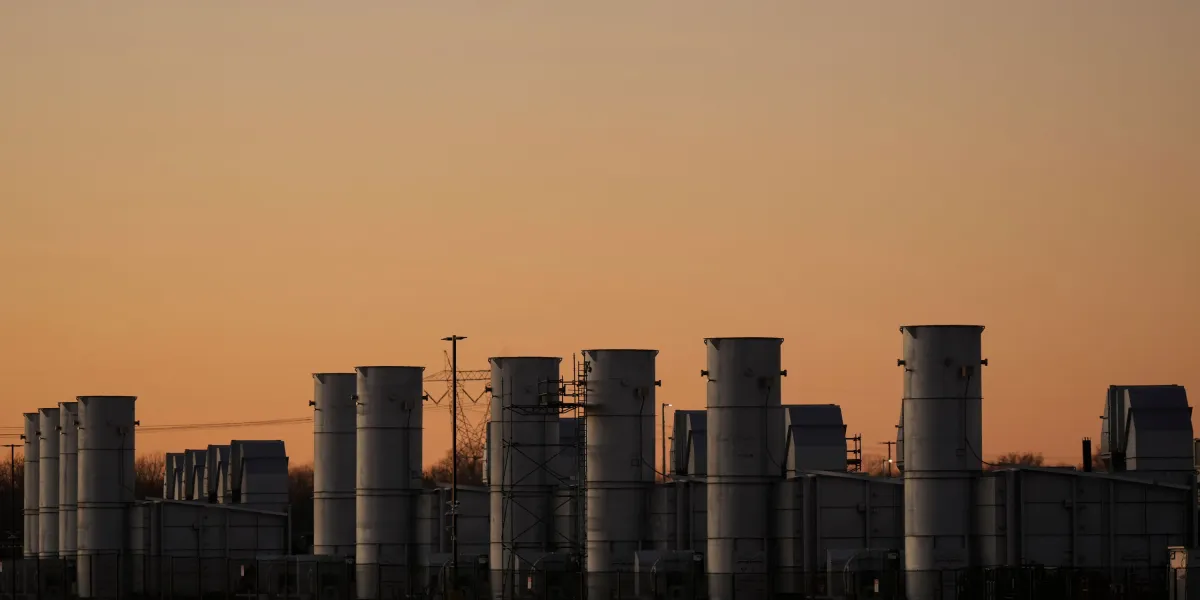
As of October 2026, data center developers in the United States had announced plans for more than 100 behind-the-meter natural gas power plants with a combined planned capacity exceeding 115 gigawatts, according to market intelligence firm Cleanview. That capacity is more than twice California’s peak electricity demand. Although only a small number of the projects are operating or under construction, the surge in on-site power proposals—most announced since early 2025—could influence the electricity grid and climate emissions for decades.
Why data centers are building their own power
Constructing a private power plant is typically more expensive than connecting a facility to the existing grid. However, the rapid expansion of artificial intelligence has made developers willing to pay a substantial premium to bring new data centers online faster.
“Right now, the biggest motivator for on-site power from data centers is speed,” said Musfika Misi, an associate at energy consultancy BloombergNEF.
When a developer proposes a large electricity-intensive facility, such as a data center, it must request a grid connection from the local utility or regional grid operator. That request can begin a multiyear planning process. Grid planners assess what upgrades are needed to supply the facility safely while maintaining reliability. Those upgrades may include new transmission lines, larger transformers and other infrastructure, costs that the developer may have to cover.
Instead of waiting for that process, developers can build power plants on their own properties. These facilities are known as “behind-the-meter” generation because they sit on the customer’s side of the utility meter and supply electricity directly to the building, rather than relying solely on power purchased through a conventional grid connection.
On-site gas plants may only bridge the connection gap
Behind-the-meter generation does not always mean a data center will remain permanently disconnected from the grid. Some developers may use gas-fired plants temporarily, later connecting to the grid and retaining the on-site facilities as backup power.
“The shift to off-grid gas in data center developers’ power strategies raises some important questions about how data centers will be powered in the future,” said Brendan Pierpont, director of power at the think tank Energy Innovation.
Pierpont described the approach as “a very expensive way to close a gap in the schedule,” likely covering the five- to seven-year period before some data centers can obtain a grid connection.
Concerns about long-term fossil fuel dependence
Even when developers present gas plants as a short-term solution, new fossil fuel infrastructure can create lasting consequences. After investing in construction, operators may decide to keep the plants running for longer than originally intended.
“While data centers say this is a grid bridge solution, the real risk is that it could be used much longer, and that would lead to fossil fuel lock-in,” Misi said.
It remains uncertain how many of the more than 100 announced facilities will ultimately be built. Nevertheless, the growing use of private gas generation shows how the AI-driven data center expansion is prompting developers to seek alternatives to lengthy grid-connection processes—potentially reshaping the power system and its climate impact for years to come.
Source: www.technologyreview.com