


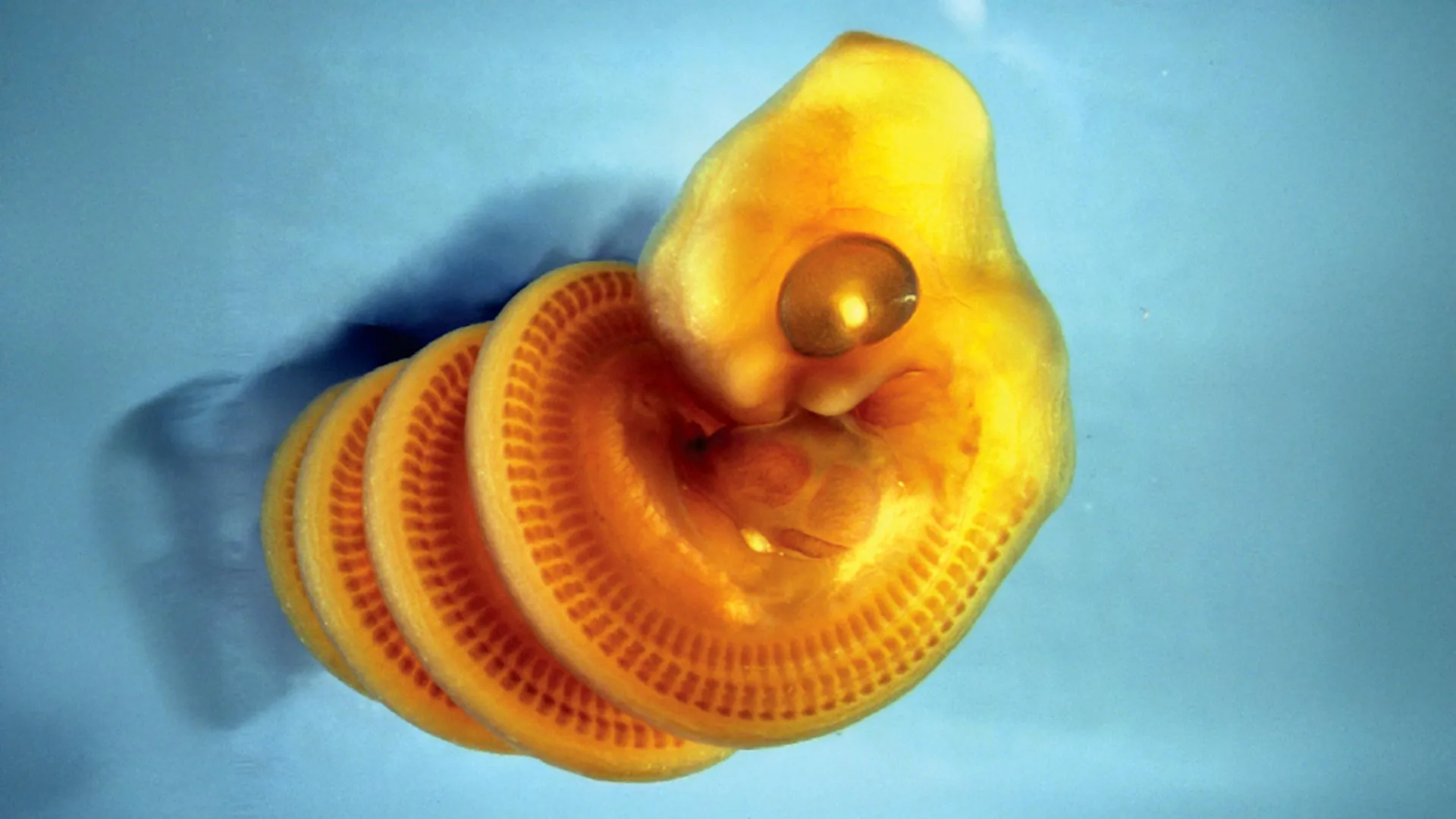
An international research team led by Canadian scientists has discovered a possible explanation for one of the most unusual features of snake development: why snake embryos form tight spirals before hatching. This early coiling behavior may help snakes adapt to the exceptionally long bodies that set them apart from other vertebrates.
The study, published in Current Biology, suggests that a snake embryo’s body elongates rapidly during development, forcing it into a spiral. Because the intestines act as an internal connector, differences in growth rates cause the developing body to buckle and twist into a right-handed coil.
“When you adjust the length of the strap, it’s like twisting the longer buckled side of the loop,” explains senior author and team leader Dr. Tetsuto Miyashita, an evolutionary biologist at the Canadian Museum of Nature.
Why do spirals form in nature?
The discovery adds snake embryos to a long list of naturally occurring helical structures that scientists are still working to understand.
“Spirals are a bit of a mystery, and we’re only just beginning to understand how these shapes are created in animals—from ring-shaped intestines and snail shells to the beautifully coiled embryos of snakes,” says lead author Alexandra Weber, now a graduate student in zoology at the University of British Columbia.
Dr. Miyashita added: “These puzzles invite our curiosity. Spiral shapes in nature have inspired human creations, from rotini pasta and barber poles to artistic and architectural designs.”
The project began under unusual circumstances. During the 2020 coronavirus lockdown, Miyashita was working from home and searching for research questions that his students could investigate without accessing laboratories or museum collections.
“Then a light bulb went on. I had inherited this fascination with animal asymmetry from my PhD supervisor. Every time I saw an image of a snake embryo in a research paper, I wondered whether its coils were right-handed or left-handed.”
This question became the foundation of the research.
More than 900 snake embryos examined
Miyashita asked Weber, then a student at Carleton University, along with two undergraduate students at the University of Ottawa, to search published studies and museum databases for images of developing snakes.
“We obtained photographs of more than 900 embryos from 39 species of snakes and other limbless squamate species. This is a statistically robust sample.”
A clear pattern emerged. During the first few weeks after an egg was laid, the embryo appeared to curl consistently in one direction: to the right when viewed from head to tail.
“At these stages, the embryo doesn’t have the muscles needed to move, so it is wound into a right-handed coil by various physical forces,” Weber explains. “But we didn’t know what was causing this movement.”
Because the embryos cannot yet actively position their bodies, the researchers suspected that a physical feature of embryonic development was responsible for the twisting.
CT scans reveal hidden intestinal structures
An important clue came from co-investigator Dr. Raul Diaz of California State University, Los Angeles. Diaz used computed tomography (CT) images to examine snake embryos in exceptional anatomical detail.
The scans revealed an unexpected internal arrangement inside the developing animal.
“The CT scan of Raul’s snake embryo revealed a structure never seen before: a column of intestines extending through the body spiral,” Miyashita says. “The intestine is separate from the rest of the body and surrounded by a network of blood vessels and tendons connected to the yolk.”
This observation provided the team with the mechanism they had been searching for.
Snake embryos must elongate rapidly to develop their unusually long bodies, but the intestines do not grow at the same rate. This mismatch creates mechanical constraints that cause the body to spiral.
“The slowly growing intestines hold the developing body together. As the body elongates, it buckles, twists, and coils,” Miyashita explains. “The coiling force directs the embryo around the yolk. Because the yolk is positioned on the embryo’s left side, the embryo initially begins curling to the right.”
Why does the coil direction change later?
The embryo does not remain in a right-handed configuration throughout development. As the yolk becomes smaller, the embryo has more space to shift position. Its muscles also mature, allowing it to move independently.
“Some embryos remain right-handed, but others recoil to the left,” Weber says. “As a result, about half of the embryos nearing hatching are right-handed, while the other half are left-handed.”
This finding suggests that the initial direction of snake embryo coiling is determined by developmental anatomy and physical forces rather than intentional muscle movements.
For Miyashita, the discovery also demonstrates how simple observations can lead to broader insights into biology.
“Scientists have long been interested in how and why snakes evolved their unusual body shapes. To answer that question, researchers have often turned to advanced genetic studies involving Hox genes and enhancers,” he says. “Those discoveries are important. But this project, which began during the coronavirus lockdown, uncovered clues about snake development through a surprisingly simple approach: examining images of snake embryos, recording how they coil, and studying their anatomy in detail.”
A new model for spirals in biology
The researchers believe this model could eventually help explain other helical structures found in living organisms.
“We are opening the possibility of developing this model further to explain other spiral forms in nature,” Miyashita says.
Weber agrees. “This all started with a simple curiosity about whether snakes had ‘handedness.’ It was exciting to follow that question and gain deeper insight into snake evolution.”
The research team includes scientists, students, and professors from the Canadian Museum of Nature, the University of British Columbia, Carleton University, the University of Ottawa, California State University, Los Angeles, and the University of Helsinki.
Source: www.sciencedaily.com