


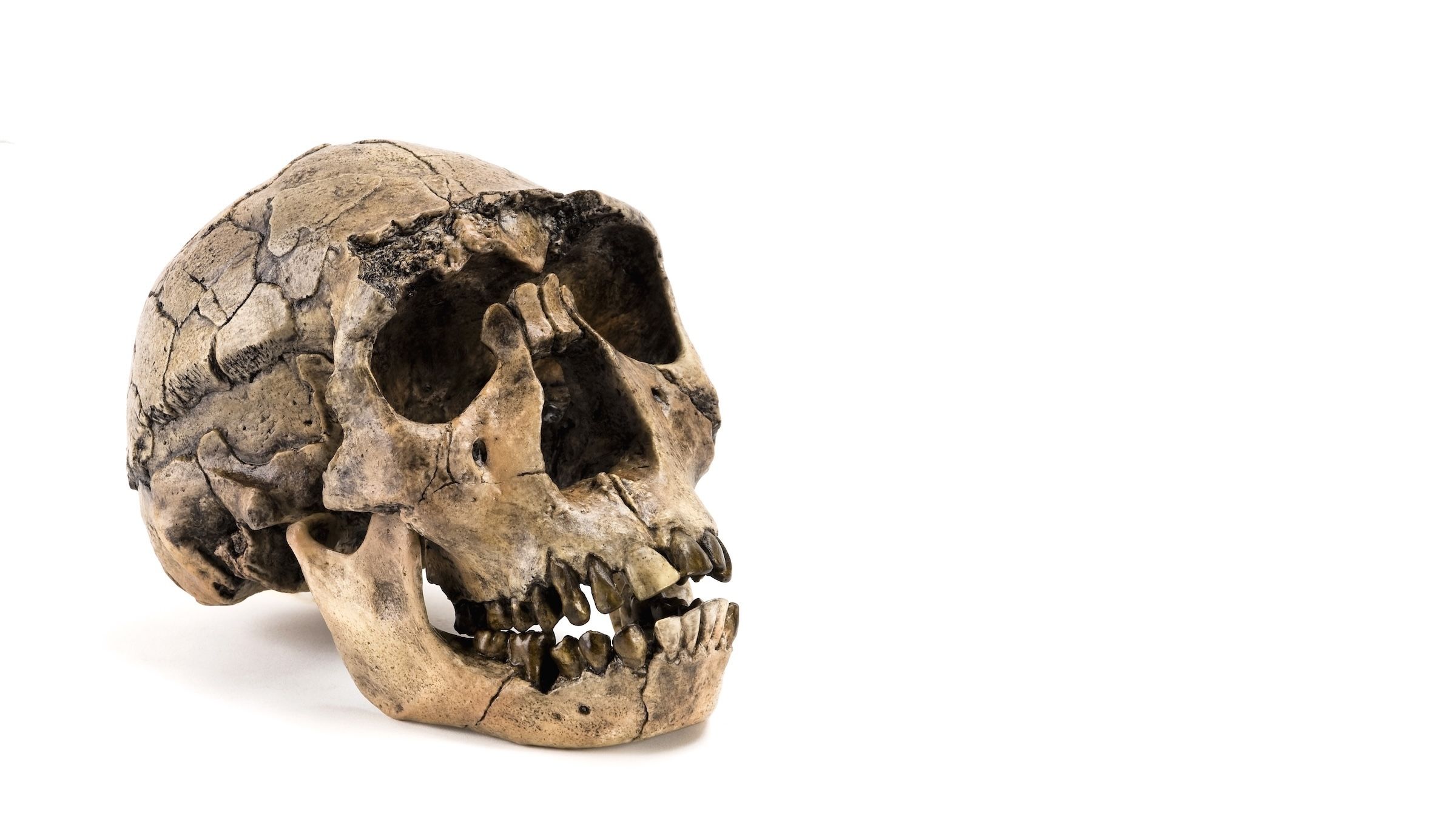
A genetic variant inherited from Neanderthals may have made part of the human brain slightly smaller without measurably affecting intelligence, while also reducing the risk of schizophrenia, according to a new study. The variant, found in the DAAM1 gene, is associated with the size of the brain’s occipital lobe and is present in modern humans outside Africa.
Study co-authors Hugo Seberg and Svante Pääbo, evolutionary geneticists at Germany’s Max Planck Institute for Evolutionary Anthropology, detailed their findings Nov. 16 in the journal Proceedings of the National Academy of Sciences.
A Neanderthal legacy in the brain
Neanderthals, one of modern humans’ closest relatives, went extinct about 40,000 years ago. More than a decade of research has shown that Neanderthals and modern humans interbred. Most people living today who are not of sub-Saharan ancestry carry about 2% Neanderthal ancestry.
Neanderthal skulls were larger and more elongated than those of modern humans. One difference is related to the occipital lobe, the smallest of the brain’s four lobes, which is located at the back of the skull and contains the visual cortex. This region was relatively larger in Neanderthals than in modern humans.
For the new study, researchers analyzed modern human genomes to look for mutations associated with occipital-lobe size that were probably inherited from Neanderthals. They identified one variant involving DAAM1, a gene linked to brain development. The variant was found only in modern humans outside Africa and appeared in five Neanderthal genomes.
Each copy of the Neanderthal-derived variant was associated with a reduction of about 0.05 cubic inches (0.85 cubic centimeters) in occipital-lobe volume. The finding means that some Neanderthal genetic variants may contribute to the slightly smaller brain size seen in modern humans, despite Neanderthals’ larger skulls.
“Neanderthal variants may have relatively strong effects on brain anatomy without affecting intelligence, while also reducing the risk of schizophrenia.”
Hugo Seberg, evolutionary geneticist at the Max Planck Institute for Evolutionary Anthropology
“This effect is the opposite of what experts expected based on Neanderthals’ large skull sizes,” Tony Capra, an evolutionary geneticist at the University of California, San Francisco, who was not involved in the study, told Live Science.
Possible link to schizophrenia
Seberg and Pääbo also found that people with two copies of the DAAM1 variant had a nearly 10% lower risk of schizophrenia. The researchers found no clear association between the variant and intelligence in modern humans.
Schizophrenia can involve altered perceptions of reality, including visual hallucinations, as well as problems processing visual signals. That might suggest a connection between the variant’s effects on the visual cortex and schizophrenia, but there is currently no evidence of such a link, Seberg said.
Capra cautioned that the variant represents only one part of the Neanderthal genetic legacy. “This does not reflect the complete set of mutations that were present in Neanderthals and may have influenced the shape and size of brain structures,” he said.
What other Neanderthal variants may reveal
Researchers are continuing to investigate how other Neanderthal genetic mutations have affected modern humans. Studying variants that are present in Neanderthals but missing from modern human genomes could help reveal which genetic changes distinguish the two groups.
“To see if they have a consistent impact on us,” Capra said, studying Neanderthal variants missing from modern human genomes “may tell us what makes us modern humans, as opposed to them.”
This article is for informational purposes only and does not provide medical advice.
Zeberg, H., & Pääbo, S. (2026). Neanderthal-derived genetic variation reduces hindbrain volume in modern humans. Proceedings of the National Academy of Sciences, 123(48).
Source: www.livescience.com