


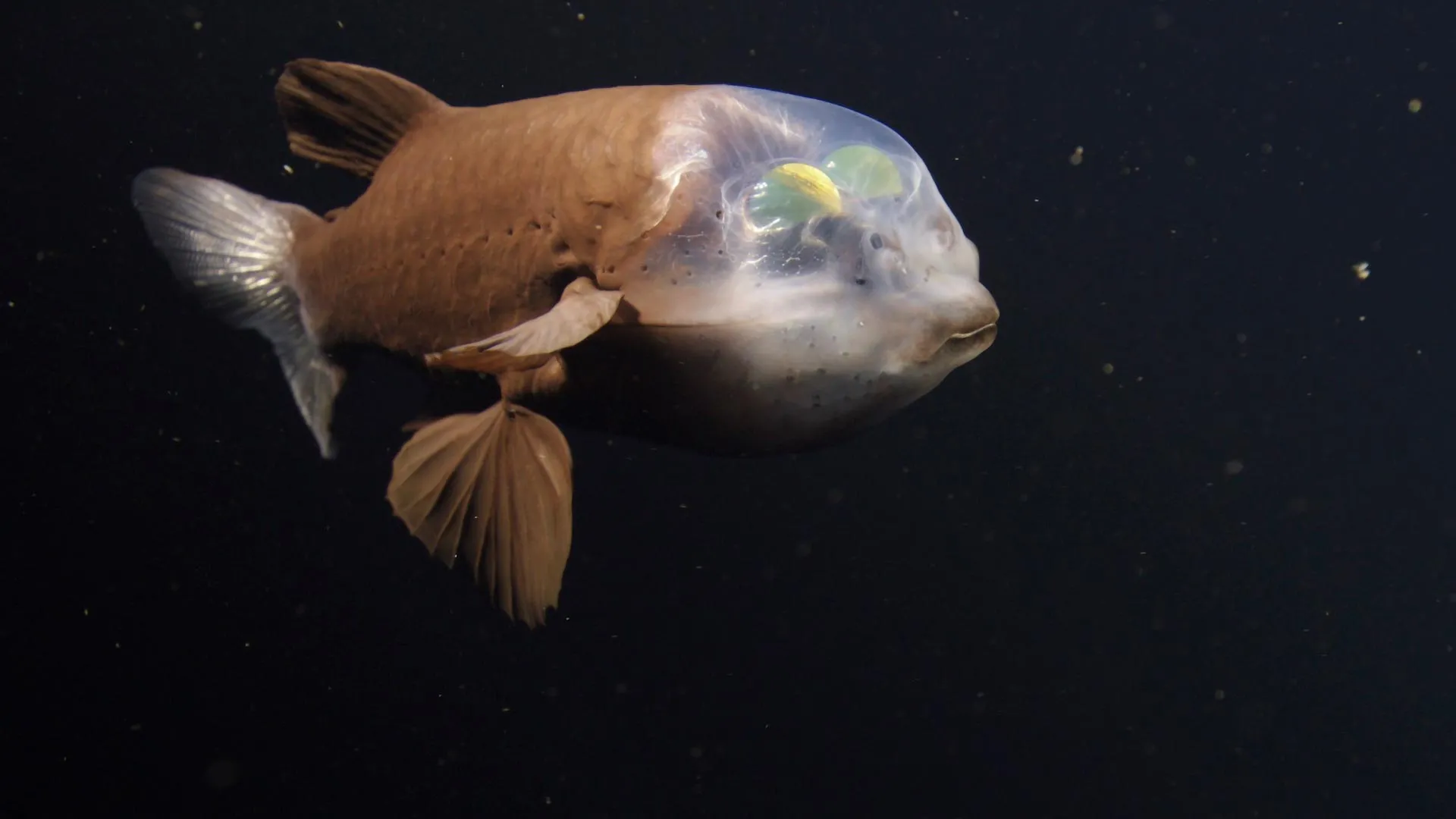
Researchers from the Monterey Bay Aquarium Research Institute (MBARI) have captured rare 4K footage of a barreleye fish nearly 600 meters (1,970 feet) beneath the Pacific Ocean. The encounter, MBARI’s 11th in almost 40 years of exploration, gave scientists an unusually detailed view of the fish’s transparent head and tubular eyes, which can rotate to track prey.
A rare encounter in the deep Pacific
The fish appeared during an eight-day expedition aboard MBARI’s research vessel David Packard. Members of the institute’s biodiversity and biooptics team were surveying marine life about 90 kilometers (55 miles) offshore when they encountered it.
Using the remotely operated vehicle (ROV) Doc Ricketts, researchers were photographing and collecting deep-sea organisms when the barreleye unexpectedly came into view.
“Seeing a barreleye fish is a rare treat. From the other side of the ship, the crew joined the science team in the control room and were fascinated by this amazing animal. Deep-sea animals capture the imagination, creating wonder and awe. We hope this will provide inspiration for the management of the largest living space on Earth,” said Senior Scientist Stephen Haddock.
[See video link below.]
An unexpected highlight of the expedition
Haddock and his colleagues were primarily studying gelatinous marine animals, including jellyfish, siphonophores and ctenophores, also known as comb jellies. Their research focuses on how these delicate animals evolved to survive in the deep open ocean.
To survey organisms throughout the water column, the team combined near-surface blue-water scuba diving with surveys conducted by an ROV hundreds of meters below the surface. Together, these methods allow researchers to observe and collect animals from very different ocean environments.
The barreleye appeared as the day’s underwater operations were ending. The ROV pilot was “flying” Doc Ricketts toward the surface for retrieval when research specialist Shannon Johnson noticed the unusual fish and ordered the vehicle to stop.
Most of the scientists had already gone to the ship’s wet lab to catalog specimens collected during the dive. After hearing about the sighting, they hurried back to the control room, joined by a crew member who wanted to see the animal. The encounter provided an exciting conclusion to a busy week of exploration.
How the barreleye’s transparent head helps it hunt
The barreleye’s unusual appearance is closely linked to how it finds food in the ocean’s twilight zone, where sunlight is weak and prey can be difficult to see.
Early observations by MBARI Senior Scientist Bruce Robison and Research Specialist Kim Reisenbichler helped explain the fish’s hunting strategy.
Rather than constantly swimming in search of food, the barreleye can remain almost motionless with the help of its large fins. These fins provide stability and precise control. Its cylindrical eyes usually point upward, allowing it to watch for the faint silhouettes of animals passing overhead.
When the fish identifies potential prey, its eyes rotate within a transparent dome of tissue covering the top of its head. This allows the barreleye to maintain visual contact as the prey changes position and the fish moves in to capture it.
The clear, gelatinous covering also protects the fish’s sensitive eyes. The barreleye can feed on small crustaceans caught in the stinging tentacles of deep-sea siphonophores, colonial animals related to jellyfish. The dome helps shield its eyes while it retrieves the prey.
4K footage reveals details of the fish’s anatomy
Scientists observed the barreleye for about 20 minutes. The high-resolution 4K camera on Doc Ricketts recorded unusually detailed images of the fish’s anatomy and movements.
The team adjusted the vehicle’s lighting to make the transparent head shield easier to see. These changes revealed structures that help make the species so distinctive.
ROV pilot and technician Cameron Roe brought Doc Ricketts close enough for its virtual-reality camera to capture additional footage. The resulting 3D stereo images offer another perspective on the fish and may eventually be used in educational programs and public outreach.
“This reminds us of the amazing ways animals have adapted to thrive in underwater environments. So many animals survive by searching for subtle optical cues, like shadows passing overhead. This has set off an evolutionary race, pitting bioluminescent camouflage against increasingly sophisticated visual abilities,” Haddock said.
Only 11 encounters in nearly 7,000 dives
The rarity of the sighting is especially notable given MBARI’s extensive exploration history. Over nearly 40 years, the institute has conducted approximately 7,000 ROV dives and accumulated more than 41,000 hours of deep-sea video. Despite that effort, researchers have recorded only 11 encounters with the barreleye.
Previous sighting information is available from MBARI. The latest encounter represents two firsts for the institute: its first 4K footage of the fish and the first observation from its new flagship research vessel, David Packard.
MBARI scientists have also encountered other members of the barreleye family during their explorations. This summer, researchers working with the Schmidt Oceanographic Institution in the mid-Atlantic are studying another rare deep-sea species, the binocular fish (Winteria telescopa).
Such encounters give scientists rare opportunities to observe the adaptations that allow animals to survive far below the sea surface, where light is scarce and much of the marine environment remains unexplored.
The “Diving Deep for Sensitive Drifters” expedition was supported by the David and Lucille Packard Foundation through its long-standing commitment to MBARI’s scientific research.
Source: www.sciencedaily.com