


Unprecedented detailed records from the Üçağızlı II cave, located on the stunning Mediterranean coast of Turkiye, suggest that the transition from Neanderthals to modern humans was more culturally fluid than previously thought. This discovery provides new insights into the archaeological significance of this region.
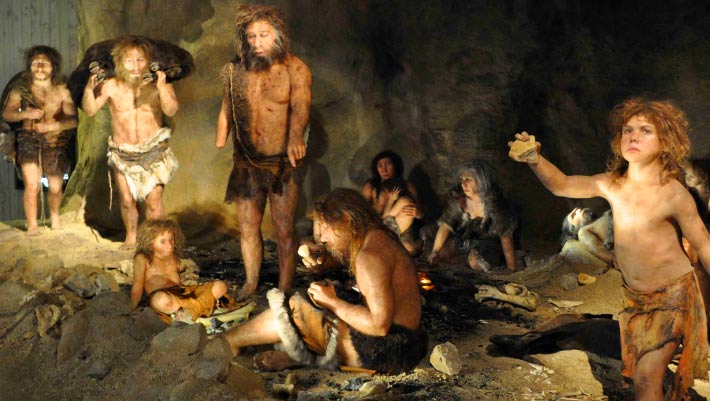
A group of Neanderthals in a cave. Image credit: Tyler B. Tretsven.
“During the mid-to-late Pleistocene, the Levant acted as a critical corridor for the migration of our species, homo sapiens, between Africa and Eurasia,” stated Naoki Morimoto, an archaeologist from Kyoto University.
Evidence of early human presence in the Levant is supported by hominid fossils discovered in Misliya Cave (180,000 years ago), Kafze and Sukfur Cave (100,000 years ago), and Apidima Cave (200,000 years ago).
“Multiple theories have emerged regarding events outside Africa; one prominent hypothesis suggests repeated dispersals between 130,000 and 80,000 years ago, culminating in significant migrations out of Africa around 60,000 years ago, which formed the genetic foundation of modern human populations.”
“There is a significant scarcity of fossil data from the time of these large-scale migrations, leaving many questions about homo sapiens unanswered.”
“Key inquiries focus on the tempo, mode, and behavioral context of interactions between homo sapiens and homo neanderthalensis,” he added.
The Levant remains one of the few regions where modern humans and Neanderthals coexisted.
In the Üçağızlı II cave, situated at the northern edge of the Levant near the Orontes River, archaeologists uncovered a layered series of teeth, stone tools, animal remains, and shells dating back approximately 77,000 to 47,000 years.
Analysis revealed that the oldest layer, dating from about 77,000 to 59,000 years ago, contained Neanderthal teeth, while the upper layer, dated from 59,000 to 47,000 years ago, featured early human teeth from homo sapiens.
Interestingly, archaeologists found not just a shift in species, but a remarkable consistency in behavior.
Both Neanderthals and modern humans crafted remarkably similar stone tools rooted in the Middle Paleolithic, or Mousterian, tradition. They employed equivalent hunting strategies for large game such as wild goats, fallow deer, roe deer, and wild boar, and collected identical marine snail shells, columbella rustica, likely for decorative purposes rather than nutrition.
Some shells exhibited intentional holes or color changes due to heat exposure, indicating that both species regarded them as symbols or ornaments.
Additionally, carved stone artifacts and other manuports (items transported to the site without direct use) suggest a shared cultural tradition transcending species boundaries.
“Our findings indicate a profound level of cultural exchange,” stated Dr. Morimoto.
“These two related yet distinct human groups not only adapted to the same environment but likely shared symbolic values as well.”
The researchers noted that their results contrast with patterns observed at other sites, such as France’s Mandolin Cave, where modern human and Neanderthal settlements appeared in clearly defined layers.
In contrast, at Üçağızlı II Cave, cultural continuity seems to have persisted beyond biological replacement, implying that the two species maintained close, prolonged contact in this area.
“The discoveries at Üçağızlı II Cave address long-standing gaps in the archaeological and paleontological records, potentially reshaping our understanding of early human interactions, communication, and coexistence,” the researchers concluded.
For more details, visit our source: Proceedings of the National Academy of Sciences.
_____
Ismail Baykara et al. 2026. Long-term cultural continuity from Neanderthals to modern humans in Üçağızlı II Cave in the northern Levant. PNAS 123 (29): e2609061123; doi: 10.1073/pnas.2609061123
Source: www.sci.news