


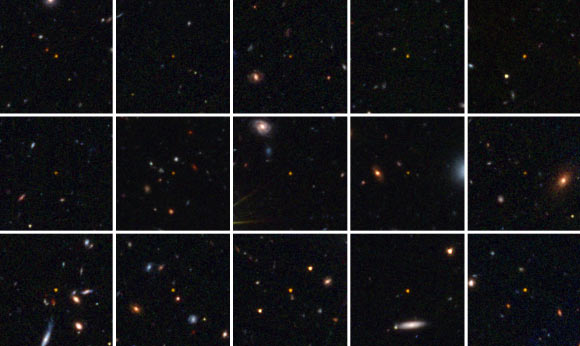
Astronomers utilizing ESA’s Euclid Space Telescope have identified 31 ancient quasars that formed when the universe was only 670 to 800 million years old. Remarkably, one of these quasars, designated EUCL J172902.75+641018.1, establishes a new record as the most distant quasar ever observed.
This collage features 15 of the 31 newly discovered quasars by ESA’s Euclid Space Telescope. EUCL J172902.75+641018.1 and EUCL J125308.55+705432.3 can be seen in the first row, first and second from the left. Image credit: ESA / Euclid / Euclid Consortium / NASA / Euclid Science Ground Segment / Antoine Basset, CNES.
Quasars are among the most luminous and energetic entities in the cosmos, powered by supermassive black holes that consume surrounding matter in the centers of galaxies.
“These ancient quasars date back to the early universe,” stated Dr. Damin Yang, an astronomer at Leiden University.
“Studying them will enhance our understanding of one of astrophysics’ greatest mysteries: how these colossal systems formed and evolved so rapidly.”
“The earliest quasars previously known were merely the tip of the iceberg—rare and bright outliers, easily detectable.”
“Until now, we lacked sufficient quasars from the early universe to analyze them effectively as a collective.”
“Euclid’s new findings have transformed this landscape, capturing a broad spectrum of the ancient quasar population rather than just the bright exceptions.”
This discovery adds 12 new quasars with redshifts greater than 7, corresponding to the first 770 million years of the universe.
The two oldest quasars in this batch, EUCL J172902.75+641018.1 and EUCL J125308.55+705432.3, exhibit redshifts of 7.77 and 7.69, respectively, setting a new record for the oldest known quasars.
Both are positioned over 13 billion light-years away and emerged during the universe’s initial 670 million years.
ESA researcher Dr. Antonio La Marca emphasized: “This discovery more than doubles the known population of very old quasars.”
“Astronomers took over a decade to find the first 10 quasars with redshifts above 7, yet Euclid has already uncovered more in just one year.”
“The Euclid research team conducted the first comprehensive study of quasars from the early universe.”
This marks a significant advancement toward a more fundamental understanding of these intriguing celestial objects.
Further details on this discovery can be found in a research paper published in this week’s edition of Astronomy and Astrophysics.
_____
D. Yang et al. 2026. Euclid: 31 new quasars discovered with 6.6 < z < 7.8. A&A 711, A104; doi: 10.1051/0004-6361/202658883
Source: www.sci.news