


The 2025 Porsche 911 GT3 Touring feels every bit as quick in everyday driving as its predecessor. The manual-equipped GT3 Touring has a slightly lower top speed of 194 mph (312 km/h), down from 199 mph (320 km/h), while its 0–60 mph (0–100 km/h) acceleration remains unchanged at 3.7 seconds. Models equipped with the PDK dual-clutch transmission can reach 60 mph in just 3.2 seconds and have a 193-mph (311-km/h) top speed.
Although the updated gearing reduces the manual GT3 Touring’s maximum speed, its shorter gear ratios make better use of the engine’s expansive rev range. Drivers can enjoy the car’s high-revving performance on the road without needing to reach speeds likely to attract unwanted attention from law enforcement.
The 992.2 Porsche 911 GT3 Touring also gains a more distinctive character. Both GT3 variants receive redesigned front and rear fascias, aerodynamically optimized suspension trailing arms, GT3 RS-inspired anti-dive suspension geometry, and revised steering calibration. Porsche has also introduced Touring-specific equipment, including the new $37,310 Leichtbau package fitted to our test car.
Porsche’s lightweight philosophy removes unnecessary components while adding exclusive performance-focused hardware.
Credit: Bradley Iger
Porsche 911 GT3 Touring Leichtbau Package Reduces Weight
Leichtbau translates from German as “lightweight construction,” a philosophy central to the Porsche 911 GT3 Touring. Even in manual-transmission form, the car has an official curb weight of only 3,239 pounds (1,470 kg). The $37,310 Leichtbau package reduces weight further with a series of carbon-fiber and lightweight upgrades.
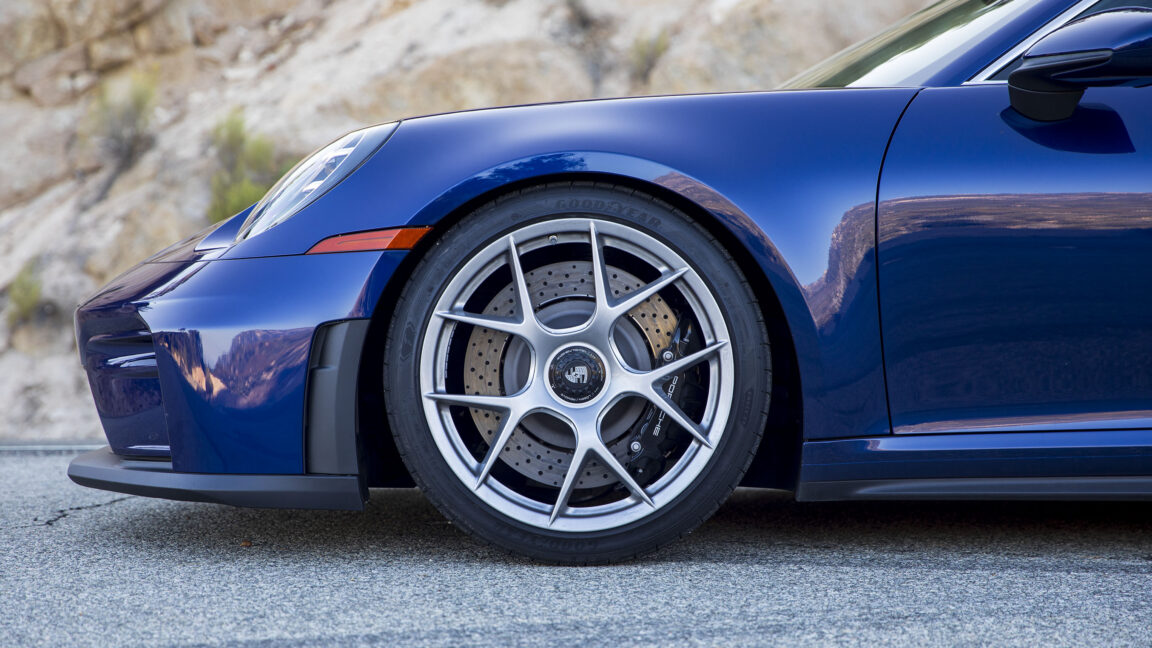
The package replaces the standard roof panel, anti-roll bar, drop links, and rear-axle shear plate with carbon-fiber components. It also adds forged magnesium wheels, reducing unsprung and rotating mass by 19 pounds, along with lightweight interior door panels. Manual-transmission cars receive the shorter gear lever from the Porsche 911 S/T, further sharpening the driving experience.
The GT3 Touring’s road-focused mission also influenced the tuning of the 992.2 GT3 suspension. An improved bump-stop design allows greater spring travel, helping reduce wheel-load fluctuations and minimizing the tendency of the front end to wander across uneven pavement. These updates are primarily intended to make the high-performance Porsche more comfortable and predictable on public roads.
The suspension remains firm, as expected from a Porsche GT3, and rough, heavily rutted pavement can still unsettle the car. Nevertheless, the latest 911 GT3 Touring tracks straighter and resists tramlining far better than most cars with such a strong track-focused character. The result is a lightweight, high-performance sports car that delivers exceptional precision without sacrificing everyday road manners.
Source: arstechnica.com