


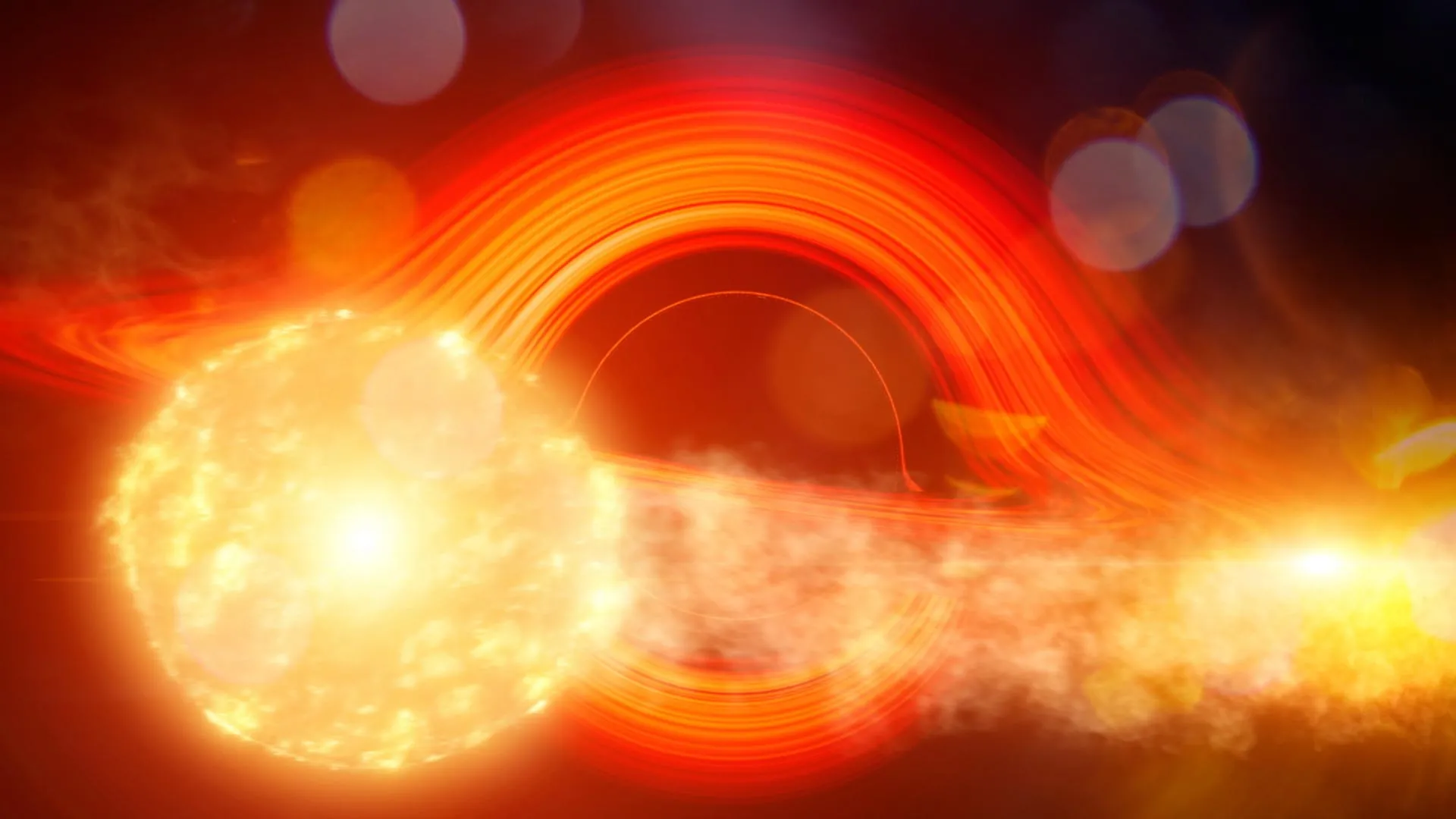
University of Maryland astronomers have discovered a dormant supermassive black hole drifting far from the center of its host galaxy. The finding marks the first confirmed detection of an inactive black hole at such a great distance from a galactic core and provides new insight into wandering black holes, galaxy mergers and black hole formation.
Because the supermassive black hole was not actively consuming matter, it would normally have remained invisible. Astronomers detected it only after the black hole tore apart a passing star, creating a brief but powerful flash of light. The study was published in The Astrophysical Journal Letters on July 27, 2026.
“This is a novel result. What’s new is that, until now, we’ve started with the assumption that supermassive black holes reside in the centers of massive galaxies,” said study co-author Suvi Gezari, an associate professor of astronomy at UMD. “This discovery will have a huge impact. It means that we’re going to find many more examples of wandering black holes, and we can understand how galaxies and their black holes merge and build up over time.”
Scientists Discover a Long-Predicted Wandering Black Hole
Scientists have long predicted that galactic collisions and mergers could push some supermassive black holes away from the centers of their galaxies and into the outer regions. These displaced objects are commonly known as “wandering” black holes.
Detecting wandering black holes is exceptionally difficult. Many are dormant, or quiescent, meaning they are not actively consuming nearby gas, stars or other matter. Without an active feeding disk, they produce little or no detectable light and can travel through the outskirts of a galaxy unnoticed by Earth-based telescopes.
Researchers first identified the quiescent black hole with the Zwicky Transient Facility (ZTF), a wide-field astronomical survey that “searches the whole universe,” according to lead author Robert David Stein. Stein is a Neil Gehrels Prize Postdoctoral Fellow at the Joint Space-Science Institute, a research partnership involving UMD’s Departments of Astronomy and Physics and NASA’s Goddard Space Flight Center (GSFC).
Artificial Intelligence Detects a Black Hole Tidal Disruption Event
Located at Palomar Observatory in San Diego County, California, the Zwicky Transient Facility uses two telescopes to survey the entire northern sky approximately once every two days. The survey records hundreds of thousands of changing cosmic events each night, making it impossible for researchers to manually inspect every signal for evidence of a black hole.
To analyze this enormous volume of data, the research team developed an artificial intelligence (AI) system trained to recognize the distinctive light pattern produced when a black hole destroys a star. Known as a tidal disruption event, this phenomenon occurs when a star passes close enough to a black hole for its intense gravity to pull the star apart.
Astronomers have observed many tidal disruption events near the centers of galaxies. The new AI system was designed to search for similar stellar flares across the entire sky, including areas far from galactic cores where wandering black holes may be located.
The UMD researchers began using the AI program in August 2025. Just three months later, it identified the tidal disruption event that led scientists to the dormant wandering black hole.
“I remember the moment we discovered it very clearly. It was a Saturday, and everyone was very excited to be messaging. We dropped everything and started triggering all kinds of other instruments to get more data,” Stein said. “We weren’t really sure we would be successful so quickly, so it’s amazing that we found one so fast.”
Supermassive Black Hole Found 30,000 Light-Years From Its Galaxy’s Center
The black hole is located 9.3 kiloparsecs, or approximately 30,000 light-years, from the center of its host galaxy. Its mass is comparable to that of Sagittarius A*, the supermassive black hole at the center of the Milky Way.
The object is especially unusual because astronomers cannot see an obvious galaxy surrounding it, according to study co-author Sylvain Veilleux, a professor of astronomy at UMD.
“To have such a big black hole outside of a galaxy is surprising to me,” he said. “There should be a Milky Way-like object around it — and that’s definitely not the case.”
Researchers believe the black hole’s remote location is probably the result of a previous galaxy collision or merger.
One possibility is that a large galaxy absorbed a smaller companion galaxy. Over time, the larger galaxy could have stripped away nearly all of the smaller galaxy’s stars, leaving behind only its dense central core and supermassive black hole.
Another explanation involves a chaotic interaction between three black holes. A galaxy may have already contained two black holes orbiting one another near its center in a system called a binary black hole. If a third black hole entered during a later galactic merger, the resulting three-body interaction could have ejected the smallest black hole from the galactic center.
Further observations of the tidal disruption event could help astronomers determine which scenario best explains the black hole’s unusual position.
Dormant and Wandering Black Holes May Be Common
Studying inactive supermassive black holes is important because most black holes are dormant, including the black hole at the center of the Milky Way.
Scientists do not yet know whether wandering black holes are present in the outer regions of our own galaxy. However, Stein said there is no reason for concern about encountering one.
“We’re very unlikely to meet one, at least in our lifetime.”
The research team is continuing to scan the sky for additional wandering black holes. Discovering more of these elusive objects could help scientists understand how galaxies form, how galaxies merge and how many black holes move through the universe, Stein said.
The discovery also shows that dormant wandering black holes can be found by combining conventional wide-field sky surveys with machine learning, rather than relying only on expensive or specialized observing programs.
“It is super exciting,” Gezari explained. “It’s an example of machine learning opening up a whole new area of research.”
New Telescopes Could Find Hundreds of Wandering Black Holes
Stein expects future searches with the NSF-DOE Vera C. Rubin Observatory to identify dozens or potentially hundreds of wandering black holes each year. The Chile-based observatory debuted last June and produces highly detailed images of the sky using the world’s largest digital camera.
Veilleux also highlighted the Lowell Discovery Telescope and its Rapid infrared IMAger-Spectrometer. The instrument debuted in June 2025 through a collaboration among GSFC, the UMD Department of Astronomy and Lowell Observatory. It could allow astronomers to detect tidal disruption events at significantly greater distances from Earth than previously possible.
“This is the strongest case of a wandering black hole that we know,” Veilleux said. “This is going to set the standard.”
UMD Astronomy Adjunct Professor Stephen Bradley Cenko and postdoctoral associate Jillian Chin Rastinejad coauthored the study with Stein, Gezari and Veilleux.
This research was funded by the U.S. National Science Foundation (Award Nos. 2407588 and 1106171); the Gordon and Betty Moore Foundation through the Data-Driven Investigator Program and a dedicated grant to SkyPortal; the W. M. Keck Foundation; the Heising-Simons Foundation; William and Marina Kast; the University of California Observatories; Google; Deutsche Forschungsgemeinschaft under Germany’s Excellence Strategy, EXC-2094/2, 390783311.939; the Australian Research Council under ARC LIEF grant LE130100104; Astronomy Australia Limited and the Australian Government through the Commonwealth’s Education Investment Fund and National Collaborative Research Infrastructure Strategy, particularly the National eResearch Collaboration Tools and Resources and the Australian National Data Service Projects. This content does not necessarily reflect the views of these parties and organizations.
Source: www.sciencedaily.com