


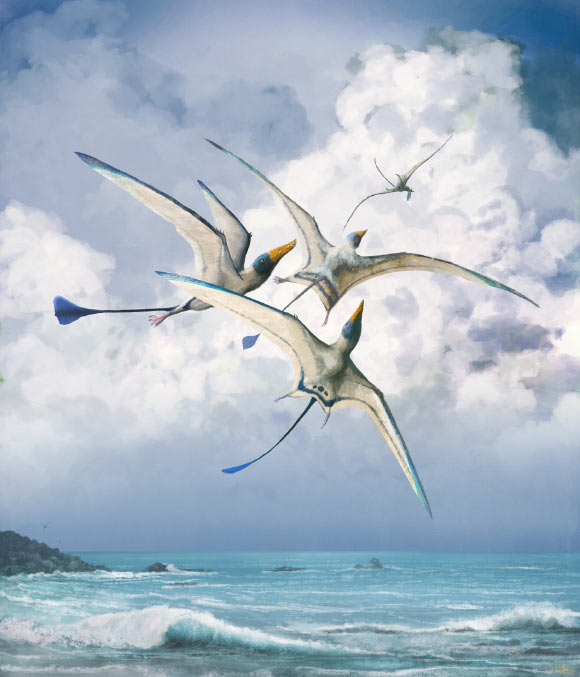
Recent research from the University of Bristol reveals that pterosaurs, the first vertebrates to master powered flight, likely had a broader variety of wing shapes and flight styles than what fossil reconstructions currently suggest.
This research elucidates the potential discrepancies between actual pterosaur wing shapes and artistic interpretations. Image credit: Mark P. Witton.
Pterosaurs thrived from approximately 210 million to 65 million years ago, until an asteroid impact led to their extinction alongside non-avian dinosaurs.
These remarkable reptiles are significant as they independently evolved flight, setting new records for the maximum size of flying vertebrates throughout their evolutionary history.
However, the true morphology of pterosaur wings remains poorly understood.
“Wing shape is intrinsically linked to flight performance and functionality in living organisms,” remarked lead author Dr. Benton Walters and his colleagues.
“Analyzing this relationship in pterosaurs is challenging due to the incomplete nature of the fossil record and the absence of consistent flight dimensions of wing membranes.”
“In the absence of completely expanded pterosaur wing fossils, reconstructing the pterosaur bauplan offers a valuable alternative for analysis.”
“Nonetheless, wing shape is influenced by various conflicting scientific perspectives as well as the artistic interpretations of researchers and illustrators.”
In this new study, the authors examined 79 wing reconstructions across eight genera of pterosaurs, including Pteranodon and Quetzalcoatlus.
They utilized a method called theoretical morphospace to map all potential wing shapes.
This enabled them to assess whether the reconstructed wings were appropriately shaped for effective flight.
Their findings indicated that the illustrations often presented overly dense shapes in terms of aerodynamic performance, irrespective of the size, age, or proposed ecological niche of the depicted pterosaurs.
A minuscule insect feeder and a massive sea glider, which would have had considerably different wing configurations in life, showed striking similarities in illustrations.
The researchers attribute this issue to the ongoing lack of scientific agreement regarding the attachment points of wing membranes on pterosaurs’ bodies.
“In contemporary flying creatures like birds and bats, different lifestyles correlate with unique wing shapes and flight capabilities,” stated Dr. Walters.
“The noticeable absence of diversity in pterosaur reconstructions suggests that crucial variations are being overlooked.”
“Reconstructing pterosaur wings is traditionally based on measurements of supportive bones and limited soft tissue information from a few exceptional fossils, yet much remains inconclusive.”
“For a species group that existed for over 100 million years, encompassing everything from palm-sized to massive forms, a range of shapes would be expected.”
“However, regardless of the specific pterosaur being depicted, the wing shapes tend to be remarkably similar.”
This study serves as a critical guide, highlighting gaps in our scientific understanding of pterosaur wings, and will serve as a benchmark to refine future pterosaur reconstructions as our knowledge evolves.
A study detailing this research was published on June 23 in the journal Paleontology.
_____
Benton Walters et al. Exploring the limits of pterosaur wing design. Paleontology, published online June 23, 2026. doi: 10.1017/pab.2026.10103
Source: www.sci.news