


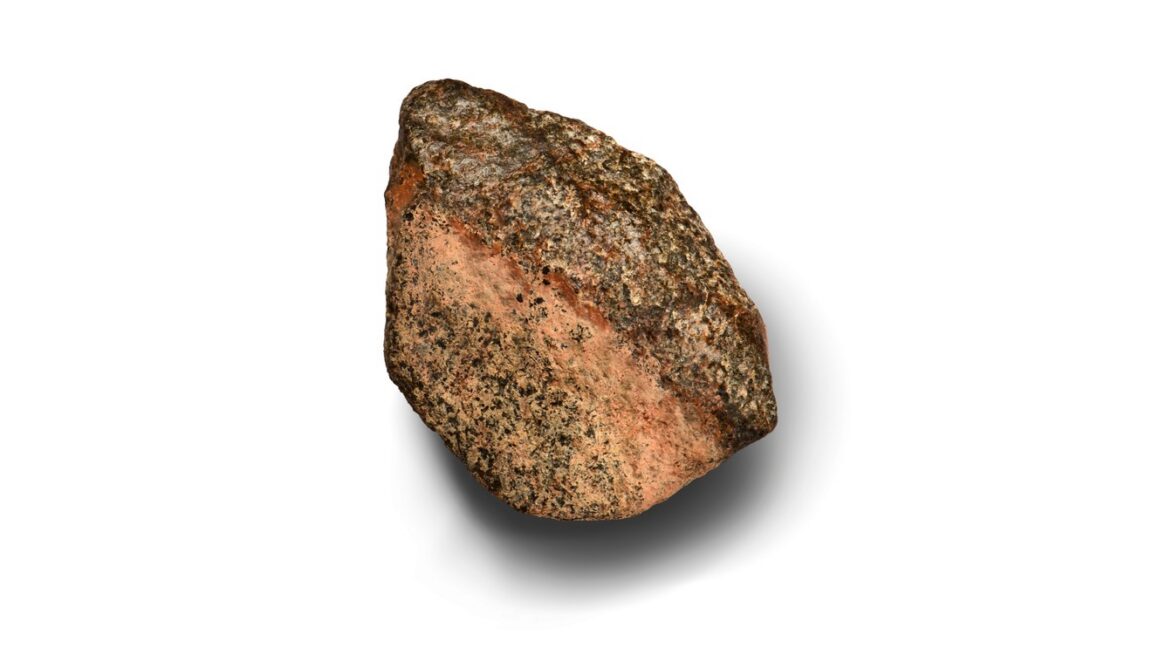
Tegaza 001, a meteorite recovered through the Sahara Desert’s meteorite trade, has been identified as an unusual Martian rock. Oxygen-isotope measurements linked it to other Martian meteorites, while its mineral composition and slow cooling history suggest it formed from magma that solidified deep within Mars’ crust rather than erupting at the surface.
Tegaza 001’s Martian origin
Meteorite hunters found the black stones in the Sahara Desert, where dark rocks stand out against the sand. Eight pieces of Tegaza 001, weighing just under 800 grams in total, were purchased by a private collector and sent to the University of New Mexico for classification.
Planetary scientists Carl Agee and Karen Ziegler measured the meteorite’s oxygen isotopes. “Each planetary body has very characteristic oxygen isotope values,” Liu says. The values for Tegaza 001 matched those of other Martian meteorites.
An unusual type of Martian meteorite
The rock was initially classified as shergottite, the most common and youngest type of Martian meteorite. However, Agee noticed unusual features and contacted Ryu. One of Tegaza 001’s minerals had altered internally while its exterior remained in its original state—opposite to the typical pattern of weathering on Earth.
The meteorite’s oxygen isotopes also appeared somewhat unusual. In addition, it contained a manganese-rich material similar to material Liu studied in Black Beauty.
“When I got to the sample, I looked around and said, ‘I’m bored,’” Liu said. “Although high-manganese material actually exists on Earth, we quickly realized that our sample was very different and very special.”
Evidence of slow cooling beneath Mars’ surface
Tegaza 001 is made primarily of feldspar, a light-colored mineral commonly found in the crusts of rocky planets. The feldspar is mixed with dark-colored pyroxene crystals. Liu said the crystals resemble rocks exposed in the Moon’s highlands.
The crystals measure up to 1 millimeter across, which scientists interpret as evidence that the rock cooled slowly. “Rocks that cool slowly tend to take longer to grow,” Liu said.
Using laboratory experiments and comparisons with rocks and crystals on Earth, the research team estimated that Tegaza 001 cooled at a rate of about 0.01 degrees Celsius per year. That slow cooling suggests the meteorite did not form during an eruption. Instead, it crystallized from magma that solidified within Mars’ crust.
Source: arstechnica.com