


New Boron Phase Is Deformable and More Than a Million Times More Conductive
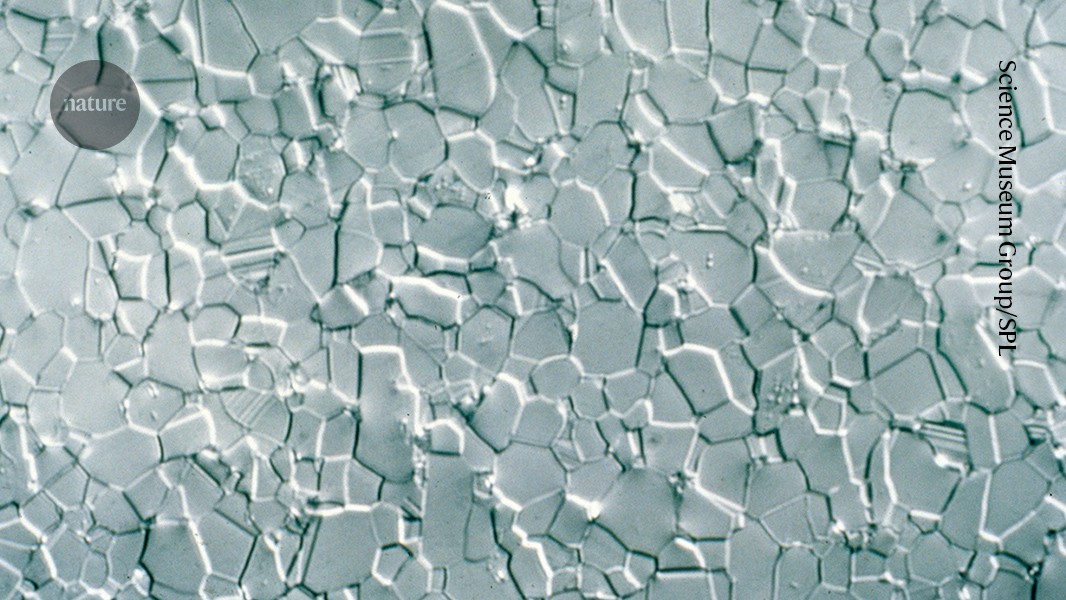
Boron carbide, also known as black diamond, is one of the hardest synthetic materials known.
Credit: Science Museum Group/SPL
Boron has long intrigued scientists because its atoms can form many types of bonds. As a result, pure boron exists in several phases, most of which are hard and have poor electrical conductivity.
Now, researchers have prepared a new boron phase with an unusual combination of properties. The material is deformable and more than a million times more conductive than typical boron materials. Known as Imma-B60, the structure is reported in Nature Chemistry.1
A rare new boron allotrope
Like its neighbor carbon on the periodic table, which occurs in forms such as diamond and graphite, boron can exist in several arrangements called allotropes. Each allotrope can have different physical properties.
The last discovery of a rare boron allotrope dates back to 2009.2 Artem Oganov, a materials chemist at Skolkovo Institute of Science and Technology in Moscow, was involved in that research. The discovery of Imma-B60 opens synthetic routes to entire families of boron materials.
Boron typically reacts readily with other elements to form borides rather than pure boron allotropes. Its light atoms are also difficult to detect accurately in experiments. Together, these challenges help explain why so few boron allotropes have been discovered in the past 16 years, even though many have been predicted.
How researchers synthesized Imma-B60
Zhou Xiangfeng, a materials scientist at Yanshan University in Qinhuangdao, China, and collaborators developed a two-step process that has not previously been applied to boron.
First, the researchers reacted boron with sodium under high pressure. They then heated the mixture to 900 °C under vacuum, removing almost all of the sodium impurities and producing Imma-B60.

Source: Reference 1
“This is a powerful approach. It’s not entirely new, but it’s probably the most elegant and most modern application,” Oganov says. “The impact could be very far-reaching.”
Why the new boron material can deform
The new phase consists of a network of boron atoms with open spaces left behind when the sodium atoms are removed. These spaces allow atoms to move through a process called dislocation slip, giving the material its unusual deformability.
Imma-B60 stretched to 23% of its original length before breaking. However, once stretched, the material did not return to its original shape.
Source: www.nature.com