


White Dwarfs Aren’t Always White: Scientists Find Green and Deep-Pink Stars
A new study has revealed that white dwarf stars come in a surprising range of colors, including what scientists describe as the first known green star and the reddest white dwarf ever discovered.
White dwarfs are the dense, cooled cores left behind when low- to intermediate-mass stars run out of fuel. Although they are known as “white” dwarfs, new research suggests these stellar remnants can emit visible light in shades of pink, green, cyan, violet and yellow.
Why white dwarfs can appear in different colors
The study was published Thursday, October 15, in the journal RAS technology and equipment.
The nickname “white dwarf” originated because the first known example appeared white or pale blue. However, the color of a white dwarf depends on more than its temperature.
“Most stars, including most white dwarfs, behave like ‘perfect radiators,’ so their color is determined almost entirely by temperature,” Mark Hollands, the study’s lead author and an astronomer at the University of Warwick in the United Kingdom, said in a statement.
“But no one has seriously considered what else white dwarfs are capable of. We found that these incredibly dense stars can produce colors that no one expected, some of which were truly surprising.”
The researchers suggest that white dwarfs’ unusual colors are linked to their extreme density. Cooler white dwarfs have a density of about 1 gram per cubic centimeter, similar to flowing water on Earth. Their density is millions of times higher than that of the Sun’s visible surface, or photosphere.
At these pressures, trace elements such as carbon, calcium and sodium interact with dense helium plasma. The elements absorb a wider range of light than they would at lower densities, shifting the stars’ appearance away from the orange, white and blue colors expected from typical stellar radiators.
How astronomers identified the stars’ colors
White dwarfs are small and distant, making it difficult to observe their colors directly. To determine how they appear, the astronomers analyzed spectra—the distinctive chemical fingerprints contained in starlight.
The team then applied the spectral data to a color-vision model that estimates how the human eye would perceive the stars.
The study found that carbon-rich white dwarfs tend to appear purple or pink. White dwarfs containing debris from asteroids or comets are usually more yellow. Cyan or pale blue white dwarfs can form when hydrogen and helium molecules collide in an extremely dense atmosphere.
A rare green white dwarf
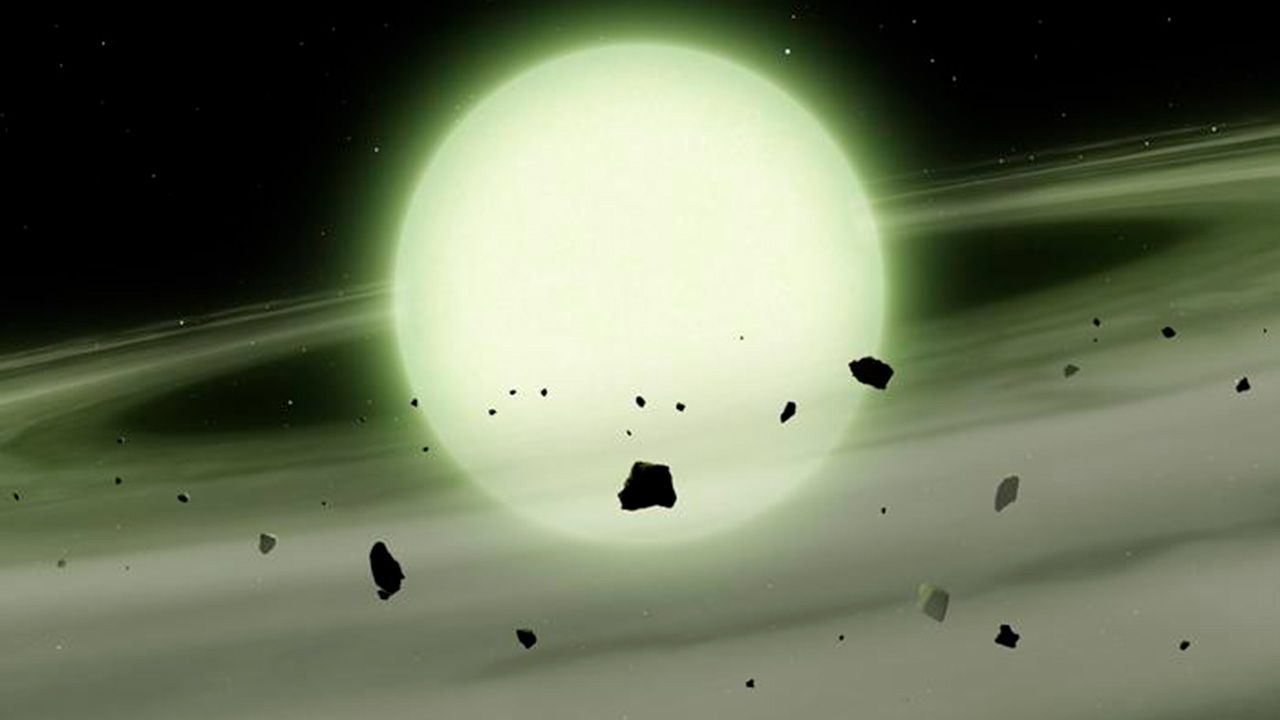
The research team identified WD J1330+6435, a green white dwarf containing rocky material. Additional elements in its atmosphere—including calcium, lithium and sodium—create what the researchers describe as a distinctive “chartreuse green appearance” visible to the human eye when viewed up close.
“The traces of sodium in this white dwarf’s atmosphere absorb the orange part of the spectrum, leaving behind a ghostly green glow,” Hollands explained. He said the star’s unusual color “feels like something out of science fiction.”
The reddest white dwarf ever discovered?
The astronomers also identified what may be the reddest white dwarf yet discovered: WD J1011+2845, located about 48 light-years from Earth.
Carbon near the star’s surface is lifted from its interior by strong convection currents. The carbon molecules block some wavelengths of light, producing what the researchers describe as a deep salmon-pink glow.
Colorful white dwarfs may be more common than expected
Overall, the researchers examined 151 white dwarfs located within 65 light-years of Earth. About one in 30 appeared in a color other than white.
The finding suggests that colorful white dwarfs—and the unusual stellar debris surrounding them—may be far more common throughout the universe than previously expected.
Source: Hollands, Mark A., Gencik, Boris T., Tremblay, Pier-Emmanuel, and Kester, Detlef. “Favorite color: Various chromaticities of white dwarfs,” RAS technology and equipment, Volume 5, 2026, rzag069.
Source: www.livescience.com